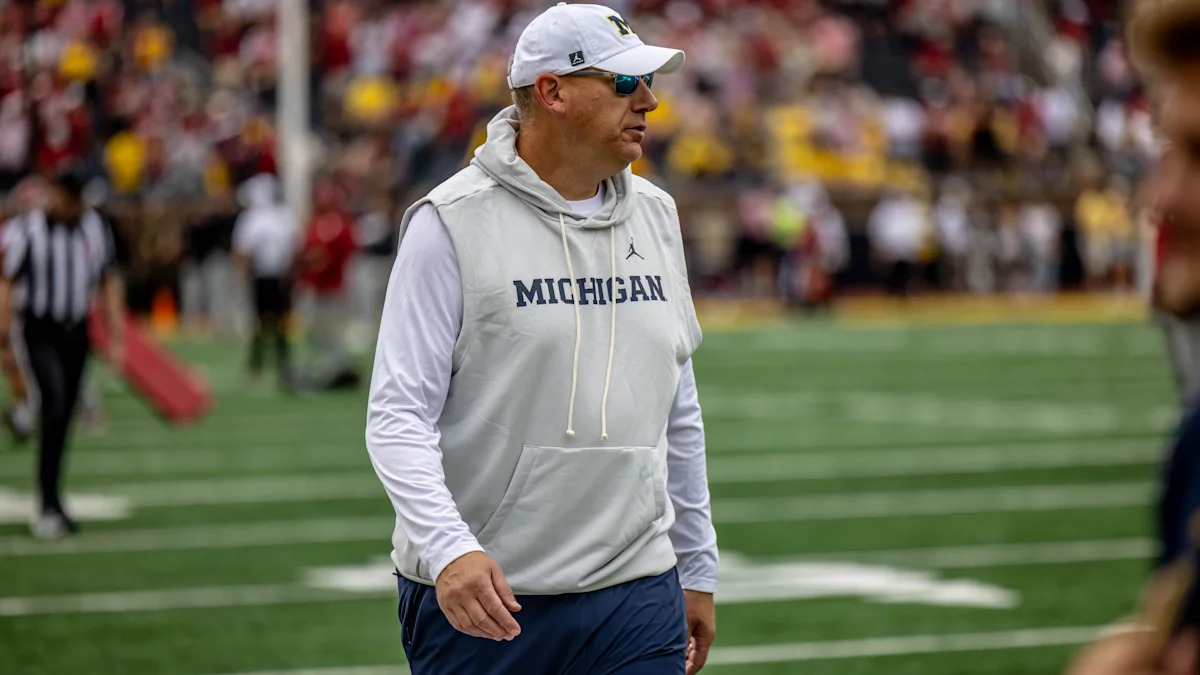
ANN ARBOR, Mich. — Usually when you’re thrust into a situation to fix an offense as an offensive coordinator, you have an entire offseason to come up with the playbook, install plays, tinker in practice, and then you get to the season and see if that works. Jim Harding had six days.
The Michigan football offensive line coach was elevated to interim offensive coordinator when Jason Beck’s offense floundered mightily. When Beck departed Ann Arbor, his unit was ranked 133rd of 138 teams, and it did absolutely nothing well. Its calling card was that it did nothing well, as a matter of fact.
Advertisement
So when Harding got the call that he would now be overseeing the offense, he had to try to see what he could do in a very limited amount of time, with just three games remaining on the schedule. He went with many more three-, four-, and five-receiver sets than what we’ve seen previously, and significantly less usage of the ‘rhino,’ or sixth offensive lineman. With that in mind, while we saw formational differences against Oregon, how much could he actually change?
“That’s a really good question,” Harding said. “I think that’s part of being in this position that you’re in, is coordinating, and you’re trying to find maybe some structural differences or advantages you have against the opponent. The previous week, Oregon had given up a lot more yards per carry and efficiency in the run game on open sets versus bringing a bunch of tight ends in. And so looking at that, that’s why that focus was. That particular game was just, they had –and they’re a really good defense — but if there was a weakness in the run game, it was when there was more space for them to have to defend rather than getting a bunch of people in the box.
“And so it’s really just a combination of what you feel the defense has given you, and then you’re right, what are things you can do? You’re not gonna change the entire playbook in these three weeks, but you go back, and you reflect on, OK, looking at your self scout what are the things that we’ve been efficient in? Our yards per carry have been good, and try to find ways to take advantage of the structure of the defense that you’re playing in that given week.”
As noted, the rhino was used less than it had been all season, with Avery Gach playing the role and having only gotten 15 plays of the 62 total offensive snaps. So why was it that Harding demurred from using the rhino? Was he as against it as many of the fans (and media) on social media have been? Or was there a different reason?
Advertisement
Harding has been a coach in some capacity going back to 2002, but the rhino isn’t hardwired into his schematic library. In fact, he’s only known it for one year before this one, when Beck came to Utah. He can see its benefits, but he can also see its drawbacks, the same way that has been bandied about in the general discussion outside of Schembechler Hall.
“I know prior to Coach Beck, I had not experienced much of it,” Harding said. “We had a ton of success, and he has had a ton of success with it. We look at, on a regular basis, what is our efficiency in both the pass and the run game when we’re using it. And so there was a regular, not debate, discussion of, OK, how much do we wanna use it this week? Is the matchup really good?
“The advantage it does give in the run game is you have a 300-plus-pound guy at the point of attack most times, you can’t just run right behind him. But most times, blocking a 260-pound defensive end and that should be a huge advantage for the offense. So I understand the philosophy behind it.
“Again, my experience with it prior to 2025 was zero. But I do see some value in it. Obviously, we used it, going to your question, a little bit less this last game, just because it didn’t seem to create an advantage for us offensively. And so, I know I’m dodging the question a little bit. I guess my point is I don’t have a strong opinion. If we feel it gives us an advantage somehow schematically, I’m all for it. If it’s something that doesn’t, then you’re better off having an eligible receiver that is a threat for the defense to have to respect.”
Advertisement
Harding won’t disavow rhino usage, but now that he’s calling the shots, he only wants to deploy it when it makes sense.
“I would say, and again, if it gives us an advantage this week, like if we feel that that’s a matchup that’s gonna help us versus a normal tight end and a particular responsibility, then we will use it and select situations,” Harding said. “But I also recognize the limitations of it because it’s a less, it’s one less guy that the defense has to respect in the pass game. And so, I get both arguments.”
This article originally appeared on Wolverines Wire: Michigan football OC Jim Harding explains reduced use of ‘rhino’
Disclaimer : This story is auto aggregated by a computer programme and has not been created or edited by DOWNTHENEWS. Publisher: Sports.yahoo.com