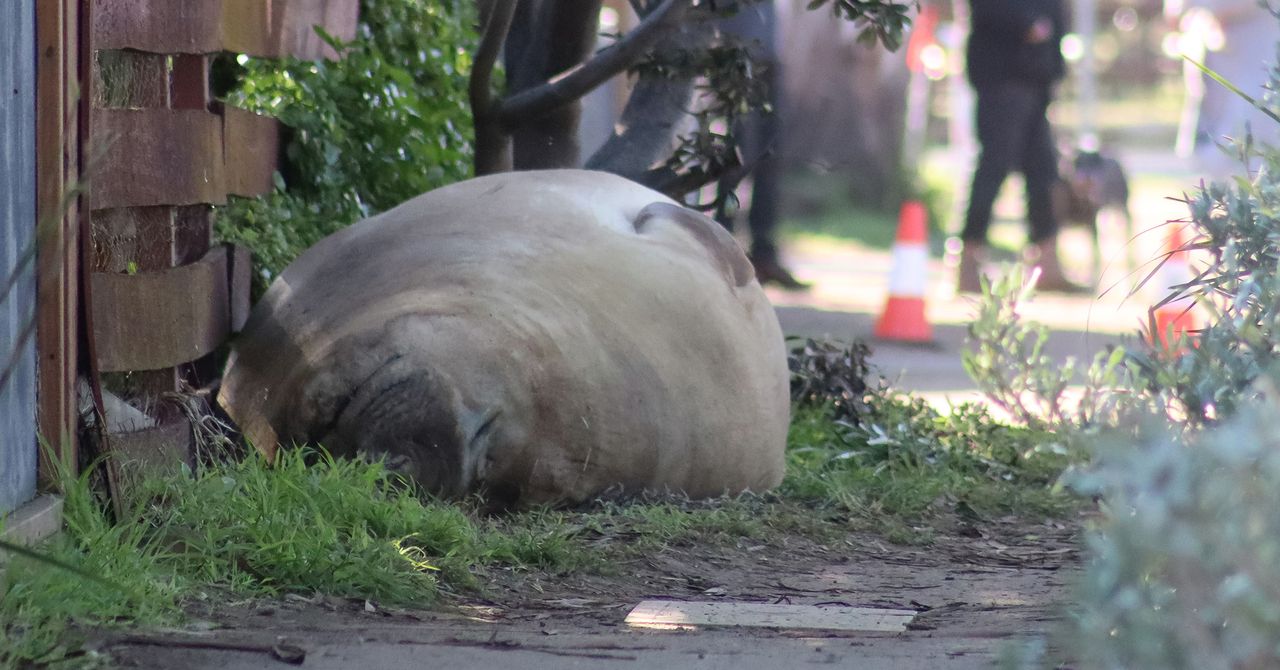
There is a six-year-old elephant seal in Tasmania named Neil who has a taste for light property damage during the winter months. Now, the state has a management plan.
Neil’s annual “hauling out” and subsequent misadventures on the southeastern part of the island has delighted locals, making him a local mascot and a viral social media star.
But Neil’s on-land hijinks—as he experiences his yearly “catastrophic molt,” during which he, like all elephant seals, sheds and replaces his top level of fur and epidermis— has also created headaches for local officials. Neil, who weighs over 2,000 pounds, has destroyed walkways, flattened bollards, bowled through fences, and rammed vehicles. The enormous and growing public interest in Neil has also been a source of concern, as officials spend tens of thousands of Australian dollars to keep the public at a safe distance from him.
The Tasmanian government, finding itself in a precarious position, has finally decided to take action. The Department of Natural Resources and Environment published a 27-page dossier this week titled “Neil the Seal Management Plan.”
“The purpose of this Plan is to set out a framework for managing the resident elephant seal known as Neil in Tasmania, recognising the complex challenges associated with his recurring haul out period,” the dossier states.
Neil has a dedicated task force to monitor his whereabouts and according to the dossier, they would take a “non-intervention,” hands-off approach if he hauls out in a secluded location. They’d keep tabs on Neil from a distance, erecting signs around the area to alert the public of Neil’s presence while advising them to keep their distance. Should the public tempt fate and approach Neil, the task force can call in security personnel to keep people and the seal safe.
The second contingency plan is titled “on-site seal management,” which would be necessary if Neil comes ashore in a more public location, and has immediate access to roads and critical infrastructure that up the odds of molting-induced mayhem. One proposed management option involves “hazing,” which would essentially treat Neil like a frat pledge. The dossier doesn’t get into specifics—ostensibly there’s no paddling or eating a live goldfish involved—but highlights what it calls a “non-violent method of using deterrents and negative associations to disturb an animal, compelling them to move,” which can include “controlled visual, tactile and vocal stimuli where appropriate.”
The document also notes that Neil appears to be adapting to and thus eluding “standard management practices,” meaning that the task force needs to stay nimble in coming up with new methods to curb Neil’s taste for antics.
Tasmanian officials also propose “seal enrichment,” which they say would be used in tandem with other management options, to redirect “natural exploratory behaviors” (like engaging with infrastructure) towards decoy items “designed to withstand repeated interaction.”
Officials also say that despite their best efforts to avoid Neil-related interruptions to daily life, “significant events,” such as road closures, public safety incidents, relocation or translocation activities, or wildlife-born diseases, are still liable to happen. During such events, members of the public are advised to contact the Marine Mammal Hotline, also known as “0427 WHALES.”
Disclaimer : This story is auto aggregated by a computer programme and has not been created or edited by DOWNTHENEWS. Publisher: wired.com