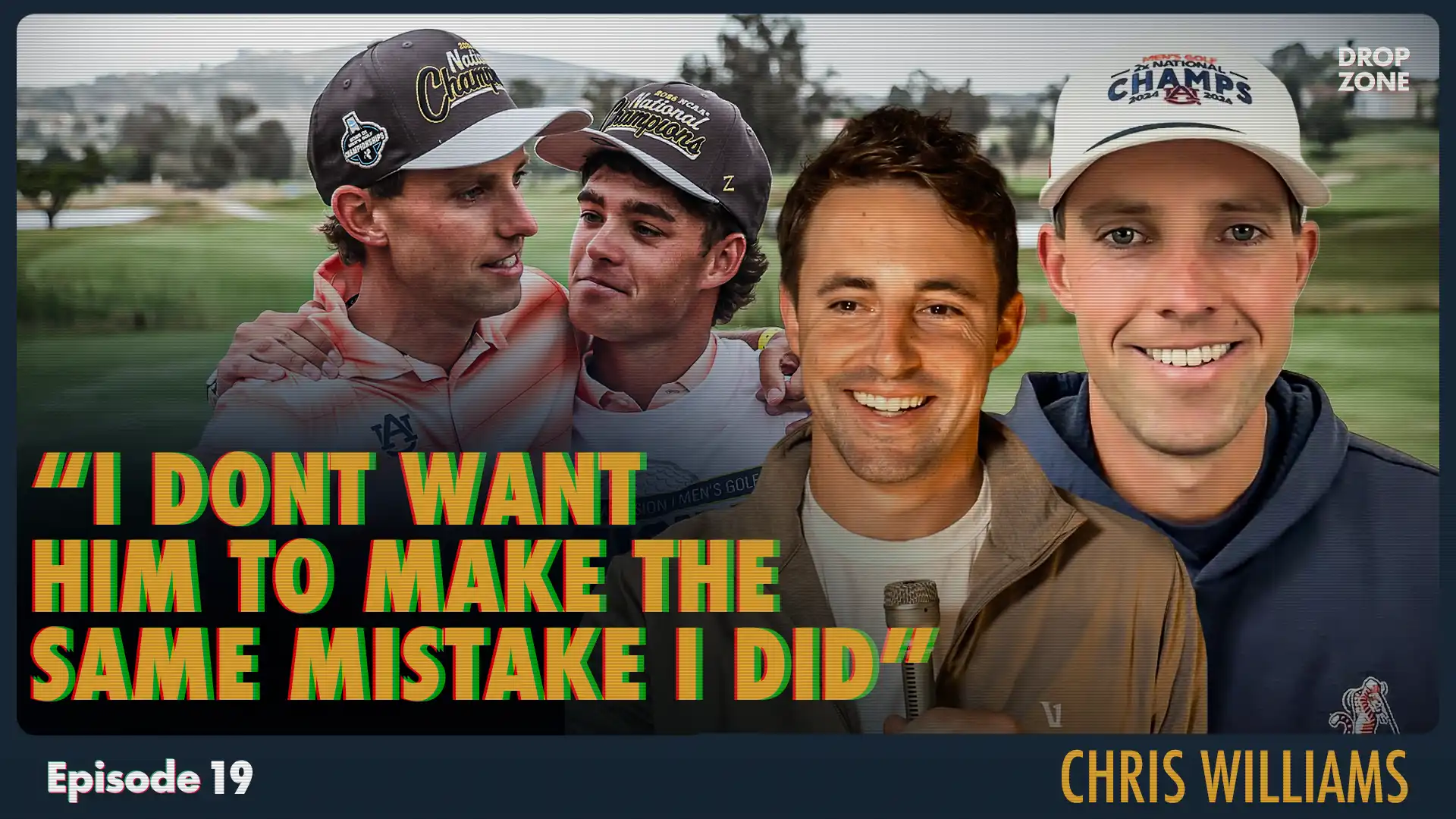
THE SECOND CHAPTER OF CHRIS WILLIAMS’ GOLFING LIFE is off to a hell of a start.
In the first chapter, everybody expected him to be an elite PGA Tour player. Williams was a small-town Idaho kid with a smooth swing and a flashy smile who worked his way to the University of Washington and just started winning. By the time he turned pro he’d been the top-ranked amateur in the world for nearly a year. He’d just won the Hogan Award, the Heisman Trophy of college golf. Nike signed him to a 5-year deal. Excel Management signed him to a team that included Tiger Woods. Even now, the mention of Williams to certain Tour pros earns a wistful response. Incredible player. College legend. That guy is a myth.
There was just one problem.
“From the game standpoint — I love the game,” Williams tells me. He’s on video from home; he’s associate head coach at Auburn University now and his “2X NATIONAL CHAMPS” hat tells part of the story. What he says next tells another part:
“From playing for a living and making it your livelihood, I couldn’t handle it,” he continues. “I never liked it from the start.”
At the end of his Nike deal, which expired in 2018, Williams still had plenty of game and plenty of status; he’d just finished No. 13 on the Canadian Tour’s money list and could make another go at climbing the ladder. Instead? He vanished from pro golf. He went back to UW, where he finished his degree. And he eventually decided to take an assistant coaching job at Marquette, which turned into a coaching job at Auburn, where his very first recruiting trip took him to San Jose, California.
And that’s where his second chapter begins.
“I go to this dumpy little golf course to watch this kid, you know, Jackson Koo-vin or Ko-vian or whatever his last name is, now I joke with him now all the time…” Williams says.
Once he figured out the pronunciation, that was the beginning of a fascinating mentorship from one former No. 1 am to a future No. 1 am. Jackson Koivun came to Auburn. They won those two national titles. They’ve talked all these years about what it would be like when he made the leap to the next level. And now? Koivun is just wrapping up his first half-year as a pro — in which he fended off Scottie Scheffler to win his first PGA Tour event, was the only undefeated American at the Presidents Cup and earned a spot in next April’s Masters.
Look at DataGolf’s list of best amateur golfers in recent history and you’ll see why Koivun has arrived with so much hype: He’s in the top slot, ahead of this generation’s top pros like Jon Rahm (No. 2) and Jordan Spieth (No. 3) and Patrick Cantlay (No. 4). And there, at No. 10, just ahead of Collin Morikawa and Ludvig Aberg, is Chris Williams.
So what’s it like to be No. 1? The wins, the joy, the pressure, the loneliness? Williams wants to make sure his young charge isn’t going through that alone.
“I don’t want him to make the same mistakes I made,” he says. “And so it’s like, all right, if I had someone in my ear, what would I have wanted them to say?”
You can listen to the full conversation with Williams — the peaks and regrets from his career, what he wished he’d known, his transition to coaching, what Koivun’s really like and more — in the embedded video below, or on the Drop Zone channels on YouTube, Spotify or Apple. You can also read on.
<figure class="youtube-facade" data-content="
“>
Dylan Dethier: Chris — it’s been a few years since you stopped playing full-time professional golf. How do you think about your playing career now?
Chris Williams: Going to college, I didn’t even know what to expect. I was fortunate to go to Washington. And the team was really good. I mean, they won the conference the year prior. They had three All-Americans that were coming back. Nick Taylor, who still is killing it, and then Richard Lee who played on Tour for a while and won the conference tournament individually that same year. And then we got a couple really good players coming in with me. So, I didn’t know if I was going to play. I had no idea what to expect.
And I came in and kind of got my ass kicked a little bit the first semester, I guess. I can still remember it. I missed the trip to go to Hawaii, and I’m sitting in my dorm room and I was so mad. And you can look back on your career and know, like, when there was a turning point and a huge moment. And I remember, I got up at six in the morning, the guys were going to the airport and I just beat myself up. Like, I should be on this trip. And as I’m sitting in my dorm room, contemplating life as it’s pouring rain and 45 degrees while they’re going off to paradise, I get a phone call. It’s from Nick.
So I’m like, it’s got to be a butt dial. Like, what’s he doing calling me at 6:45 while he’s in the airport?
And so I let it ring, let it ring, and finally I’m like, ah, whatever, I’ll just answer it. And he was on the other end. He was like, ‘Hey, man, we’re sitting in the airport. I’m just thinking about you. And I know that if we want to do the things we want to do, then you need to be in this lineup. You need to believe. And we believe in you, Coach believes in you, but you need to believe in yourself.’ And I was just kind of dumbfounded. Here he is, Nick Taylor, who at the time was the No. 1-ranked am in the world. He was the college player of the year, was a finalist for all the awards leading up to that season. He just won the Publinks the year prior and was low am at the U.S. Open. For him to call me out of the blue on a rainy Saturday morning as he’s going to Hawaii and tell me that, it just gave me this weird belief in myself. All of a sudden I had this confidence that I’d never had before, just because one person told me that.
And I go on and obviously have a good career. But I end up, again, back in my dorm room — a lot happened in that room, I guess — watching Nick win the Hogan Award in 2010 and thinking like, well, if that guy can do it, I mean, I can beat him now, maybe I could do that at some point. And so, fast-forward three years, we’re in Colonial Country Club and they call my name as the 2013 winner of the Hogan Award. And so I look back on it, sometimes as a blur because it feels like it was such a long time ago, like a lifetime ago, playing with the guys I was playing with, playing on these Walker Cup teams and these World Am teams, with guys who are now still killing it on the PGA Tour. It feels like that was a hundred years ago.
And then I think back, like, that’s really only 10, 12 years ago.
So it’s funny, I have two different outlooks on my time playing. Obviously some memories are really good. But some memories, back to when we were playing the Canadian Tour, I realized that the pro life was not for me. I never liked it. Never enjoyed it. Never enjoyed traveling that much, being gone that much. As I tell these guys now, I know Jackson Koivun and I have had a lot of conversations about this, but you’re on the road, you’re by yourself, you’re in a hotel room, all of a sudden you’re not with your boys, you don’t have coaches, you don’t have support staff. It’s like — it is you and only you.
Anyway, looking back, there are great things because golf has given me so many incredible memories and has allowed me to do what I still love to do, which is play golf. From the game standpoint, I love the game. But from playing for a living and making it your livelihood, I couldn’t handle it. I never liked it from the start.
DD: There’s no such thing as a sure thing in golf. You look at that 2011 Walker Cup team you were on and it’s [Jordan] Spieth, [Patrick] Cantlay, Russell Henley, Harris English — but then it’s also a handful of guys that were great players but aren’t playing at that level. Looking back, is there anything that you think you could have done differently that would have helped you enjoy the lifestyle more?
CW: I went down this bad path with tendencies and golf swing and then changing equipment and just a lot of changes all at once because I felt like I needed to to play on Tour. And I look back and think, ‘I wish I would have had someone in my ear telling me, like, no, what you’re doing is good. What you’re doing is good enough to be a really good player.’
At the time, I don’t think I was No. 1 in the world, but I think I was top two or three and playing really well in amateur events. And then the one pro event I played in, I played terrible. And I look back on that as like, I took that experience too heavily and was too hard on myself to then think like, all right, well, I’ve got to do something different to get to the next level. And so, to your question, is there one thing that you wish you would have done differently? I wish I just would have looked in the mirror and said, ‘You’re good enough.’ And think back to that 18-year-old kid in that dorm room and someone telling him that he was good enough. That’s all it took.
DD: This is a completely different level [Note from Dylan on re-read: I would like to really emphasize just how different], but the year I qualified for the Canadian Tour, it was the highest level of golf I’d ever seen. I’d played Division III college golf. And I showed up to the first tournament [at this super narrow course] in Vancouver and the first few weeks I realized like, if you can hit 3-wood dead straight and you can start it on your line and it stays there, you can be all right. But hitting a big hook was kind of my DNA. And I just remember being like, ‘Oh s—, I need to change everything.’ The more time I’ve spent around professional golf, the more I’ve realized like, oh yeah, everyone has their own uncertainties. And if a couple things go sideways, it doesn’t take long before you’re questioning everything. So it’s interesting to hear that perspective from you.
CW: It’s so easy to overcomplicate the game and overcomplicate the golf swing. And I see it all the time; I think there’s some good instruction. There’s some really bad instruction. Once you get to a certain level, it’s just making your misses smaller and just believing in yourself. I mean, that self-belief is something that’s hard to teach. But once you have it, it’s such a weapon for you.
DD: Before we get fully to your coaching career, I do want you to gas yourself up a little bit and take me to the moment in your career where you felt like you had the most self-belief. When your confidence was the highest, where you could do no wrong with the golf ball? Does a specific moment or tournament or period in your playing career come to mind?
CW: Yeah, I think back to — you mentioned the 2011 Walker Cup. And 2011 was a big year for me. I was kind of outside looking in [for that team] and then I ended up winning the stroke play at the Western Am.
By the way, then I get into match play and play Cantlay, he’s the 16 seed of all freaking guys. And I’ll never forget it. I’d known Pat pretty well, cause he’s a UCLA guy. We played with him a lot. And I’m like, all right, this will be fun. I’m playing with a buddy of mine. Like, this’ll be pretty chill.
And I get up to the first tee and I’m like, ‘Hey, Pat, what’s happening, man?’
He’s like, ‘Hey, Pat Cantlay, nice to meet you.’
I mean, I was rattled immediately. He was in my kitchen. I think he whooped me like 6 and 5. I remember walking down the fairway like, what the hell just happened? Like, the guy already beat me.
Anyway, when they announced my name [for the Walker Cup], that was just a boost of confidence. Then we go over to Scotland and look, growing up in Idaho, the weather sucks. It’s windy all the time. It’s cold. We get over to Scotland, well, there was a hurricane that had hit the Northeast and was going across the Atlantic and it smoked Scotland, so the wind’s blowing 20, 25 miles an hour every day. It’s cold, it’s rainy, it’s miserable. Well, we have the cold and the rain in Seattle and I had the wind growing up in Idaho. So I was like, this is perfect, I feel right at home.
So I was just rocking and rolling. [Williams went 2-1, including a 5-and-3 opening foursomes win alongside Cantlay.] We actually ended up losing the Walker Cup that year. But I just remember thinking, that I was the seventh-highest ranked player on the team or so, but I was like, I’m just as good as these guys, and I might be better than these guys in these conditions.
DD: Do you remember the decision to get into coaching and if it seemed clear to you at the time? Was it something that you’ve learned to enjoy more over time, or was that something you were always interested in doing if your playing career came to an end or at least a pause?
CW: I’d never really thought about what I would do. There was never a plan B. It was always like, here’s what I’m gonna do. I’m going to play golf the rest of my life. And so I never thought about what I’d do if golf didn’t work out.
But I look back on my college days and I loved college and I loved [UW head coach] Matt Thurmond. And he’s still to this day, one of my closest friends. He and I had such a good relationship. He was just the right guy to push me hard enough but not to over-coach me technically, and it just — I thrived in his environment. I know a lot of guys that maybe don’t have great relationships with their college coaches, and I think that’s just such a shame. Because as I stopped playing in 2018, the first person I called was Thurmond.
I was like, ‘What do you think?’ I was at a loss. Like, I didn’t know what to do. I love the game, but there’s not a lot of different avenues in terms of golf that you can go down. And he said something that stuck with me. He was like, ‘We always joked internally as a staff that if golf never worked out for you specifically, you would be a really good coach. You cared more about the team than your individual wins and you were more excited when we won as a team and you finished 20th than if you won and we finished second as a team.’
And looking back on why I enjoyed college, it was because we were with a team. You had coaches, and you had, like I said, Nick [Taylor] telling me, hey, you could really do something with this if you believe in yourself. And then Thurmond saying, ‘Hey, you could be a good coach if you really, truly believe it because of the way we saw you as a teammate when you were at Washington.’ It’s funny how two different conversations have led me to two totally different paths in life.
DD: Just how good is your team now? [Williams was assistant coach at Marquette before joining the Auburn Tigers, where he’s now associate head coach and has been a part of two national championships.] Because you guys have obviously accomplished a ton in the last few years specifically. I mean, you played on a terrific college golf team. Just how good are your guys?
CW: The space that we’re in now with college golf, how good it is and how competitive it is, to think that we won two out of three in ‘24 and ‘26, and [head coach Nick Clinard] and I talk all the time that arguably on paper, the best team we had was the team in ‘25. We had two first-team All-Americans, two second-team All-Americans and a guy who should have been — basically you could have five All-Americans on that team, and that’s the year that we didn’t win. So it’s kind of hard to really describe how good they are.
And doing it with a different team every year and a different environment in both, it’s kind of mind-blowing how good the team’s been, really the last four years, to be honest. And then even this year, obviously Jackson [Koivun] turns pro and he’s doing his thing. And we’ve played five events in the fall. We won three of them and finished second in the other two. So just to maintain that constant sort of dominance is actually kind of incredible to think about, and just to think that we’re only getting better.
DD: The entire golf world seems to be having the reaction of, okay, Jackson Koivun is different. There are a lot of guys who have gotten a lot of hype and he is the latest guy to get a lot of very well-deserved and well-earned hype that he keeps backing up. Take us back. What were your first impressions of Jackson? Do you have a first memory of meeting him and seeing his game? Where does your relationship with Jackson begin?
CW: Yeah, it’s actually a really interesting story. I’ll start at the beginning.
I get the job at Auburn, June 10, 2021. And my first recruiting trip is to San Jose. I’m living in Seattle and Nick and I kind of figured it out, like, why don’t you recruit the West Coast, I’ll recruit the East Coast and then we’ll meet in the middle?
It was a hell of an idea. I could live in Seattle, do my thing, be up there in the summer months, play golf every day and then just fly out of SeaTac, which is dead easy.
So there’s this kid out of San Jose I need to go see. My first recruiting trip. I go to this dumpy little golf course to watch this kid, you know, Jackson Koo-vin or Ko-vian or whatever his last name is, I joke with him now all the time. But I show up and find a scrawny little kid, he’s 135 pounds. He has a push cart. But he’s wearing an orange shirt and navy shorts.
I’m like, ‘All right, that’s a good start, school colors.’ And I watched him play, and he didn’t play great, but I saw this kid and was like, man, he’s fiery. Like, he just had something about him that you don’t see all the time. Fast-forward a couple months, I saw him again, we had a long conversation, we were texting back and forth. But he would go play these national events, like I think he got in the U.S. Am that year, played the Western Junior and he would play terrible, for him. And so a lot of schools were down on him a little bit. He was a highly ranked junior, but because they’d only seen him play these national events, they were kind of sour on him.
I watched him play a couple more times and we’d have these long conversations, and I remember him calling and we had a long conversation about pro golf. He’s going into his junior year of high school and he’s asking about pro golf. And so I gave him my whole spiel, just like what I did here, and, he was like, ‘Well, that’s what I’m going to do. I’m gonna be a pro golfer.’
Sure. Everyone says that, right? But it was just the way he talked about it that was just different. He’s like, here’s what I’m going to do, I want to live here. I’m going to do this and here’s what I want to accomplish in college, I want to win national championships. Win Player of the Year. But you just listen to him talk and you believe it, because, like, all he did is play golf, play golf, play golf. And that’s all he wanted, and he was a fiery competitor, and you could hear, talking to him, his internal confidence. And probably the most important thing is he was a hell of a putter as a junior golfer. That’s gold, because a lot of kids at that age, me included, are not very good putters. That’s sort of a separator in certainly college golf.
So we got him on the visit, he fell in love with it, and he committed basically on the spot. And then he came in — and he’s got some funk in his golf swing, not to get too into it, but he has some things that probably you wouldn’t teach if you were teaching a perfect golf swing. But it was sustainable, and it was manageable. And I remember when he came, talking to Nick, and Nick’s like, ‘I want to change this, I want to change that. Y’know, he gets a little laid off, he gets a little right bend, his grip’s too strong, club face too shut.’
I’m like, ‘Nick, just give it one semester. Let’s just go one semester, not touch it, just see what happens.’ And he’s like, ‘All right, fair enough.’ And Jackson has an incredible fall. And so many different reactions could have happened from having an incredible freshman year. But he was like, ‘Whatever. Doesn’t matter to me. I’m just gonna keep getting better and keep getting better.’ And he was the type that just grinded every single day. There were no days off.
I remember we came back from an event where he’d finished third or fourth and was obviously very frustrated because he didn’t win. And we got back to the facility at 7 p.m., the sun sets at 7:30. And my wife was out of town, so I was like, well, I’m just going to hit a few balls and spend some time here. No reason to go home to an empty house. And I was hitting balls, it was getting dark. And he shows up at 7:30 with about 19 different putters. He’s like, ‘I’ve got to figure something out.’
And in anyone else’s head, it’d be, ‘I just finished third as a sophomore and I’m rocking and rolling, I’m doing great.’ He’s, like, ‘Nah, dude, I putted terrible. I’ve got to figure something else out.’ So him and I stayed out there for an hour with our flashlights, he was just hitting putts all night. And what’d he end up doing? He stuck with the one that he had just finished third with, but he tried ‘em all.
The way his mind worked was so different than anyone I’d ever seen. And that continued on for the three years that we had him, where he just had this different perspective of himself. He was like, ‘I’m so much better than everyone else, but I need to get better to compete with the guys on the PGA Tour.’ But he went about it the right way. Y’know, I went about it the wrong way. And I can remember having so many conversations with him about my mistakes and what I did wrong. Of like, I don’t want that to happen to you. And granted, he got to a level that I’d never gotten to. But along the way, at one point we were kind of equals. I was like, I just want to help you continue to get better and continue to do it the right way, and take what you do; some things aren’t perfect, but just make them a little bit better. You don’t have to change everything.
But his short game was pretty pathetic. His short game is now one of the best parts of his game. You know, his driving was always good, but it was sporadic, it’s gotten so much tighter. Just little things like, hey, I have to apex my 4-iron 15 feet higher to play on Tour. So we worked on that. Just the little things that were deficient in his game that we just chipped away at every month or so. His wedge game was horrendous. He’d have 110 yards and be like, I’ll gas my 60[-degree wedge]. It’s like, ‘No one does that, kid. Let’s figure out a way to chip a sand wedge.’ Little tiny minute things that have proven to be what he needed to then succeed now at this level that he’s at.
But to your point — he is different. His mindset’s different. He is one hell of a competitor. He doesn’t believe that anyone is better than him. And he just works his ass off and he’s a kid that’ll be on Tour for 30, 40 years — who knows what the future holds. But I think once his career’s over, you can put him up there with all the greats.
DD: It’s interesting the way you described that, that one of the big differences seems to be making changes but never thinking of them as reinventing the wheel or starting over from scratch, but instead maybe, you know, I mean, people talk about getting 1% better, making little incremental changes rather than having the mindset of, ‘Oh, geez, something is very wrong and we need to completely start over.’
CW: That was my message to him. Looking back on my time and my experiences, like I said, once I realized, all right, this kid could get to a level that you haven’t seen in a long time, like, what can I do to help him?
And basically it was like, just don’t screw him up, for starters, but also, all right I’m gonna take my experiences and share it with him of like, here’s what worked, here’s what didn’t work, and here are my suggestions. We spent countless hours just talking, while he was sitting there hitting balls, I’d just sit in the cart and we’d just have conversations about all kinds of things. Sometimes golf, sometimes not golf, but always back to, like, how can I help him the most?
We developed this relationship where he sort of felt like a younger brother at times. I get a little protective of him and was like, I’ll do anything for you. And so, to your point of fixing the small things over time, it was never like, hey, we have to fix this tomorrow. It was like, let’s just chip away at it. He’s obviously rocking and rolling now, doing his thing. But we still talk almost daily just about little things here and there and how he can get better. And so it’s been awesome just to watch it, to see it, and obviously now he’s about as big a name in golf as you can get. It’s funny to think that just four months ago we were at La Costa playing the national championship in college. And now he’s at the top of the game.
DD: It’s clear you like the guy. I’m curious from a personal standpoint what you enjoy about spending time with him, from these conversations with him.
CW: He’s just a down-to-earth kid. After his first year, things could have gone so many different ways, but I’ve had a lot of coaches come to me and say that the best thing about Jackson is just how humble he is and how humble he stayed throughout the three years of college. And even now, seeing him at the Presidents Cup, obviously he’s on top of the world and he got probably 50% of the media attention that whole week, totally overshadowed a lot of the other rookies on the team, just because he’s kind of the new fresh face and young kid just out of college and Player of the Year and maybe best amateur in the last 20, 25 years. But he’s still just a little kid out of San Jose, and still the kid that I first saw in 2021 trying to recruit him to Auburn. Like, his personality hasn’t changed. And that’s what’s so interesting about it. Because obviously things change people, fame changes people, money changes people. And you just don’t see that with him. I don’t see that ever happening. He’s just grounded. His parents did an incredible job. George and Megan are awesome people. And he’s just a kid that’s easy to root for.
[Grinning] Now, he did come back to Auburn last weekend. He did drive my car, left it on empty, took the car key with him to Mexico and left the car unlocked. So I’m a little bit pissed off at him right now. And I did let him know. I said, pal, that’s not gonna fly anymore. I got a nice car. I get it, you can drive it. But I can’t have you taking the car key with you to Mexico, leaving it on empty, leaving the car unlocked, a window down, we gotta get better, okay? We gotta be better.
So I kind of jumped his ass a little bit this week, but I still love him to death and still he’s the same kid that we all know and love and it’s just cool that he even wanted to come back to Auburn, he went to a football game, he had all his media obligations and we can’t walk five feet around a football game or campus without people stopping him, wanting to take photos, whether it’s a six-year-old kid or a 60-year-old woman, everybody knows him, everybody recognizes him but he’s so great with all that, whether internally he wants to do it he still does it anyway. I think it’s just rare to see that with someone, one, his age, and two, where he’s gotten already.
DD: Taking your car keys, it’s good to have reminders here and there that he’s just a 21-year-old kid and there’s still some idiot in him. Do you feel like he has a sense and a proper appreciation for how good you were in your moment? Like, you were World No. 1 am for nearly a year. Obviously he’s reaching new heights in his game, but…
CW: I think there have been enough times where we’ve run into J.T. [Justin Thomas] or Jordan [Spieth] or even Xander [Schauffele], Collin Morikawa, Max Homa, all these guys that I played with that we’ve now played practice rounds with like when I was caddying for him. Whether they’re blowing smoke up my ass, they’d be like, ‘Man, you don’t realize how good this guy was.’ It sounded like some old guy talking about his days in high school, but when you’ve got those kinds of guys hyping me up and I don’t even have to do it, I think that’s when he realized like, maybe you were pretty good, I dunno. So I think in that sense, yes.
The first time we ever played, he’d been talking about it for months. He’s like, ‘Hey, when are we gonna play? When are we going to play?’ I was like, ‘My back hurts. I’m not really playing a whole lot right now…’ But we ended up going to Wade Hampton up in the mountains just about four hours from here. And we drive up; he’s all excited. He’s like, ‘We’re playing, me and you are having a match and it’s going to be serious, putting everything out.’
I was like, ‘Great. Love to do it.’ I hadn’t played in three months, but we go up there and I’ll just say he has to make a six-footer on 18 to tie me. Of course he makes it, but we both shoot 65 and he’s like, “I practice eight hours a day, you haven’t touched a club in three months and we tie?!’
I was like, hey man, I’ve still got it. I don’t know what to tell you. But then I said, JK, it doesn’t matter anymore. That’s why I’ve still got it. Like, if it mattered, I’d shoot 75. But we still joke about that round.
DD: That’s the best, though. What a special thing to just be able to break that out and give him a little reminder that you’ve still got it.
CW: It was probably one of those maybe fluke rounds that if I played 10 more times, I wouldn’t break 70. But that day I was hyped up. I mean, I was giddy. I couldn’t even sleep that night, I wanted to beat the kid so bad. And so it was fun.
So, yeah, I think he has an appreciation. He’s talked to enough guys, and even at the Presidents Cup, we’re sitting having dinner and we’re in the team room and Xander came by and he was talking to JK and he was like, ‘Man, no surprise that this kid’s good hanging out with you, as good as you were.’ Just little comments like that where JK’s like, ‘Dude, these guys care more about you than they do about me.’
Anyway, I haven’t seen these guys in years, but we’ve talked about it enough. And [at Auburn] they would sit in their living room at times and watch YouTube golf and they would always find these videos and I’d get a video from them of them watching a video of me back in the day, playing in college and these stupid little videos that we’d made. So anyway, it comes up every once in a while.
DD: Do you feel like when you’re giving advice to Jackson that you’re talking to your younger self? So is this like, advice that you wish you had gotten at the time?
CW: I think when I say that I get protective with him it’s more so because I don’t want him to make the same mistakes I made. And so it’s like if I had someone in my ear, what would I have wanted them to say? And so, to that question, I’d say yeah, at times I do think if I was a 19-, 20-year old kid, what would I want to hear? And Nick and I talk all the time. He’s like, ‘Hey, I’ll cut the guys at the knees. You make them feel six feet tall.’
And we developed such a good relationship that I felt like I could tell him what I wanted to tell him. And also, what’s going to be the best thing for him and what does he want to hear? We do personality testing at Auburn and, knowing his personality, like if you were really, really hard on him, he would not take that very well. You pump him up at the same time you tell him where he needs to get better.
DD: When you’re protective of him, what do you worry about? I mean, there are so many people who want things from him now, places like my company; media members want time with him, equipment companies want stuff from him, he has endorsements and attention, and what in that tornado gives you pause?
CW: We do this personality testing with every guy on the team. I do it, Nick does it, all of our staff does it. And one thing that did come back about him that not a lot of people know is he’s fairly high-anxiety. And going back to a conversation we had about qualifying his freshman year, like, ‘I don’t think I can qualify, I’m so nervous about qualifying’ — he’s always sort of had that in the back of his head.
Anyway, now that he’s out of college, so many people want a piece of him and a part of him. And I don’t see him as much as I used to, obviously we’d see him every day. But his first event, he played the John Deere and I can remember it like it was yesterday, he finished the first round and after all these years of conversations of all these things, me telling him, hey, here’s my experience as a pro, here’s my experience on the road. Here’s what I liked. Here’s why I hated being alone, being stuck in a hotel, it’s your first year out, you’re going to have sponsors and you’re going to have to go to dinner with people that you don’t want to have dinner with, and it’s not like we’re going out to dinner with the team and me and Nick and all this — it’s a job now.
And I remember I was sitting at Aldarra in Seattle. We’d just finished our round, was watching him play on the app, and I get a long text from him. I wish I had my phone, I’d read it. But he’s just like, ‘Man, you were right. This whole pro golf thing is so different.’
This was his first tournament as a pro on the road by himself. He’s, like, I’ve been in the hotel room by myself all week. Now it’s Thursday, he shot like 75. He was beside himself. Didn’t know what to do. Didn’t know how to think. And we talked for two hours that night. And he’s like, ‘Man, this life thing is brutal. I don’t know if I’m ready for this.’
I was like, pump the brakes, buddy. It’s your first night as a pro after the first bad round you’ve played. But everyone goes through it. But I think, I hope, I can really help this kid, even after three years of college, now he’s on the road, now he’s a pro, and walking through sort of those things and what you can do to mitigate some of those feelings. So, yeah, I think there’s always going to be that part of me that is always going to feel that sense of just like a little brother, older brother type feeling.
DD: I know you don’t want to give yourself too much credit, but has there been a moment where you’re like, man, this seems like where I was meant to be? It’s kind of the perfect pairing of you, a decade on from being in this specific position, to here comes this kid who’s talented and going through a lot of similar things.
CW: Yeah. Y’know, I look back on my days of playing and I have two different lenses I look through. Sometimes it is regret, like, man what could have been. Who knows where it could’ve gone? I look back to the guys that I played with and guys that are winning majors and playing Ryder Cups, Presidents Cups, and that could have been my path. But unfortunately it wasn’t, so then the flip side of that is like, well, this is exactly where I’m supposed to be, and this is exactly the path that I was supposed to be on, whether it’s Jackson or the guys on the team now and dealing with the things that those kids deal with.
But I do know it’s always going to come back to, all right, the first kid you really recruited and helped was Jackson. It just worked out that he turned out to be the player that he is now. I think at times I wish I could have figured out a way to make pro golf work out and continue on the path I felt like I was on in college. But then it’s like, you know what? I think I’m way more happy and enjoying way more what I’m doing now, helping these kids get to where they want to be and, you know, pouring into them like someone poured into me and giving back, in a way. To me, I get probably more enjoyment out of that than playing good golf.
DD: With that said — where’s your golf game at? Can we expect some sort of Chris Williams comeback tour at some point here? Do you ever feel the competitive fires burning?
CW: It is funny, because I thought about it and I’ve talked to a lot of people about it. And like, last year, obviously, Jackson was on the Walker Cup team at Cypress. I just looked around there and said, man, this would be awesome. This would be so fun. Like [longtime Walker Cup mid-am] Stewart Hagestad, he’s had his run, it’s time for someone to move him out. So I was like, I would love to start getting in the mix, playing some events.
But then I’ll get out on the course and I’m like, y’know, I really don’t want to take it too seriously. Going out to Aldarra with the boys back in Seattle, maybe having a couple cocktails? To me, that’s fun. That’s right in my happy place. That’s what I enjoy the most.
It was funny, about a week before the 3M, I called Jackson on the way back from Aldarra. And I’d had the best round I’d played at Aldarra. I shot 61, shot 28 on the back nine. And I was like, ‘Man, this is fun. I’ve got it. I’m back.’ And the next day I think I shot like 74. And I was, like, ‘this sucks. This is not fun.’ Anyway, the next week he shoots 28 on the back nine on Tour and I was like, see, bud, I’m just motivating you.
It’s not fun when I hit it 270 and these boys are hitting it 300, 310. I’m like, that’s just demoralizing. So I don’t play up a lot [at Auburn], but when I do play, I enjoy it. It’s back to that feeling I had as a kid, like, this is enjoyable, it’s fun. In terms of playing competitively, I’ve always toyed with the idea, but I think in the back of my mind, I know that once it actually becomes real and I have to put lead on paper, I don’t think I’d enjoy it anymore.
Dylan Dethier welcomes your comments at dylan_dethier@golf.com.
<figure class="youtube-facade" data-content="
“>
Disclaimer : This story is auto aggregated by a computer programme and has not been created or edited by DOWNTHENEWS. Publisher: golf.com