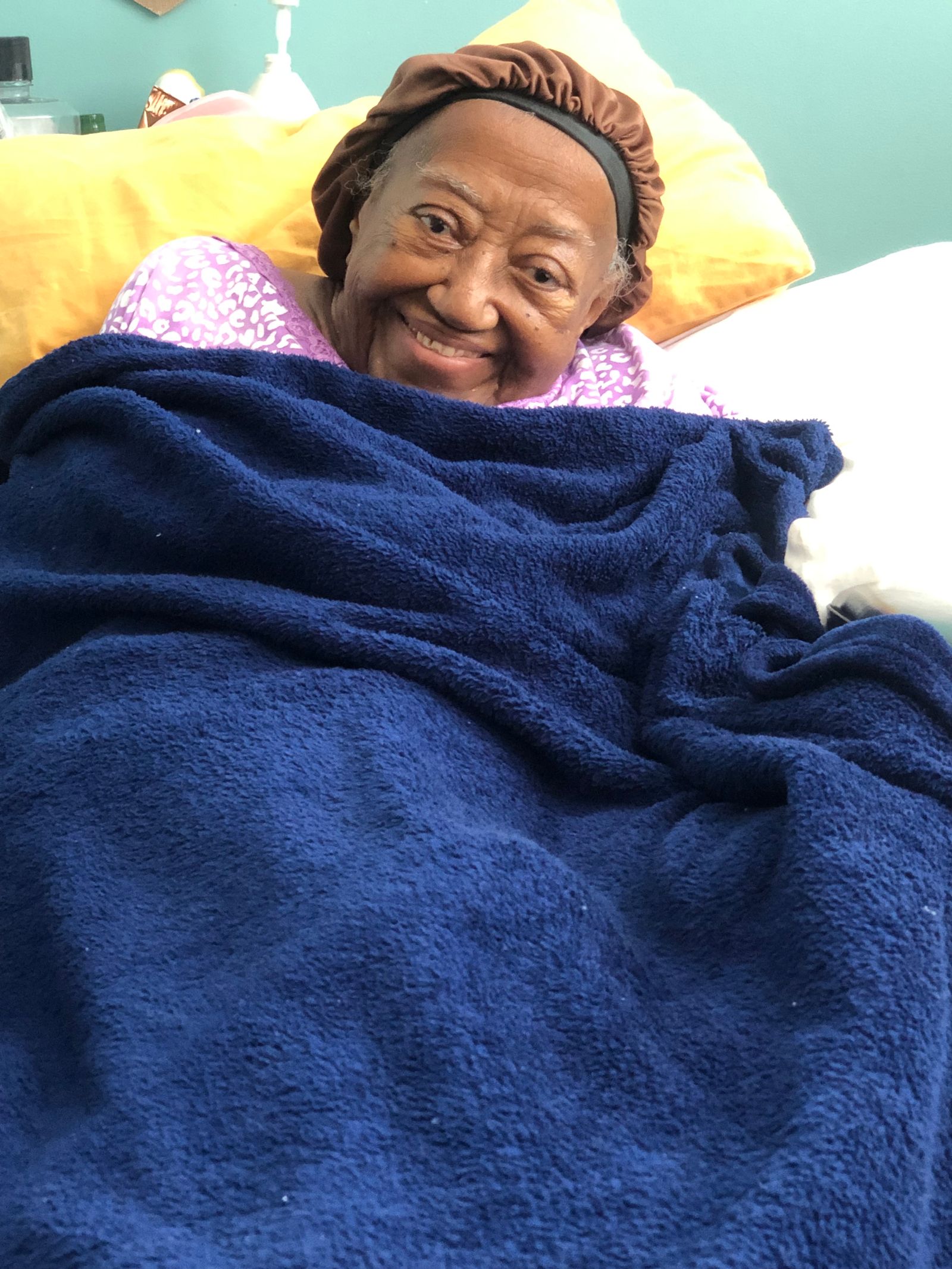
Within hours of being injected with insulin that was meant for her roommate, 93-year-old Emma Lewis’ blood sugar plummeted, and she was rushed to a nearby medical center.
Twelve days later, she died.
Felicia Kaye, the licensed practical nurse who gave the injection in May 2022, was not an employee of Peachtree Centre, where Lewis lived. She was a gig worker who picked up her shift on the nursing app ShiftKey. She wasn’t familiar with Lewis or her roommate and never received orientation on any of the facility’s policies and procedures.
“It’s pretty much you get the keys [to the medication cart] and just figure it out yourself,” Kaye testified this August. Kaye declined to comment for this story.
Gig workers are flooding America’s understaffed nursing homes, resulting in a revolving door of staff caring for the nation’s elderly and infirm. ShiftKey boasts a network of more than 10,000 facilities—many of them nursing homes—and more than 200,000 health care workers hoping to fill shifts.
An investigation by Proof News and WIRED found that the gig nursing model is putting lives at risk: Numerous court filings, federal inspection reports, and interviews with former employees of the company, attorneys, and gig nurses themselves describe how ShiftKey thrusts workers into understaffed nursing homes with little to no onboarding—leading to dangerous situations.
In January, a federal surveyor from the US Centers for Medicare and Medicaid Services noted that a ShiftKey worker made a mistake inserting a PICC line, a catheter threaded in a patient’s arm to their heart. No one at the nursing home had checked that they were trained on the procedure. In 2025, a CMS surveyor wrote that a Texas nursing home didn’t orient temporary workers on how to feed residents before a ShiftKey worker tried to force feed one with a syringe. Later that year, a nursing home in Texas banned a ShiftKey worker after a resident who was supposed to be under her care was found sitting in urine and feces.
Inspection reports also reveal alleged abuse and theft. This summer at Hillsboro Rehab in Illinois, a ShiftKey worker allegedly stole the debit cards of two residents and used one of them at a local smoke shop and ice cream store.
According to the inspection report, the nursing home notified ShiftKey about the incident and blocked the worker in the app so they couldn’t pick up shifts there in the future. The worker was later arrested, and residents repaid, according to Tim Blythe, regional vice president of operations for Tutera, Hillsboro Rehab’s parent company.
“We sincerely regret this unfortunate incident,” Blythe wrote in an email. “We completed an internal investigation and notified the individual’s employer, law enforcement, the Office of Inspector General, and appropriate regulatory agencies.”
One ShiftKey worker was accused of slapping a resident in the face in Texas in 2022, and another of “verbal abuse” of a resident in Tennessee in 2023. At the Center at Grande in Texas, a third was accused of stealing hundreds of dollars from four residents in February 2025. None of the facilities responded to a request for comment.
ShiftKey pitches itself as the Uber for nursing. “We applied technology to the nurse staffing industry,” reads an internal “selling points” memo obtained by Proof and WIRED. “What Uber did was connect the customer directly with drivers. ShiftKey connects facilities directly with providers.”
“Our technology is part of the solution to [the] patient care crisis by allowing highly experienced nurses to work on the schedules they choose and by enabling healthcare facilities to quickly fill care gaps and deliver patient care,” ShiftKey CEO Mike Vitek said in a statement to Proof News and WIRED.
Though ShiftKey advertises open shifts for a variety of facilities—including those for addiction treatment, psychiatric hospitals, and correctional institutions —a Proof News and WIRED analysis of 108,706 available shifts collected in March, July, and August 2026 found that 89 percent of open shifts were at nursing homes.
The app offers shifts for mostly lower-paid nursing staff. A majority of the open shifts Proof New and WIRED reviewed called for licensed practical nurses or certified nursing assistants, careers that don’t require a bachelor’s degree and are paid between $20 and $30 an hour on average, according to the Bureau of Labor Statistics.
In his statement, Vitek disputed that the model is “harmful to the industry” given “long-standing, systemic issues within the healthcare ecosystem.” He emphasized that ShiftKey verifies credentials, conducts background checks, checks abuse registries, and makes that information available to facilities.
“Importantly, training or orientation required by any facility to operate within its policies is conducted by that individual facility,” Vitek said. “At ShiftKey, we do not employ nurses—we simply enable their access to flexible shifts.”
Like a growing number of platforms built to automate workforce management, ShiftKey relies on a variety of automation tools. The software allows facilities the option to automatically post and accept shifts; the app uses a “formula-based calculation” to assign workers a “reliability score,” according to Vitek, which nurses said affects their ability to get shifts; and it offers shift scoring, last-minute pricing, and dynamic pricing based on demand and supply, according to the company’s job postings and employees’ professional profiles.
But when a concern is raised, Vitek said, a human reviews it. He said they evaluate claims of “medical malpractice or abuse, neglect, or exploitation of a patient as soon as ShiftKey receives it” and decide if deactivating the worker is “appropriate.” He declined to comment on these specific events, citing reasons of privacy and ongoing litigation. He added there may be instances where ShiftKey is not promptly notified, which can delay action.
After the insulin incident, Kaye testified, she wasn’t prevented from working on the platform.
In court filings, both ShiftKey and Peachtree maintain they shouldn’t be held responsible for Lewis’ death. ShiftKey argued that it is not liable because Kaye “has never been its employee,” while Peachtree said it “cannot be held liable for the acts of an independent contractor.” Kaye is not named as a defendant, and ShiftKey is paying $40,000 to settle with Lewis’ family.
A representative for Peachtree Centre declined to comment citing pending litigation. In court, the home pointed out Lewis was admitted to the hospital with many conditions besides effects from the injection, and her death certificate lists “senile degeneration of the brain” as the cause.
As part of the case, Kaye testified that she drove more than 250 miles from Myrtle Beach to work the Peachtree overnight shift. She had over two years of experience at the time and said she wasn’t given so much as a tour before being the only nurse posted to oversee a floor of 22 patients.
“This particular shift I had a lot of patients,” she testified in the August deposition. “It was very overwhelming.”
In their complaint against Peachtree and ShiftKey, Lewis’ family said they’d entrusted their “vulnerable” mother to a home they expected to “properly train staff.”
“I’ll never get Mom back,” said Lewis’ son, James Lewis, in a deposition earlier this year. “I just don’t want it to happen to anybody else.”
“Walking Into a Shit Show”
Kara Smith can’t tell you where she’ll be working next week. A certified nursing assistant, Smith logs into the ShiftKey app most mornings to browse eight-hour shifts at more than a dozen long-term care facilities within driving distance from her West Virginia home.

Lured by the promise of scheduling freedom and premium pay for hard-to-fill shifts, Smith became a ShiftKey contractor in 2022. She claims she soon learned it’s not unheard of to work night shifts at nursing homes staffed entirely by ShiftKey.
Founded in 2016 in Texas, ShiftKey grew rapidly during the COVID-19 pandemic, as unprepared nursing homes reeled from rolling outbreaks that could claim dozens of lives in a single facility. Health care workers sought higher pay as their risks mounted, and homes scrambled to fill shifts.
Backed by private equity, ShiftKey and its competitors Clipboard Health and IntelyCare benefited. According to an analysis by the US Department of Health and Human Services, from 2019 to 2022, the use of contract staff in nursing homes tripled from 4 to 12 percent of all nursing hours. Though it’s since declined, the rate remains higher than prepandemic.
In 2023, ShiftKey’s then CEO told Axios that the company was valued at more than $2 billion.
Nursing homes pay ShiftKey set rates for workers. The platform then “mathematically” calculates a “suggested” rate for each shift posted, Vitek said in a statement, emphasizing that dynamic pricing tools are only used to increase pay for “difficult-to-fill” shifts—and never to decrease rates.
Workers then bid to claim it. This bidding system is what got Smith hooked: Instead of accepting whatever wage a facility would offer, Smith haggled for higher pay.
“If I can even make 25 extra cents, I’m going to try to push for that,” said Smith, a 47-year-old single mom. “Every penny counts.”
Since the pandemic, however, wages on ShiftKey have plummeted, according to several nurses who spoke with Proof News and WIRED. Teresa, an LPN who declined to give her last name, joined ShiftKey in 2019. She stopped using the platform last year when she noticed competition for shifts growing—and pay rates declining.
“People were fighting over trash shifts for under $20 an hour,” said Teresa, a single mother of three kids.
Smith remembers being able to bid $3 to $4 more an hour above the facility’s suggested rate when she first joined, but this year she said she’s been forced to accept less money or risk no work at all.
According to her ShiftKey payment records that she shared with Proof News and Wired, one facility paid her $32.50 an hour in the summer of 2025 and around $26 a year later. Payments from another nursing home showed the same downward trend. On Facebook groups, many ShiftKey workers have posted about a similar dip in earnings.
“The starting bids are shamefully low,” said Smith. “It’s not worth the workload or the drive.”
During her four years with ShiftKey, Smith said she routinely felt “thrown in” at new facilities without orientation, clear instructions, or logins. She said she had to work hard to familiarize herself with the residents’ conditions, because critical details, such as who is a fall risk or who has a catheter or an ostomy, are frequently missing. Hours in, she felt like she was in “an ocean and nobody’s around me.”
“We’re coming there because they’re short-handed,” said Smith. “So we are automatically going to be walking into a shit show.”
Smith said a lack of orientation led to scary close calls. Last year, she says she arrived at a Virginia nursing home with no advance information, not even the door code. She didn’t know anything about the patients, and that made her “very stressed out.”
“I know my blood pressure went up because of it,” she said.
Another time, Smith said she dropped off a regular drink to a resident only to later learn that they were prescribed only thickened liquids to avoid choking.
“What if they choked and died?” said Smith.
Facilities on ShiftKey have the option to require that workers attend a paid “orientation shift” before picking up a regular one. But four ShiftKey workers told Proof News and WIRED that they’ve frequently picked up nursing home shifts without doing an orientation shift first.
Inspection reports from the Centers for Medicare and Medicaid Services dating back to 2023 and obtained by Proof News and WIRED reveal ShiftKey workers making dangerous mistakes.
In Ohio, after a ShiftKey nurse made a PICC line mistake at Stellar Care Center, a federal inspection report noted that the nursing home’s administrators had never checked to see whether she was trained to do IV therapy.
The report noted that an administrator had spoken with someone at ShiftKey, who told her that because they consider everyone on the app an independent contractor, the company didn’t test for what skills they knew.
In other cases, the orientation was inadequate. At Woodway Rehabilitation and Healthcare Center in Texas, a federal health surveyor spotted a ShiftKey worker trying to force-feed a resident a health shake using an oral syringe. The ShiftKey worker said it was her first time at the facility, according to the 2025 inspection report. She received some orientation for the facility on the app before she started her shift, the report said, but couldn’t remember if feeding was included.
In 2024, another CMS surveyor wrote that a ShiftKey nurse at the Medical Suites at Oak Creek in Wisconsin told the surveyor she was not shown any care plans for residents on her first day. According to the report, the surveyor spoke with an administrator, who handed the surveyor an undated orientation checklist. The administrator said they did not currently have a policy regarding orientation for gig nurses, but that she’d be implementing one in 30 minutes.
Neither Stellar Care, Woodway Rehab, nor the Medical Suites at Oak Creek responded to requests for comment on this story.
Researchers warn that gig nurses who aren’t properly oriented and who move constantly between facilities can disrupt the continuity of care. Jasmine Travers Altizer, an assistant professor at New York University’s Rory Meyers College of Nursing, conducted a qualitative study of 22 nursing home administrators this year and found that they felt relying on temporary workers led to “less consistent care, more hospital transfers, potentially unnecessary treatments and antibiotic use, and increased falls.” Administrators also reported staff having less ability to support one another across the facility.
Gig nursing “shouldn’t be a fix for chronic understaffing,” said Travers Altizer in an email. It’s critical, she said, to “have consistent staff who know the residents.”

In response, Vitek, the ShiftKey CEO, said, “Continuity of care is an important consideration in nursing home quality, but the issue predates platforms like ours.”
ShiftKey says its model keeps more nurses on the job during a time of critical shortage. Vitek said a survey of workers on ShiftKey found that more than a third stated they would not be able to stay in the health care industry without such a platform.
“We reject the premise that enabling independent flexible nursing support is harmful to the industry, because the challenge in addressing these issues is not about the choice between full-time staff versus temporary shift support,” he said.
Short-Staffed to Gig-Staffed
Katie Wells, a researcher who tracks gig nursing, said a combination of factors made platforms like ShiftKey an attractive option for nursing homes. Health care facilities were struggling financially, and many of them had been taken over by private equity, which Wells said “contributed to lean staffing models that make facilities more likely to want to just plug the hole rather than invest in a larger staff.”
According to CMS data, the average time worked by nursing staff per resident at Peachtree, where Lewis was accidentally injected, is lower than the state average and less than minimum requirements set by the US Department of Health and Human Services under the Biden administration that are no longer in effect. The American Health Care Association, a nonprofit group that represents nursing homes, successfully challenged the rule in court in 2025, and the Trump administration ultimately withdrew the rule, stating that the move would save nursing homes $55.1 billion over the course of 10 years.
“We need to have minimum safe staffing levels,” said Hannah Garden-Monheit, who worked on nursing home reform at the White House National Economic Council and now is executive director of Columbia Law School’s Center for Law and the Economy. “The patients need that continuity of care.”
Half a dozen ShiftKey nurses and the two former corporate employees told Proof News and WIRED that many of the facilities that use ShiftKey have a history of poor quality of care and staffing issues.
One ShiftKey nurse recalled rats scurrying in the ceiling and roaches falling from lights at one nursing home.
Constance Hicks, a longtime certified nursing assistant in Connecticut, said that most nursing homes she worked at through ShiftKey were in terrible condition: no barrier cream, no soap, no supplies. Some places had no hot water. Not once in more than a year of picking up shifts through ShiftKey does she remember receiving any training at the homes.
In November 2023, while working a double shift at Cobalt Lodge Healthcare, Hicks discovered an elderly patient with their head and neck trapped in a bed rail, their forehead compressed against the metal, according to court records. She checked the patient’s vitals and, finding dangerously high blood pressure, called 911. Even though her shift had ended, Hicks stayed until emergency workers arrived.
Hicks said she documented everything and sent it to ShiftKey. She also tried reaching out to the company’s representatives but said no one responded. By the next day, her ShiftKey account was deactivated.
Hicks, who says the incident with the patient caused “a whole lot of psychological trauma,” tried to file a lawsuit against ShiftKey over the deactivation and other issues, but court records show the company successfully moved her case to private arbitration.
Cobalt Lodge Healthcare did not respond to a request for comment, and ShiftKey declined, citing ongoing litigation.
Regarding the quality of the facilities, Vitek said, “When professionals raise a concern, we encourage them to use the formal reporting channels, and remind them that they can choose whether they can accept future shifts there.”
Some lawmakers have begun scrutinizing platforms like ShiftKey, in part over concerns that it’s misclassifying its workers as independent contractors.

“It’s not like they’re coming in, bringing their own tools, fixing a pipe, and leaving,” says Emma Greenman, a Minnesota state representative, of gig nurses. “They are being managed by somebody.”
ShiftKey disputes that characterization. “ShiftKey, as a technology marketplace, does not employ healthcare professionals but connects them with healthcare facilities that have gaps in their schedule,” said Vitek, adding that the company works “tirelessly” to ensure its model complies with the law.
Greenman is working on a bill that she said would curb worker misclassification in Minnesota, including in gig nursing.
“What they’re doing is building business models to evade, break, and distort labor law for profit,” Greenman said.
There’s also the issue of whether to allow nursing homes to staff largely with gig workers. The year Lewis died, an analysis of staffing data submitted to CMS shows that nearly a third of the total nursing staff hours at Peachtree were performed by temporary workers.
Gary Poliakoff, one of the attorneys representing Lewis’ family, said that some weeks, the rate of temp workers including ShiftKey rose to as high as 50 percent of all nursing staff.
With little orientation, Poliakoff said, the model puts both patients—and workers—at a “great disadvantage.”
After the mistaken insulin injection, James Lewis said he got the call from Peachtree letting him know his mother was in the hospital. According to his deposition, he was getting ready to go to church to preach and planned to visit her later. He often went every day. They’d eat lunch together and watch The Price Is Right, but that day he was looking forward to spending some time outside. It was Mother’s Day.
When asked if he knew that Peachtree sometimes had temporary workers, he responded that he wasn’t aware.
“I don’t know if it was a traveling nurse or what,” he said in the deposition. “But I know it wasn’t a regular person.”
In her testimony, Kaye blamed understaffing for her insulin mix-up. She remembered working at Peachtree twice in November 2021 but went six months without returning because she thought it was a “shithole.”
“It was not a nice facility by any means,” Kaye said.
She testified she was already an hour late giving the insulin, having too much on her plate.
“I remember being not helped at all by administration, not knowing who anyone was,” said Kaye. “And pretty much being by myself.”
Disclaimer : This story is auto aggregated by a computer programme and has not been created or edited by DOWNTHENEWS. Publisher: wired.com