
When retired Japanese-language teacher Tsui-Ming Shea bought a no-frills two-bedroom apartment in Artarmon in 2023, she wasn’t planning to renovate.
Then her three children came to her with a proposal.
“We wanted to thank her for looking after us for all these years by transforming the apartment into a Japanese-style home,” says her son, Tin Jung Shea.
The resulting makeover, completed in 2024, is an ode to Japanese living. There is a traditional sunken entrance, a Zen balcony garden and an onsen-style bathroom with deep soaking tub.
Two years on, as Tsui-Ming moves into a new phase of her retirement, the apartment at 10/10-16 Parkes Road has been listed for sale with a guide of $830,000 to $880,000.
Tsui-Ming, who has Hong Kong heritage, fell in love with Japan her early 20s, when she and her former husband moved there and started a family.
When they relocated to Sydney in the 1990s, Tsui-Ming began teaching high-school Japanese.
“Mum kept a lot of Japanese culture in our lifestyle,” Tin Jung says. “I remember bringing onigiri to school for lunch, before onigiri was popular in Australia.”
Those lunchbox treats were a taste of things to come: when Tin Jung graduated from school, he decided to establish a Japanese restaurant in Sydney.
Today, he co-owns six buzzy venues, including Nomidokoro Indigo in Darlinghurst and Ramen Auru in Crows Nest.
Tin Jung’s burgeoning hospitality portfolio has allowed him to explore his other passion: interior design. He has been closely involved in the fitouts for his venues, and took the lead on the apartment renovation.
The two-bedder was an ideal makeover candidate. “When Mum bought it, it was a bare shell,” Tin Jung says. The walls were painted a sterile white, the composite floorboards were worn and the bathroom tiles were a dated beige and blue.
“What we all wanted was to create a restorative space for Mum; something that was akin to the culture she experienced in Japan,” Tin Jung says.
Key to the transformation was the introduction of timber detailing.
“In Japan, they use a lot of local oak and pine, but our preference was to use an Australian timber,” Tin Jung says. “We ended up selecting blackbutt, which creates a lovely sense of warmth.”
Echoing residential Japanese style, timber accents adorn the apartment walls. Thick slabs of kitchen-safe camphor laurel top the kitchen benches, and floating floorboards have been laid throughout.
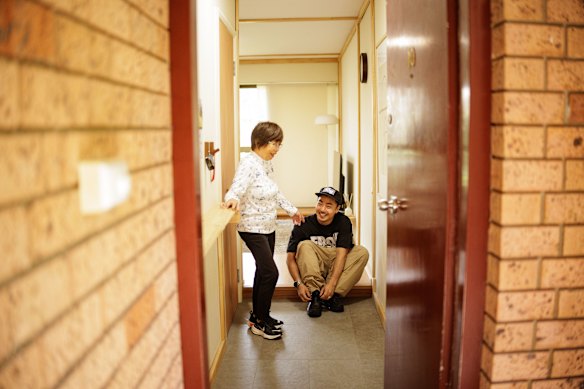
The traditional Japanese sunken entryway, known as a genkan, is a place to remove shoes before stepping into the main living space. A second sunken zone in the living room accommodates a sofa and television.
In the bathroom, a fully tiled built-in bathtub and walk-in shower are enclosed by a glass screen, creating wet and dry zones.
Next door, in the main bedroom, tatami floor mats create a moment of sensory enjoyment before bed.
“The mats are made of woven dried straw, and the subtle aroma transports you instantly,” Tin Jung says.
Bamboo screening, raked pebbles and a small garden bed transformed the balcony into a private sanctuary. “I wanted to show that we could improve even the smallest space,” Tin Jung says.
The renovation took six months and, according to Tin Jung, proceeded remarkably smoothly. “We had a very clear idea of what we wanted and had great trades helping us,” he says.
“What I’ve learnt from all the builds I’ve done is that being hands-on is critical. Selecting the timber, buying the tiles, managing the trades … Being part of the process ensured we got the right result.”
Selling agent Grace Lin of Ray White AY Realty Chatswood says she’s amazed by the transformation.
“It really does feel like stepping into Japan when you walk through the door,” she says. “I’ve never sold a property like it.”
Lin reckons the apartment would suit a first home buyer with an affinity for thoughtful design and an appreciation of Artarmon’s conveniences.
“You’re incredibly well-connected: the train station is a 10-minute walk, arterial roads are nearby and you’re in a great school catchment zone,” she says.
Tsui-Ming says leaving her Japanese sanctuary will be difficult.
“I didn’t know that my children had renovated the place like a Japanese home until I stepped through the door, so it came as a very exciting surprise for me, and I have loved living here.”
Rather than risk burdening her children in her old age, she is moving to a retirement home. “Not wanting to burden your children is very Japanese,” she laughs.
She will miss spending time with her family in the apartment, immersed in a culture they love.
“The Japanese take turns getting in the bath; it gives you a sort of union among family members,” she says.
“We’ve been doing that here, after dinner. It’s been a beautiful way for us to share this home that I have been so lucky to live in.”
Property alerts are now available in the SMH app. Turn them on to receive the latest market news and trends.
 Dan F Stapleton writes on First Nations issues, visual art, property and more. His writing has appeared in The New York Times, the Financial Times and others. He is based in Sydney.
Property listings
From our partners
Disclaimer : This story is auto aggregated by a computer programme and has not been created or edited by DOWNTHENEWS. Publisher: www.smh.com.au