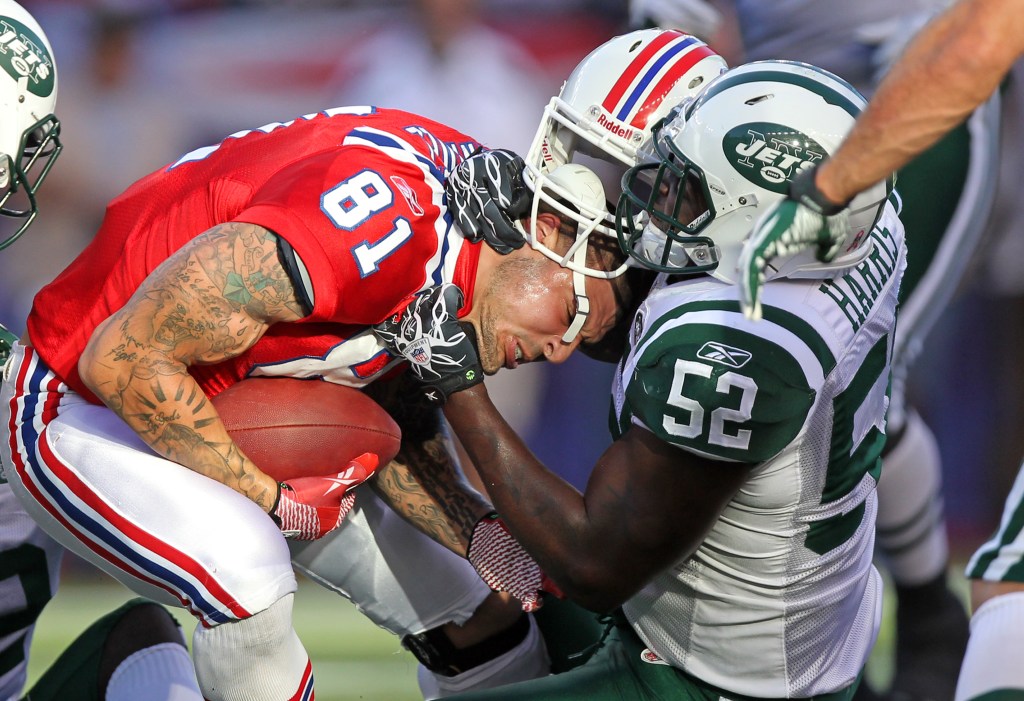
A simple blood test could identify CTE in living patients — a groundbreaking innovation at a time when the traumatic brain disease can only be diagnosed after someone’s death.
“This is a game changer,” said Michael Alosco, co-director of clinical research at the Boston University CTE Center and an author of the new study.
Recent research has found that as many as 1 in 4 NFL players develop CTE, sometimes leading to disturbing changes in personality and cognition during life. It can develop into addiction, psychosis and violence, and has been linked to higher risk of ALS.
The only currently proven way to detect CTE is by extracting and examining a person’s brain tissue from their dead body. A non-invasive test conducted on living patients that will pave the way for athletes like NFL players to access the treatment they need before it’s too late.
Advertisement
A research team led by Boston University and Banner Health examined 21 former American football players. The players had their blood drawn while they were still alive, and also donated their brains after their deaths for further examination.
Of the samples, 18 (85%) had CTE, or chronic traumatic encephalopathy. Of these, 16 (88%) had more severe (stage 3 or 4) CTE.
High stage CTE has been diagnosed in athletes who died as young as their early 20s but tends to most commonly be found with older age.
Advertisement
These were just NFL players, but a mix of athletes who’d played at all ages. Eleven of the 12 professional players, four of the seven college players, and one of the two high school football players had high stage CTE.
Alzheimer’s biomarker and CTE
Higher stage CTE is associated with dense clumps of an abnormal protein called p-tau around the brain, which disrupts cell functioning and drives neurodegeneration. This happens in CTE, but also in other diseases like Alzheimer’s and frontotemporal dementia.
When there’s more of that tau protein buildup in the brain, the blood contains more of a biomarker called endogenously cleaved microtubule-binding region tau (eMTBR-tau).
Advertisement
That biomarker is currently used to identify Alzheimer’s, bur researchers wanted to see if it would signal CTE, too.

Their hypothesis seems to have been correct: eMTBR-tau levels were significantly higher in higher stage CTE, but weren’t higher in people with low stage CTE or no CTE.
Some of the samples showed the former football players had both CTE and Alzheimer’s. Levels of eMTBR-tau were highest among these people.
Advertisement
The future of CTE
People who have CTE may develop memory loss, confusion, trouble with decisions and planning, and be irritable, aggressive, and depressed. They could also have problems with movement like tremors or problems with balance.
But to help them in life, all doctors can do is rule out other causes. The blood test proposed in this study is a ways away from becoming a validated test.
“We are still in the discovery phase and it’s a small sample size, but if future studies validate these findings, this blood test will allow us to detect CTE with a high level of accuracy and open the doors to clinical trials and treatment,” Alosco said.
Advertisement
In the future, research will need to look at hundreds more participants at varying stages of CTE and who have Alzheimer’s.
There is no treatment for CTE, and it gets worse over time.
That said, there are measures doctors can take to ease symptoms. For example, patients can get cognitive therapy to help with memory and attention, behavioral therapy to help with mood, and medication to help with depression, sleep, and pain.
Advertisement
Nicholas Ashton, another author on the study, points out that a blood test “has been revolutionary” in diagnosing and treating Alzheimer’s disease. “With this new study, we are optimistic that the same will be true for CTE.”
Disclaimer : This story is auto aggregated by a computer programme and has not been created or edited by DOWNTHENEWS. Publisher: nypost.com