
Warning: This story contains content some readers may find distressing
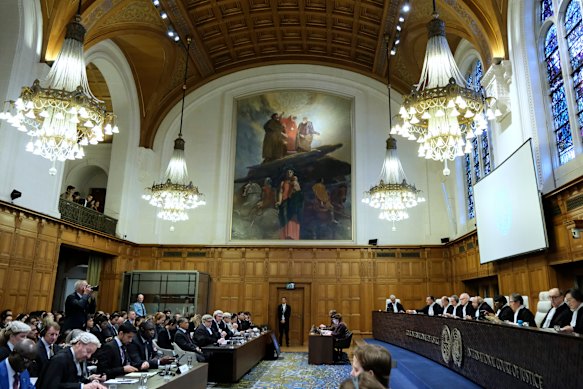
Singapore: A landmark ruling by the United Nations’ top court convicted Myanmar of genocide, validating the suffering of Rohingya Muslims during the so-called “clearance operations” of 2017, in which thousands of civilians were brutally murdered, raped, or both, by the military’s soldiers.
It is the first time the International Court of Justice (ICJ), based in the Netherlands, has judged a state guilty of breaching the 1948 Genocide Convention.
Scholars will be poring over the judgment for precedents that may play into pending matters, including a genocide case against Israel, lodged by South Africa, for its actions in Gaza.
The United States administration also followed the case closely, fearing that lowering the legal threshold for genocide could be used against its troops and those of its allies. US ambassador to the UN Mike Waltz last month warned the 15-member panel of judges that the US would “not allow globalist, faux judges to weaponise the law against our troops”.
President Donald Trump this year applied sanctions against the International Criminal Court (ICC) and could do the same to members of the ICJ, who, regardless, affirmed that Myanmar committed genocide with a vote of 9-6.
They ordered Myanmar to stop any ongoing violations, prosecute individual culprits, help reunify Rohingya families and pay reparations.
The ICJ’s only means to enforce the orders, however, is to notify the UN Security Council (UNSC) of noncompliance, and China and Russia, which hold veto powers on the UNSC, have strategic interests in keeping the brutal military regime afloat. Myanmar will almost certainly ignore the orders.
The court’s judgment was nonetheless immense for Rohingyas in its detailed recognition of the crimes committed against them, which included many references to oppression and stretching back decades.
It was also a significant win on the world stage for the tiny West African nation of the Gambia, which brought the case against Myanmar seven years ago out of a sense of moral responsibility to condemn such crimes “wherever and whenever they occur”, Attorney-General Dawda Jallow told the judges from the courtroom floor.
It was the first time a country not directly affected by the alleged crimes had lodged a genocide case with the ICJ.
Though the history of Buddhist-majority Myanmar’s persecution of the Rohingyas is long, the nation’s military, or Tatmadaw, began the campaign of genocide considered by the court in 2016. Myanmar said the “clearance operations” were in response to deadly 2016 attacks on police posts by the Arakan Rohingya Salvation Army (ARSA), which it considered a terrorist organisation.
While the ARSA attacks did happen, the court found the Tatmadaw’s large-scale pattern of rape and indiscriminate killings in Rohingya villages went beyond what could be considered counter-terrorism operations or the actions of a few bad apples.
“For example, there is no evidence before the court that … Myanmar distinguished between civilians and alleged ARSA fighters,” the president of the Court, Iwasawa Yuji, said in a near three-hour reading on Thursday night (Australian time).
“The court views casualties and damage far in excess of what was justified by military necessity … further, the execution of Rohingya men and boys in some locations, the widespread sexual violence, the targeting of children and babies, the methodical burning of villages, and attacks on fleeing civilians are not consistent with an intent to conduct counter-insurgency operations.”
The court, which unlike the ICC does not hear cases against individuals, found that about 10,000 Rohingyas were killed in 2017, including as many as 2109 children under the age of five. The campaign was fuelled by hate speech from military social media accounts and leaders.
From a population of about 815,000 people, more than 700,000 Rohingyas fled the genocide to squalid refugee camps in Bangladesh centred around Cox’s Bazar, which now has a population of more than 1 million people living off diminishing global aid.
“The fact that it was only Rohingya villages that were destroyed supports the inference that the Rohingya were selectively targeted by Myanmar,” Iwasawa said.
“Second, the burning of houses sent a clear message that they had nothing to return to. The intention to purge Rohingya from northern Rakhine State is also evidenced by Myanmar’s coordinated policy of construction of new infrastructure and resettlement of non-Rohingya groups in formerly Rohingya areas.”
The Gambia’s case called three de-identified eyewitnesses, and leaned heavily on a 2018 report by a UN fact-finding team that found a pattern of atrocities at more than 50 Rohingya villages in northern Rakhine state.
In one village called Min Gyi, the Tatmadaw soldiers shot directly into crowds of people attempting to flee to the riverbank or trying to swim to the other side, according to the report.
The men not already murdered or drowned were rounded up and executed, while the children were shot or, in some cases, thrown into the water or fire.
“Many of the women and girls had infants and children with them, who were killed or severely injured, while their mothers were raped,” the court heard. “The houses were then often locked and set on fire and most victims who were still alive were burned to death.”
Myanmar argued against the report’s veracity. The court, however, found it “generally reliable”.
Myanmar now joins the likes of the Khmer Rouge regime of Cambodia, which killed an estimated 2 million people in the late 1970s, in being found guilty of genocide in an international court since 1948.
International courts have also established genocide in Rwanda, and in Srebrenica in Bosnia.
The ICJ considered Bosnia’s case against Serbia in 2007, finding the Srebrenica massacre of 1995 amounted to genocide, but that the Serbian state could not be held responsible. Instead, it ruled Serbia had only failed to prevent it.
The ICJ had never previously convicted a state of the “crime of crimes” in part because of the high bar in satisfying the judges that “the only reasonable inference” to be drawn from the presented circumstantial evidence was genocide.
In the Myanmar case, the court found that while there may have been “additional intentions”, such as eliminating ARSA operatives, “the totality of the evidence can only be explained by the perpetrator’s genocidal intent”.
Myanmar’s brutal 2016-17 campaign came during the country’s transition period to democracy when Nobel laureate Aung San Suu Kyi headed the elected government. While she had no meaningful abilities to contain the military, which has ruled Myanmar for most of its post-colonial history, she disappointed legions of followers around the world by telling the ICJ in December 2019, shortly after the case was filed, that Gambia had presented an “incomplete and misleading factual picture of the situation in Rakhine State”.
Barely a year later, she was imprisoned during a coup led by Senior General Min Aung Hlaing, the supreme commander of the Tatmadaw during the Rohingya genocide. She remains in detention as the renewed civil war rages across the country, including in Rakhine State. The remaining Rohingyas there remain under assault by both the Tatmadaw and an ethnic armed organisation called the Arakan Army.
After elections widely seen as fraudulent this year, Min Aung Hlaing swapped his military uniform for a suit and started going by the title of president. He and other regime officials remain banned from attending international summits, such as that of the Association of Southeast Asian Nations (ASEAN), which just concluded in Manila, Philippines.
But with his regime propped up by China and the civil war grinding on seemingly without hope of resolution, some ASEAN members including Thailand are seeking to bring the regime into the regional fold.
The court’s ruling on Thursday will make it harder for Myanmar with Min Aung Hlaing at the helm to progress its goal of being seen as a legitimate government, but practical considerations – Myanmar’s vast natural resource wealth, for example, or the resolution of humanitarian and criminal crises spilling over its borders – remain powerful trump cards.
Get a note directly from our foreign correspondents on what’s making headlines around the world. Sign up for our weekly What in the World newsletter.

From our partners
Disclaimer : This story is auto aggregated by a computer programme and has not been created or edited by DOWNTHENEWS. Publisher: www.smh.com.au