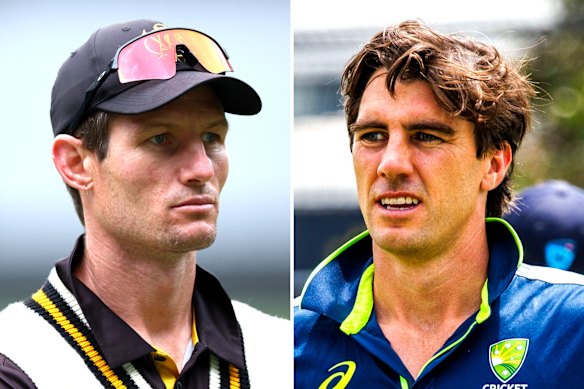
In 4500 words, Cameron Bancroft got very granular. His statement was so detailed, it was compelling.
He relayed verbatim conversations with Darren Lehman and David Saker about getting sandpaper onto the ground. Indeed, he recounted multiple Saker conversations. He described numerous conversations with David Warner, who suggested sandpaper be used in the first place. And he described the all care, no responsibility – in fact no care, no responsibility – attitude of Steve Smith rushing away, hands aloft.
He recalled the very words of his conversations with media manager Kate Hutchison – one of the few to emerge well from this soap opera – about using sandpaper.
Then he got to Pat Cummins and the bowlers, and he suddenly became very vague.
He shifted from Geoffrey Robertson to Dennis Denuto; his account went from granular to “oh, they all knew”.
Maybe they did. It stretches credibility to think the people who hold the ball more than others, and consider it like a craftsman a favourite chisel, did not notice differences in the ball. But seeing change and knowing what caused it are two different things.
In his lengthy account, Bancroft goes from smoking gun to deductive leap. And those reading it likewise appear to have joined in the same “oh, of course they did” conclusion.
It might be thought Bancroft’s sudden mid-rant vagueness was to protect the remnants of a broken relationship with the bowlers and Cummins in particular, but Bancroft had already gone out of his way to individualise Cummins and talk of his anger with him.
The angry man seems unlikely to pull a punch, unless he can’t remember a punch he can throw.
Bancroft’s stated aim in his 4500-word recounting was to tell all. That is not consistent with him holding back the single most important bit of knowledge or incriminating specific anecdote indicating what the current Australian captain knew about the team’s use of sandpaper back in 2018.
The logical extension of Bancroft suddenly falling back on “they all knew” is that his memory permits no more than assumption. It was a logical assumption, but set against the strident, unequivocal and detailed denials from Cummins, Mitchell Starc, Josh Hazlewood and Nathan Lyon, the assumption must carry less weight.
Like Bancroft, Chadd Sayers was prompted to speak out in defence of Usman Khawaja because of their anger at Cummins’ decision to personalise his defence by talking of Khawaja being casual with their friendship.
But then neither of them cited a specific moment from Cummins, or any of the other bowlers, that acknowledged the use of sandpaper.
Everyone has acknowledged, even the bowlers, that the team worked on the ball. They all knew Warner was manipulator-in-chief. But not that sandpaper was used.
The only way to know that someone knows something, as distinct from assuming they know, is to have been witness to them seeing it, hearing it or of them telling you they know. None of Bancroft, Warner, Khawaja or Sayers have offered such a moment about the bowlers.
That is interesting because Bancroft goes out of his way to say in his lengthy statement that there is a difference between knowing the ball was being worked on and sandpaper being used.
“I recognise there is a distinction between knowing a ball is reversing, suspecting it has been altered and knowing specifically that sandpaper has been used,” he said.
He understands the importance of the distinction but then offers nothing concrete to support it. He does not say how he knows the bowlers knew it was sandpaper. He does not say – as he did of others – I know they knew because we directly spoke about it on this day.
Being aware of the important distinction and then failing to attempt to say which category Cummins and each bowler fell into is instructive.
Bancroft may well have further incriminating stories to tell about this, but the point is he has not told them in his 4500-word statement.
Maybe they will do so at the closed door forum. Incidentally, is there really any reason to close the doors any more on the most public of dirty linen being washed?
Short of punishing the whole team (and there was genuine merit in Khawaja’s recommendation at the time that they say ‘we are all in on this’), the real upshot of the latest instalment in the issue is effectively that the three players punished by Cricket Australia remain the three most culpable players.
Bancroft says it was Warner’s idea to use sandpaper, Warner admits it was his idea, but he couldn’t carry the paper because people were looking at him, and Smith knew but didn’t want to know.
As all have made clear, that a team was doctoring the ball was no surprise to anyone, least of all the South Africans or the English. It was the sandpaper that was, legitimately, the audacious difference.
But can we also take a moment to check on the moral arbiters Nasser Hussain and Michael Vaughan, the former England captains of two Ashes campaigns in which Marcus Trescothick outlined in his book how he had stocked his pockets so full of sticky mints it looked like he had developed a growth in his thighs?
Trescothick wondered at how he was never called out by the umpires for having so many of them and using them on the ball.
They were brought onto the field for a very specific purpose, which was not to satisfy a diabetic need for sugar, but to load the ball up to swing. An outside product brought on to change the condition of the ball.
Personally, I don’t care if anyone wants to ruin one side of the ball – it doesn’t always work and if it doesn’t you are left with a wrecked ball. But that is not the rule, and sandpaper was still an awful leap.
This story has, for years, not been about what the team did, but who knew? And assuming people knew remains a stretch from explaining how and why.
Read more on the sandpaper scandal
News, results and expert analysis from the weekend of sport sent every Monday. Sign up for our Sport newsletter.
 Michael Gleeson is an award-winning senior sports writer specialising in AFL and athletics.Connect via X or email.
From our partners
Disclaimer : This story is auto aggregated by a computer programme and has not been created or edited by DOWNTHENEWS. Publisher: www.smh.com.au