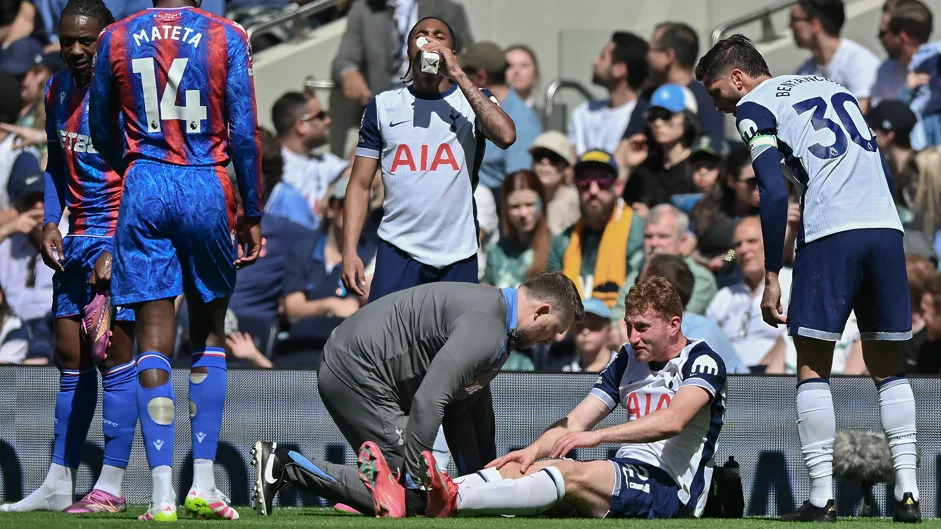
“I told my mother. I sat with her and I told her: ‘Listen, I don’t think I can play any more’,” says Dejan Kulusevski in a moving interview about his injury nightmare.
It is 18 months since Tottenham and Sweden winger Kulusevski, 26, last started a competitive match.
Advertisement
Spurs have won the Europa League, sacked both Ange Postecoglou and Thomas Frank, “mutually agreed” to part ways with Igor Tudor and appointed Roberto de Zerbi since the former Juventus player last started a first-team game for his club.
A serious knee injury two weeks from the end of the 2024-25 season forced him to miss the whole of the following campaign, as well as the 2026 World Cup.
“You feel like the whole world has forgotten about you,” adds Kulusevski in an interview with Tottenham’s in-house media about the emotional toll of being out for so long.
Thankfully, the player nicknamed ‘Deki’ has made a full recovery and is closing in on his first Tottenham start since 11 May 2025.
Advertisement
He is not the only footballer to question their career after having their world turned upside down by injury.
In the women’s game, Everton club captain Megan Finnigan recently returned from a cruciate ligament injury after 602 days out.
“The amount of times the thought of retirement entered my head during rehab was a lot,” Finnigan, 28, tells BBC Sport.
Countless hours in the gym away from team-mates, boredom, setbacks and frustration – what is it like for a player at the peak of their game to miss a season because of injury?
‘I stared at the wall for hours’
Before Crystal Palace visited Tottenham a fortnight from the end of the 2024-25 campaign, Kulusevski had much to look forward to.
Advertisement
Off the pitch, he was making plans to marry his partner Eldina Ahmic, a former midfielder with Swedish club Brommapojkarna and Bosnia-Herzegovina.
On the pitch, there was a Europa League final against Manchester United coming up.
Everything changed in that match against Palace.
In the early stages, Kulusevski stayed down after a challenge with Marc Guehi. He was able to climb to his feet and walk unaided off the pitch and straight down the tunnel.
But in that moment, his problems were only just starting.
Start of a nightmare for Dejan Kulusevski who goes down injured in May 2025 – and does not play again until October 2026 [Getty Images]
“It was pain, but it didn’t hurt that much,” Kulusevski says, recalling the patella and cartilage injury in his right knee.
Advertisement
“I could feel that the knee was moving a little bit too much.”
The initial diagnosis from Tottenham was that the £25m signing from Juventus, who arrived in the summer of 2023, would be out for “at least a few months”.
Due to complications, those months turned into a year and Kulusevski’s dream career threatened to turn into a nightmare.
He travelled to Bilbao on crutches to watch his team-mates beat United in the Europa League final.
“That was one of the hardest days of my life,” he says. “It was so beautiful to see all the people happy, but for me I was going there with crutches, I couldn’t work.
Advertisement
“I couldn’t even go and get my medal because it was too slippy to go on that thing [platform].
“Seeing the team celebrating on the bus [outside Tottenham Hotspur Stadium] was probably one of the most difficult parts of this journey because you feel so alone.
“You feel like the whole world has forgot about you and what you put in.”
As months went by, Kulusevski underwent multiple operations and was even offered a knee transplant as a treatment option, which he rejected.
“You get stressed because nothing works,” he says.
Then came another crushing blow delivered in a phone call with Sweden boss Graham Potter. Stockholm-born Kulusevski, who had played for his country since the age of 19, would not be going to the 2026 World Cup.
Advertisement
He had hoped to recover in time to be selected.
“I just stared at the wall for three hours because I really believed I would do it,” he says.
It is not just the players who suffer when they are out for so long; the people around them feel the emotional toll as well.
“Seeing him miss the Europa League final and the World Cup, every Premier League game last season, seeing him skipping around on his crutches, those parts were really difficult,” Eldina, Kulusevski’s wife, says.
As recently as this past summer, Kulusevski wondered whether he would play again.
“It had been one year and two months and I could still not walk up the stairs like a normal guy.
Advertisement
“I wasn’t going to give up, but I also had to think if this didn’t work out, what am I going to do, because I am 26 and I have to have some sort of plan.”
Enormous comfort came from Leonie, Kulusevski’s two-year-old daughter, during his bleakest days.
“I said if I cannot play football any more, I will still have fun with her.”
Then, after multiple setbacks, came a crucial breakthrough.
His knee had healed sufficiently for specialists to give him permission to train again.
On 19 October, Kulusevski was given a hero’s reception by Spurs fans when he made his first appearance in 526 days.
Advertisement
It came in Tottenham’s 3-1 win over Coventry City as an 87th-minute substitute.
Waiting for him after the final whistle were Eldina and Leonie, his daughter wearing a Spurs shirt with the number 526 on the back, along with the words ‘My Hero’.
He made his Sweden return this month, coming off the bench in a win against Bosnia-Herzegovina.
“Every day is just beautiful now,” says Kulusevski, who has made four substitute appearances totalling 42 minutes for his club this season.
“I don’t take it for granted any more.”
‘I wasn’t pleasant to be around’
Research suggests female footballers are two to six times more likely to suffer anterior cruciate ligament (ACL) injuries than their male counterparts.
Advertisement
Everton captain Finnigan remembers how she “completely lost my sparkle” as she endured the long road to recovery.
“It’s not comfortable to think back how I was,” Finnigan tells BBC Radio Merseyside’s Giulia Bould.
“Anyone that knows me knows I’m very bubbly, quite loud, I like to be at the centre of things. I completely lost myself in rehab, completely lost my sparkle as my mum says.
“How I was in this building is not nice to think back on. I was always thinking what other people were thinking about me. I was not pleasant to be around as I was struggling so much.
Advertisement
“I was also thinking ‘no-one wants to be around me’. I was just miserable. Everyone in this building has seen me cry over the past 18 months.”

Megan Finnigan, Everton’s number 20, returned to competitive action this season after 602 days out following an ACL injury [Getty Images]
Finnigan – Everton’s longest-serving women’s player having joined the Blues at the age of nine – suffered her injury in an FA Cup tie against Tottenham in January 2025. She did not return to competitive action until September of this year.
“I was in quite a difficult place mentally,” she adds.
One thing that helped her through her lowest moments was writing down her feelings.
“It was an absolute whirlwind of a rehab, a rollercoaster,” she adds.
Advertisement
“Anyone who went through it with me will tell you that. I am really glad I kept a diary as proof I did it and survived it.”
‘I felt like a ghost’
Former Arsenal and England midfielder Fara Williams points to how some players who suffer serious injuries in the Women’s Super League face specific worries.
“While they are going through rehab, there are financial worries, bills to pay; they are on short contracts so you don’t have that stability,” says Williams.
“While you are managing the injury, mentally you are stressing, wondering where the next contract is coming from. When you are stressed, I imagine that doesn’t help with the healing of the injury.”
Advertisement
Micah Richards suffered multiple long-term knee and hamstring injuries before he retired in 2019 while at Aston Villa.
A few months later the former Manchester City and England defender opened up to BBC Sport about injuries and the “dark side of football”.
“I was in a lonely place for a long time, and I did not know how to get out of it,” he said at the time.
“Deep down, I probably knew it was already over, but for most of the two and a half years between my 295th and final game as a professional, against Wolves in October 2016, and the day I announced my retirement in July 2019, I was living in denial.
Advertisement
“I could run and I could jump – but I couldn’t twist on my right knee, and it would not get any better. Whatever I tried, it did not make any difference.
“There were times while I was injured at Villa when I felt like I was a ghost.
“They told me to come in three times a week, then two. Then one.
“I would go into the gym and tell myself ‘I am all right, I am all right, I am all right’ but actually I had no idea how to deal with what was happening to me, and my body.”
Disclaimer : This story is auto aggregated by a computer programme and has not been created or edited by DOWNTHENEWS. Publisher: Sports.yahoo.com