Note: The Vyasa Project does not publicly disclose the names of children who contribute to its platform. The child featured in this story has therefore been identified by their chosen nickname.
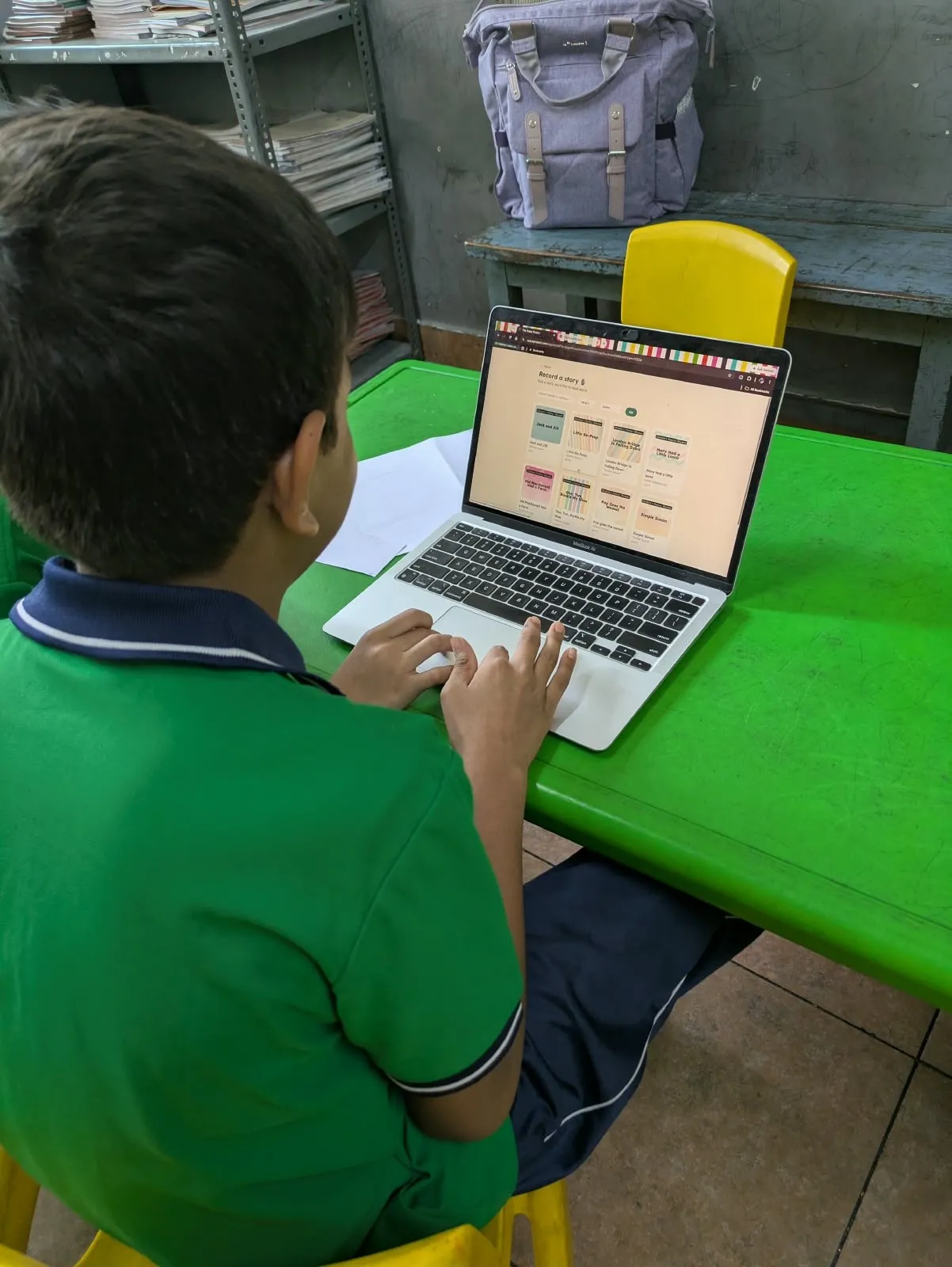
For a Class 5 student (nickname Super_Goalie) at Royal Concorde International School in Bengaluru, narrating a story meant becoming six different people at once.
One of the stories the young reader chose was Arjuna and the Bird’s Eye from the Mahabharata. Having heard it from their parents several times, the child knew the story well. But recording it for other children offered a new experience: bringing each character to life with a different voice.
“I particularly enjoyed this one because I could use different voices for the five Pandavas and their guru, Dronacharya. It felt like I could become six different people all at once,” she shares. “I had heard this story from my parents many times, so I already knew it well. But this time, I got to tell it in my own way and add my own style.”
For the child, it was an opportunity to have fun with a familiar story. But with every page read aloud and every recording made, children are also practising their reading, exploring expression and becoming more comfortable with their own voices.
This is the idea behind The Vyasa Project, a free, non-profit audio library where children narrate stories for other children.
The initiative brings together two simple pleasures: reading a good story and listening to another child tell it. Its founders hope that this experience will encourage more children to pick up books, enjoy reading and discover the confidence that comes with expressing themselves.
When children become storytellers
The process begins with children exploring a curated collection of stories on the Vyasa Project platform. They can choose from Panchatantra tales, Aesop’s fables, folktales, abridged classics and poems.
The collection includes stories in English, Hindi, Telugu, Bangla and Kannada, allowing children to explore narratives in languages they are comfortable with.

Once they have chosen a story, children practise reading it before recording their narration. They can listen to their recordings, re-record them if needed, and submit them for review. Every submission is manually checked before being added to the library. If a recording cannot be published because of quality issues, the child receives detailed feedback to help improve it.
The platform also has demonstration videos to help children and parents understand its features and navigate the process.
For Karan S Kumar, co-founder of The Vyasa Project, the idea comes from his own childhood relationship with books.
“I was the kind of child who always had a book open. Those stories took me to worlds I could never have reached otherwise, and somewhere along the way they shaped how I think, how I speak and how I see other people,” he says.
He wanted to bring that same sense of wonder to more children. The idea of children narrating stories for their peers became a way to make reading feel less like a lesson and more like a shared experience.
“When a child narrates a story, something changes. They find their voice and their confidence, and they discover that what they have to say matters. And when another child listens, it feels less like being taught and more like a friend sharing something special,” he adds.
A library that grows with every child’s voice
The stories are selected to be age-appropriate, engaging and enjoyable, with interesting characters, humour, unexpected twists and meaningful themes.
Priyanka Tadipatri, co-founder of the project, says the English collection began with stories from different storytelling traditions, including the Panchatantra, Arabian Nights, Grimm’s fairy tales, Aesop’s fables and Zanzibar tales. It also includes abridged works by authors such as Charles Dickens, Mark Twain, L Frank Baum and Oscar Wilde.

The collection has since expanded into regional languages, with the founders hoping to add more Indian and international languages over time.
Importantly, children do not have to record stories to use the library. They can simply listen to narrations uploaded by other young readers and explore stories across genres and languages.
The founders have also deliberately kept the platform free of likes, comments and peer-to-peer messaging. Their intention is to create an experience similar to visiting a library: children come to discover stories, enjoy them and return whenever they want to read or listen again.
For Madurai Sridhar, a grandparent whose granddaughter regularly uses the platform, this interest has been particularly encouraging.
“My granddaughter asks me to log in to The Vyasa Project regularly. What she loves most isn’t the listening; it’s reading stories aloud and recording them for other children. We’re strict about screen time at home, and this is one of the few things on a screen I’m happy to say yes to,” he says.
He adds that seeing his granddaughter so absorbed in the activity has been reassuring, especially when children often move quickly from one activity to another.
The early response has been encouraging. Within three months of starting the project, the team received close to 700 recordings across languages, with several children contributing more than 10 narrations each.
Priyanka says they have also noticed children becoming more comfortable with narration after initially hesitating. Some begin tentatively but grow more confident within just a few paragraphs.

“We do not expect children to have perfect pronunciation or error-free submissions. For us, it is more important that they have fun, enjoy the journey and hopefully fall in love with stories and books,” she says.
Nischala Agnihotri, a working mother and children’s author of Yellow Kabbadi, believes the value of reading extends beyond developing language and cognitive skills.
“It’s not just about cognitive skills. Reading as a habit works at a deeper level. It builds the unseen. It works on their character, personality, and how they develop their first response and thinking patterns,” she says.
She believes that folklore, poetry and storytelling traditions can play an important role in shaping how children understand the world. For her, The Vyasa Project is helping bring these experiences to more children.
Making reading a shared experience
To encourage more children to participate, The Vyasa Project is organising Readers’ Quest 2026, a seven-day online storytelling challenge during National Library Week, from 14 to 20 November.
Open to children in Grades 1 to 7, or those aged 6 to 12, the challenge invites participants to contribute at least seven narrations during the week. Up to 20 winners across junior and senior categories will receive prizes, certificates, and an opportunity to attend a Voice and Storytelling workshop led by RJ Jayashree Raj.
But for the founders, the larger idea goes beyond a week-long challenge or the number of recordings in the library.

As Karan puts it, “A child doesn’t have to narrate a story to benefit from the platform. Listening is just as central to the experience.”
And perhaps that is what makes the idea special. One child discovers a story, another finds the courage to narrate it, and someone else listens and feels inspired to pick up a book.
With every new voice added to the library, another child gets an invitation to discover a world between the pages.
All images courtesy of Priyanka Tadipatri
Disclaimer : This story is auto aggregated by a computer programme and has not been created or edited by DOWNTHENEWS. Publisher: thebetterindia.com