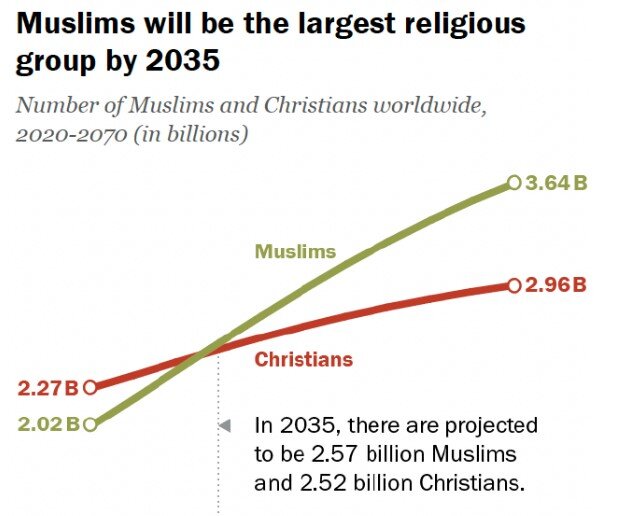
Muslims are expected to outnumber Christians by 2035, according to new projections from Pew Research Center. Both religious groups are growing in size, but Muslims are growing faster. By 2070, if recent trends continue, there will be more than 3.6 billion Muslims and just under 3 billion Christians worldwide.
The world’s total population is projected to increase by 29% between 2020 and 2070. Muslims and Christians are the only religious groups analyzed are expected to keep pace, with Christians growing by 30% and Muslims by 80%.
As a result, the size of many religious groups will change relative to the world’s overall population. Muslims will make up a larger percentage of the global population in 2070 (36%) than they did in 2020 (26%). Christians, meanwhile, will hold fairly steady at 29%.
Although Hindus are growing in absolute number, they are projected to decline as a percentage of the global population. Jews are expected to follow a similar pattern.
Meanwhile, Buddhists are expected to shrink both in number and as a portion of the world’s population in the coming decades.
All other religions combined (including Baha’is, Daoists, Jains, Sikhs, adherents of folk religions and many other groups) are expected to experience a modest increase in number. However, they will slip below 2% of the global population by 2070.
And people who have no religious affiliation – sometimes called religious “nones” – are projected to drop substantially as a share of the world population, from 24% in 2020 to 17% in 2070.
In the 21st century, most of the world’s population growth is expected to occur in Africa, particularly in countries south of the Sahara Desert.
By 2070, more than a quarter of all people worldwide will live in sub-Saharan Africa. Since the vast majority of people who currently live there are either Christians or Muslims, the region’s high fertility and rising life expectancy will boost the global numbers of both faiths.
By comparison, the populations of other major geographic regions are expected to grow more modestly, or even to shrink. For example, between 2020 and 2070, the number of people living in Europe will decline, and their share of the world’s population is projected to drop from 10% to 6%.
Fertility differences have big effects on populations. Globally, Muslims tend to have more children than other major religious groups. During the 2020-2025 period, the total fertility rate for Muslims was 3.1 children per woman. By comparison, the rate for non-Muslims was 2.0 children per woman.
The current age profile of the people in each religious group also plays a role in the projections. In younger populations, a larger share of people have yet to complete their childbearing years. On average, Muslims around the world are younger than any other religious group in this study. As of 2020, the median age of Muslims (24) was nearly a decade lower than the median age of non-Muslims (33).
If recent trends continue, by 2070:
– More than half of the world’s Christians will live in sub-Saharan Africa.
– An African country, the Democratic Republic of the Congo, will surpass the United States as the country with the greatest number of Christians.
– The United States will no longer have a Christian majority, though Christians will remain the biggest religious group in the country.
– Pakistan will have the largest Muslim population, followed by India, Nigeria and Indonesia (which currently has the most Muslims).
– Hindus will increase the most in absolute number in India, but they will grow faster in countries outside India, including the U.S.
– The overall populations of China, Japan and South Korea will shrink, and their Buddhist populations will drop by more than half.
– Most countries will have more religiously unaffiliated people than they do now. But the increase will be entirely offset by population decline in China, where most religious “nones” currently live.
– 62% of all Jews will live in Israel, up from 46% in 2020.
These findings are part of a broader Pew Research Center project examining how the size of seven religious groups will change globally between 2020 and 2070 if recent demographic trends continue. Pew Research Center’s projections take into account the differences between religious groups’ age profiles, fertility rates, and patterns of religious switching and migration. (Religious switching and migration are assumed to continue at the same levels that have been recently observed.) We also incorporate mortality rates, applying the same rate to each religious group within a country. Read the methodology for more details about these projections and their limitations.
Disclaimer : This story is auto aggregated by a computer programme and has not been created or edited by DOWNTHENEWS. Publisher: tehrantimes.com