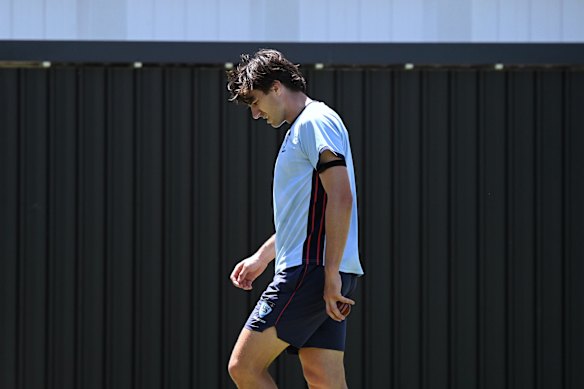
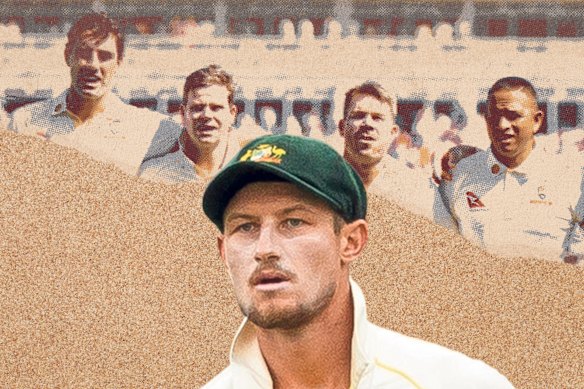
Cameron Bancroft watched the first 10 minutes of Pat Cummins’ marathon press conference last Friday on his phone before he had to hand in his device to play in a Sheffield Shield match for Western Australia in Melbourne.
For integrity reasons, players are not permitted to have their phones in their possession during a game – even when they’re off the field, as Bancroft was for most of that day while his teammates batted.
It wasn’t until stumps were called at the end of the day’s play that he was able to catch up on Cummins’ entire hour-plus exchange with reporters in Sydney.
What he heard convinced him to unleash the 4000-word exposé that has set off an earthquake under Australian cricket and the captaincy of Cummins.
“For eight years, I shared the burden of this story for the whole team,” Bancroft wrote, saying he “took the bullet for everybody”.
“It was not just the three of us – Steve Smith, David Warner and I – who knew about me using sandpaper on the ball in South Africa. It was the whole team.”
There has been turmoil afoot since this masthead revealed the contents of Usman Khawaja’s autobiography a fortnight ago. The implosion has now spiralled to a crisis on par with or exceeding the greatest flash points in the game’s history in Australia – among them World Series Cricket, the underarm incident and the ball-tampering scandal itself.
Amid lies, incomplete truths and allegations of a cover-up, nothing less than the credibility of the national sport and its leaders is at stake in Sandpapergate revisited.
It has been a ticking time bomb since a limited Cricket Australia investigation in South Africa isolated blame for the team’s cheating to Bancroft, captain Smith and vice-captain Warner, throwing the book at all three of them with bans ranging from nine months to a year on top of the ignominy.
While the team rose from rock bottom under Smith’s successor Tim Paine and then Cummins, winning a World Test Championship and 50-over and Twenty20 World Cups, the untold story of 2018 always threatened to come out one day.
That its emergence has left Australian cricket in such a state of emergency speaks to just how deeply the secrets of South Africa were buried.
Cummins, a young fast bowler at the time but the captain now, has stood by his insistence that he had no prior knowledge of Bancroft’s use of sandpaper to alter the condition of the ball in that series, or of any illegal tampering efforts by the Australian team at all.
“Pat’s position hasn’t changed in eight years,” his agent Neil Maxwell said in one of a series of statements in reply to Bancroft’s tell-all story. “He’s been consistent and adamant from day one.”
“Pat feels for Cam, of course. He has been through a lot. We would urge people to again read Pat’s interview transcript. There is nothing he hasn’t answered. And that includes in response to what Cam has now said.”
Cummins was the focus of “hysteria unfounded in reality”, Maxwell later added.
But, while the facts have remained contested, his detailed recollections of discussions among the team and coaches about the devious tactics he was employing have eroded public trust in the holder of a high office that demands it.
“Pinocchio Pat,” the British broadcaster Piers Morgan branded him, as he called for his sacking on London radio – a social media clip of which was liked by Warner’s wife Candice.
Bombarded by media on the doorstep of his eastern suburbs home and at training with the NSW team at the SCG, Cummins became a captain under siege.
Bancroft said he was not out to point fingers or cause damage to the game on the eve of the Australian summer, in which Cummins is due to lead the team in a Test series against New Zealand.
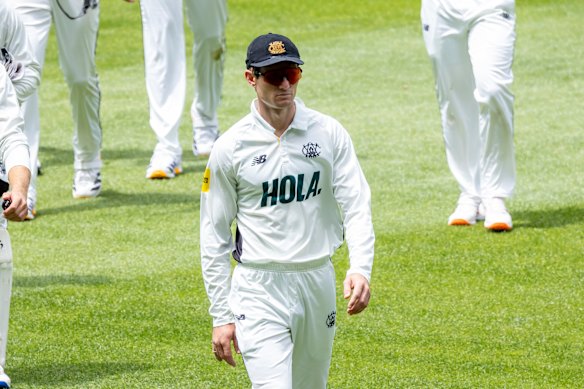
He initially had no intention of releasing his version of events when he began to draft it in the weeks before the Australian team’s long-awaited return to South Africa for a Test series last month.
Devoted to yoga and meditation, journaling is also part of the batsman’s spiritual regimen and with the national side travelling back to the scene of the sandpaper crime, his thoughts were drawn to what transpired on the previous tour eight years earlier.
It was a cleansing exercise for the West Australian, whose career and life have been haunted by what had happened in South Africa and the code of silence around it.
A chain reaction over the past fortnight, however, triggered Bancroft to push send on Wednesday.
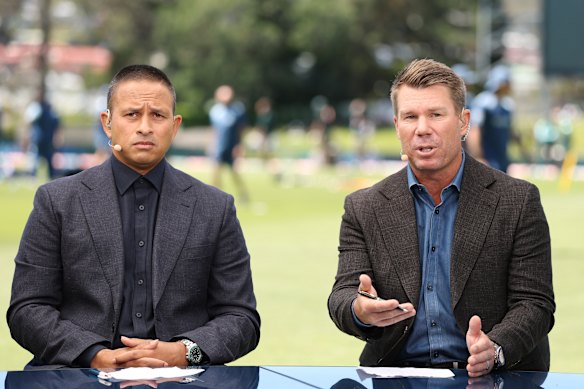
The first was the release of Khawaja’s book, which implied much wider knowledge of conspiracy than the trio penalised, and the backing of those claims by Warner and back-up bowler Chadd Sayers.
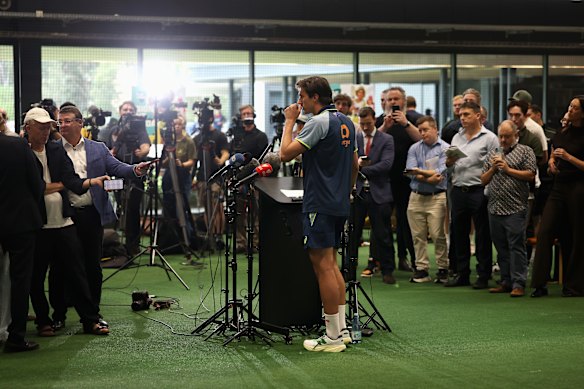
Bancroft was then moved to detail the “entire truth” about the plot after being angered by Cummins’ forceful repudiation of Khawaja in his 68-minute media conference.
His manager, Ben Tippett, phoned CA chief executive Todd Greenberg on Wednesday to tell him Bancroft was considering unloading his conscience.
Greenberg was preparing at the time to front a press conference that afternoon in Hobart with acting CA chairman David Boon to announce an independent forum for veterans of the 2018 series to share their memories. The CEO had rung Bancroft the night before to let him know about it.
The concept was widely viewed as a bid to get players to cease airing their dirty laundry in the open and an attempt to convince Bancroft not to tip the bucket.
If that was the case, it was proven unsuccessful within hours.
The live-broadcast Cummins press conference, in which he took questions from journalists until they had no more, was received at the time as a statesmanlike performance.
Members of the 2018 tour squad were taken aback, though, about how hard he went at Khawaja. Bancroft said it “made me feel angry, betrayed and alone”.
“What I saw, experienced and lived with – not only him, but everyone else on that tour in South Africa – is not the public account he gave in his press conference and in the years previously when he has spoken on this time,” he said.
Bancroft also said a joint statement issued by Cummins and fellow bowlers Mitchell Starc, Josh Hazlewood and Nathan Lyon in 2021 denying they were aware sandpaper had been taken on the ground at Newlands had been “deeply painful” for him.
The quartet was reacting to an unplanned comment from Bancroft in an interview with the Guardian in Britain in which he said it was “probably self-explanatory” that the bowlers knew what was going on.
As well as exerting extreme pressure on Cummins, Bancroft’s claims put former head coach Darren Lehmann and bowling coach David Saker under the gun, placing them in conversations at the time in which sandpaper was discussed.
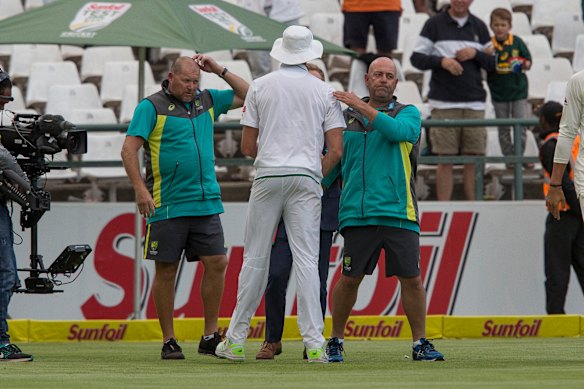
Lehmann, who resigned before the end of the tour of South Africa, said in the hours before Bancroft’s missive that he had “nothing to hide”, but after it came out, told ABC Radio he would take “the next few days” to consider a response.
CA itself has also been under fire over its handling of the storm eight years ago and since it’s been raging again.
The personnel at the Melbourne-based governing body of the sport are almost entirely different from eight years ago. Chief executive James Sutherland, who left six months after Cape Town, is long gone and has been running Golf Australia since 2020, and there are no survivors from the CA board at the time.
But the current leadership has been criticised for reacting too slowly and inadequately to the widening fissures within the 2018 generation and the immense fallout.
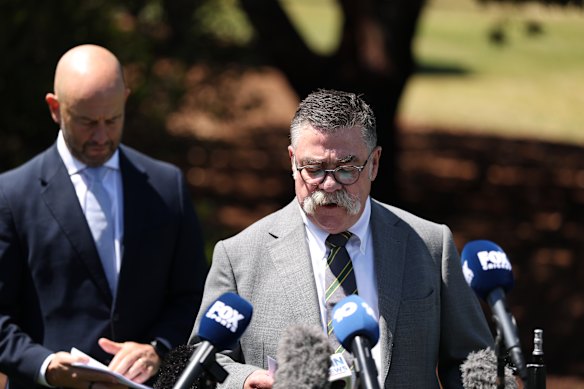
Greenberg and Boon were in Bali for International Cricket Council management and board meetings for several days as players turned on each other over the past two weeks.
After refusing to reopen the sandpaper probe, CA belatedly unveiled its solution to the unfolding mess: the establishment of an arena in which players and others involved with the Australian squad from the era could open up without fear of sanction, overseen by a KC or former judge.
“As a former player, I know that one of the most important things cricket gives us is the relationships we build and the mateship that endures long after playing careers end,” Boon said.
“My hope is that this process can help strengthen those connections and allow us to focus on what lies ahead. I would encourage everyone to allow the process to unfold respectfully and privately.”
The horse had already bolted and the CA’s truth and reconciliation commission was derided as a lame-duck inquiry.
It is voluntary even for those still contracted by CA, and crucially, it will be up to the board what findings are released in the end, Boon said.
“How is that an actual way of trying to present what people are saying?” Khawaja said on Kayo Sports. “So I can go in there and say something, but then the board can decide that they’re not going to release that. I just feel like then we just go in a circle again.”
The Albanese government also weighed in, indicating a desire for more transparency.
CA relies mostly on television rights fees and sponsorship for its revenue but received $10 million in federal government funding between 2017 and 2024 while Cummins has been a face of its $50 million Game On community sport program.
“Integrity in the game matters for every kid with a bat or a ball,” a spokesman for Sports Minister Anika Wells said. “This is Cricket Australia’s process to run, and it is a matter for them to work through. Australians will expect this to be run independently and as openly as possible.”
CA’s original investigation was hindered by Bancroft being untruthful, as he said he had been in an effort to cover for the rest of the team.
It did produce much the same conclusions on Warner and Smith that Bancroft described this week. The sandpaper had been Warner’s idea, he wrote, and Smith had been guilty as captain of knowing but looking the other way.
But its rushed and incomplete nature, with players such as Khawaja not even interviewed, has been demonstrated by Bancroft’s lengthy confession to have been hopelessly insufficient.
It was conducted in an atmosphere of self-preservation, which permeated through the Australian dressing room in the aftermath of Bancroft being busted and lingered for years.
The team had been a law unto itself in a spiteful series that featured a stairwell altercation between Warner and South Africa’s Quinton de Kock, instances of on-field misconduct and persistent crowd abuse of players’ partners.
It was in that context that Australia’s tampering efforts gathered pace and Bancroft took up the euphemistic ball management duties from Warner, who had reacted to the focus on him by writing the names of his wife and daughters on strapping tape on his hand.
A subsequent culture review by the Ethics Centre held CA accountable for a “win-at-all-costs” mentality that had taken root in Australian cricket and that tipped over the edge in South Africa.
How much, if any, weight was given to the general direction the team had taken when applying the heavy punishment meted out to Warner, Smith and Bancroft was never made clear.
But the sheer scale of the suspensions, far eclipsing the traffic-offence style treatment of ball tampering by the International Cricket Council, and the concealment of what went on behind the scenes set the game on course for an inevitable reckoning.
It is highly unlikely there will ever be an agreed narrative about what occurred in South Africa.
Beyond Cummins and the bowlers, there are others who were on the tour who have maintained privately that they did not know Bancroft was using a foreign object on the ball.
Unless CA changes course and commits to seeking and delivering a full, unvarnished record of the episode to the public, though, the stain of sandpaper may never go away.
News, results and expert analysis from the weekend of sport sent every Friday. Sign up for our Sport newsletter.
Disclaimer : This story is auto aggregated by a computer programme and has not been created or edited by DOWNTHENEWS. Publisher: www.smh.com.au