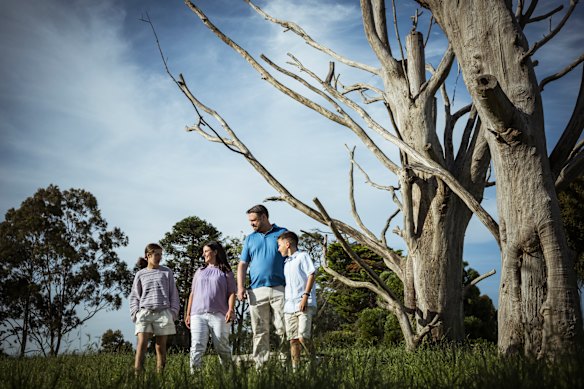
Lisa Briggs often wonders what it would be like to wake up and feel normal, just for a day.
Each morning, she checks for changes to her breathing and mentally scans her body for any unfamiliar pain. Subtle shifts can trigger panic. Could this be a side effect of a medication? Has the cancer spread?
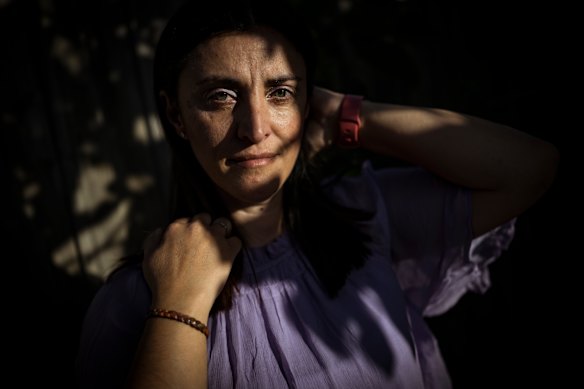
“There is this whole psychological element of it,” the 44-year-old says.
“This process of analysing, overanalysing and worrying. It is almost like a tab that’s open on a computer. It’s running silently in the background all the time.”
When the anxiety feels paralysing, she closes her vivid green eyes and settles her mind by focusing on her gratitude for being alive, and her love for her two children, Jasmine and AJ, and her husband, Kirk.
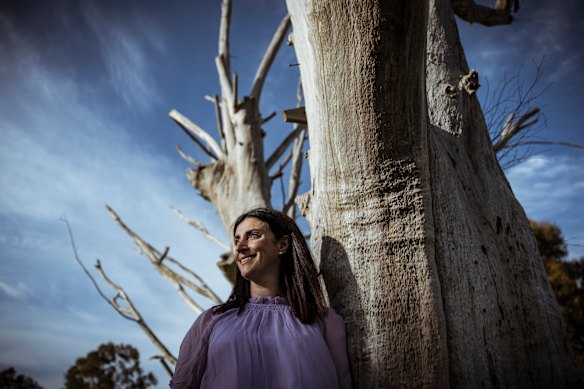
Briggs has stage 4 incurable metastatic lung cancer.
The disease was detected four months after she gave birth to her son in 2014.
By then, the cancer had spread, invading her liver, spleen and lymph nodes, and riddling her bones. The prognosis was devastating: a 3 per cent chance of surviving five years.
Yet, 12 years later, Briggs is still here. The whiteboard in the kitchen of her home in Doreen, in Melbourne’s north-east, is a testament to that. There, she scrawled the defiant words “I am not a statistic” in big, bold, black letters.
Briggs is one of a growing number of Australians living for years with incurable cancer. She is not imminently dying, nor is she ever likely to be rid of the disease.
“You’re holding on to hope and fear at the same time,” she says.
Not so long ago, a stage 4 cancer diagnosis was a death sentence, meaning the disease had metastasised and spread far from where it first formed, attacking distant parts of the body.
Now, revolutionary advancements in new targeted therapies alongside pioneering immunotherapy and novel drugs mean rising numbers of people are living with incurable cancer for longer.
For some, like Briggs, the disease has become a chronic illness of sorts, kept at bay by a brutal regimen of drugs.
She takes at least 10 tablets a day to stay alive and be well enough to care for her children. They are a mix of targeted cancer therapy drugs, cholesterol and heart medication, probiotic supplements, and pills to counter debilitating side effects such as reflux or sudden changes to her mood.
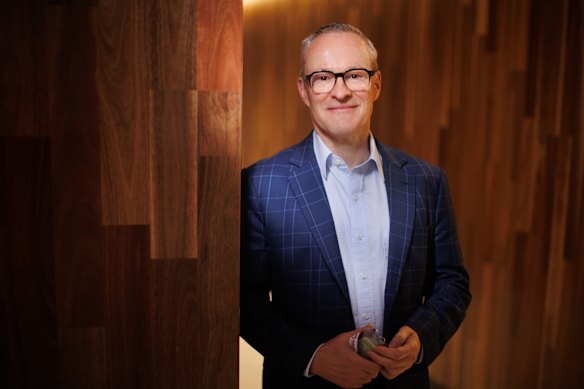
Professor Michael Jefford, director of the Australian Cancer Survivorship Centre at the Peter MacCallum Cancer Centre, describes the rise of long-term survivors as “a new paradigm”.
“Since the emergence of immunotherapy and targeted cancer therapies there’s been a much bigger number of people living longer term,” the oncologist says.
“But because they are relatively new treatments, we’re assuming some people may actually even be cured eventually. We just don’t know yet.”
More than 2.6 million Australians are forecast to be living with a cancer diagnosis by 2050 – an increase of almost 1 million people over the next 25 years.
About 44 per cent of those are expected to have a cancer that is not yet cured and will require ongoing treatment.
Researchers also predict that breakthroughs in immunotherapy, a treatment that boosts the body’s immune system to fight cancer, and targeted therapy, which targets specific features of cancer cells to stop the disease growing and spreading, will continue to propel survival rates higher than ever before.
Researchers also predict that breakthroughs in immunotherapy, which boosts the immune system to fight cancer, and precision oncology, such as targeted therapy that blocks malignant cell growth, will continue propelling survival rates to record highs.
While early detection and treatments have improved dramatically, it remains difficult to determine who will be a long-term cancer survivor.
Questions remain about why individual responses to these transformative treatments can vary so profoundly between patients, though the differences are thought to be driven by a complex mix of biological, genetic and lifestyle factors, and even the specific type of tumour.
“There’s an enormous amount of uncertainty people have about whether the treatment will work for them, and if it does, how long will it last?” Jefford says.
Sydney cancer researcher and oncologist Professor Bogda Koczwara says the distinct human experience of living indefinitely with advanced and incurable cancer is increasingly being recognised as its own unique form of cancer survivorship.
“When you are first diagnosed, people are happy to cheer you on for a short haul, but running out of stamina later is a real thing,” she says.
“People want to return to normal. But for survivors living with advanced cancer, the old normal never returns. There is a new normal, which is completely different.”
Koczwara says those living in the limbo of incurable cancer have been left floundering.
“These individuals have significant, unique needs, and so do their caregivers,” she says.
While people cured of cancer linger in dread of a relapse, Jefford says those surviving for years while enduring relentless treatment face a different kind of fear.
“For both groups of people it is marked by persisting physical issues, but overwhelmingly psychological concern,” he says.
“They might have ongoing consequences from their treatment. They might be worried about developing another cancer. They might feel that they’ve changed as a person.”
At the moment there are glaring gaps in cancer survivorship support for people like Briggs.
“The cancer system has been set up to do a good job of diagnosis and treatment, but it is almost like a conveyor belt of diagnose, treat, and then off you go,” Jefford says.
“We’re leaving people lost in transition. If you have a knee replacement or a heart attack, you automatically get rehabilitation afterwards. We don’t do that with cancer.”
‘Something’s wrong – I can’t breathe’
The breathlessness began during Lisa Briggs’ second pregnancy. Her chest felt tight, like she could never get enough air in.
Then she developed a wheeze and a severe fatigue she had never felt before. She estimates she went to the doctor 16 times in 10 months.
“I kept saying, ‘Something’s wrong – I can’t breathe,’” she says.
Her GP put her symptoms down to exhaustion and pregnancy-related asthma – a woman stretching herself too thin. She was working as an osteopath and exercise physiologist, running her own sports medicine clinic. She was pregnant and had a lively toddler at home. But months after her son was born, she still had a persistent, throbbing pain in her back.
One morning, as she was buckling her young daughter into a car seat, she coughed up blood into a tissue.
The days that followed are a blur. She is rushed to hospital in an ambulance. She is put in an isolation ward when doctors suspect she might have tuberculosis. Her world comes tumbling down as an oncologist tells her gently, but frankly, she has terminal lung cancer.
“He just said, ‘The cancer has spread, and there is no cure,’” Briggs recalls.
“I don’t remember a single word that came out of his mouth after that. I went into shock. Then the panic kicked in. I started to think about my kids and my family, and what was going to happen to them.”
She remembers Kirk sitting beside her in the hospital, holding her hand, reassuring her that they will get through it, promising her she will see her daughter start school.
For Briggs, the precariousness is always there. Her life is a cycle of waiting for the results of her scans every three months.
“What happens to a lot of people in my situation is things pop up, and it’s so unexpected,” she says.
“You can literally go into a scan feeling fantastic. Then you walk out being told you’ve got a tumour in your brain. That’s the reality we face.”
In Australia, five-year survival rates for advanced cancers including melanoma, lymphoma, prostate, breast, lung and some blood cancers, such as multiple myeloma, have all increased.
“To think that people with diseases associated with such a poor prognosis, like advanced melanoma or advanced lung cancer, may even be cured with medication is incredible,” Jefford, who has worked in oncology for almost 30 years, says.
“That didn’t exist when I started out as a doctor.”
Yet, despite the extraordinary strides to extend life, survival gains remain stubbornly uneven.
Immunotherapy, for example, works for only a small fraction of bowel cancer cases, Jefford says.
Survival rates for advanced types of cancer, including pancreatic, brain and ovarian, have also lagged behind as they are notoriously difficult to detect and often diagnosed in the very late stages when treatment options are limited.
“Ideally, what we want is to have highly effective treatments that are very well tolerated and that they work for the vast majority of people,” Jefford says.
But promising research is on the horizon.
Earlier this year, the US Food and Drug Administration fast-tracked approval of a new drug, daraxonrasib, for the most common form of pancreatic cancer after a clinical trial showed it can block a mutated protein that spurs tumour growth.
Patients who took the drug lived notably longer, for an average of 13.2 months, compared with 6.6 to 6.7 months for patients who had chemotherapy, the researchers found.
In a world-first trial this year, CAR T-cell therapy, a specialised immunotherapy in which a patient’s own immune cells are genetically modified in a lab to hunt down cancer, extended survival rates by about 40 per cent in people with advanced gastric or gastro-oesophageal junction cancer, when compared with standard care.
The results, published in medical journal The Lancet, sparked cautious optimism globally about the potential of immunotherapy on solid tumours.
“The boom of immunotherapy is kind of just taking off,” Koczwara says.
“We’re going to see some really exciting developments. The challenge remains that access to treatment is very inequitable. Not every treatment is affordable. The costs of these drugs are huge and getting higher by the minute.”
As doctors closely monitor the toxicity of cancer treatment on the body, Koczwara warns our systems of care remain poorly equipped to help people cope with the fallout of living with cancer for years.
“We know less about survivors living with advanced cancer than those who have completed treatment, and that’s a real gap in the research and the support,” she says.
Koczwara wants a shift in how society views advanced cancer, arguing there is much to learn from the management of chronic conditions such as diabetes and cardiovascular disease.
But Koczwara, who also leads the Australian Research Centre for Cancer Survivorship in NSW, says one of the most challenging realities of living with incurable cancer is that it is so unpredictable.
“We can say, ‘You’re likely to be alive longer,’” she says.
“This is a really good thing. And yet, what sits underneath all of that is for a lot of people they will eventually die of it. This uncertainty is incredibly difficult to live with.”
People are left agonising over life choices. Should they have the child they yearn for? Is it safe to travel overseas? Should they keep contributing to their superannuation? There are difficulties in maintaining employment and finances.
Invisibility can be a hallmark of metastatic cancer too.
“People might look terrific, but they don’t necessarily feel that terrific,” Koczwara says.
“It is so hard for people to comprehend what they are going through behind closed doors and the energy it can take to do things.”
Briggs says: “This is the space where I live each day. It’s where life persists, but the systems around us are still figuring it out.”
Living for the ordinary moments
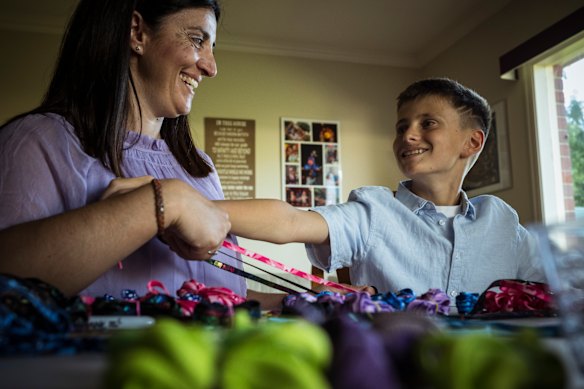
Some days, Briggs is well enough to clean the house, do the washing, complete the shopping and pick up her children from school. On rarer days, she can be bedridden. Her body has weathered a gruelling clinical trial and years of endless treatment. Some medications have rendered her violently ill or sent her pulse racing so rapidly she thought she was having a heart attack.
Briggs grapples daily with her children having to grow up faster than they should. There is a quiet tenderness between her and her husband, both wanting to carry the weight of it all for each other.
“There’s been times when I’ve purposely tried to mask or hide how I’m feeling because I’m trying to protect him,” Briggs says.
“He does the same for me. But he does it way better.”
More than a decade ago, too ill to rise from the couch while her infant son lay nearby, Briggs vividly remembers asking her daughter Jasmine, now 15, to always take care of her little brother.
“I remember her little face, and I’m going to cry as I say this, but I just said to her, ‘I need you to be a mum to AJ because Mummy’s really sick,’” Briggs says, her eyes filling with tears.
“She’s so nurturing. She is just the most beautiful kid. I said, ‘Promise me you’ll take care of him forever.’ She said, ‘OK, Mummy’, and she did.”
There is a piercing clarity that comes with confronting your own mortality. Your world shrinks. Briggs savours picking her children up from school and hearing about their day on the car ride home. She finds solace in nature. The walls of her home are full of photographs of precious family holidays to Disney World. This year, she was well enough to travel to Italy to surprise her parents.
“Nobody can tell you what’s going to happen between today and tomorrow, let alone in 12 months’ time,” she says.
“But these are the moments I live for.”
Every summer, they pack their car and caravan and drive to the coastal town of Mallacoota in East Gippsland.
Briggs rises while it is still dark and sits outside to bask in the sunrise.
It was in this caravan years ago where AJ, arms outstretched, called his mum for the first time from his bed.
“I could hear him calling ‘Mama’, and I just sat, and I listened to that because it was not a moment I ever thought I’d live to see,” she says.
“Kirk said, ‘Aren’t you going to go pick him up?’ I said, ‘I just want to listen for a moment.’ I let him call my name over and over again because it was the most beautiful thing I had ever heard.”
Disclaimer : This story is auto aggregated by a computer programme and has not been created or edited by DOWNTHENEWS. Publisher: www.smh.com.au