India’s most extraordinary landscapes do not always announce themselves with grand monuments or marked tourist trails. Some are hidden beneath tropical forests, others rise out of the sea, and a few preserve evidence of geological events that unfolded millions of years ago.
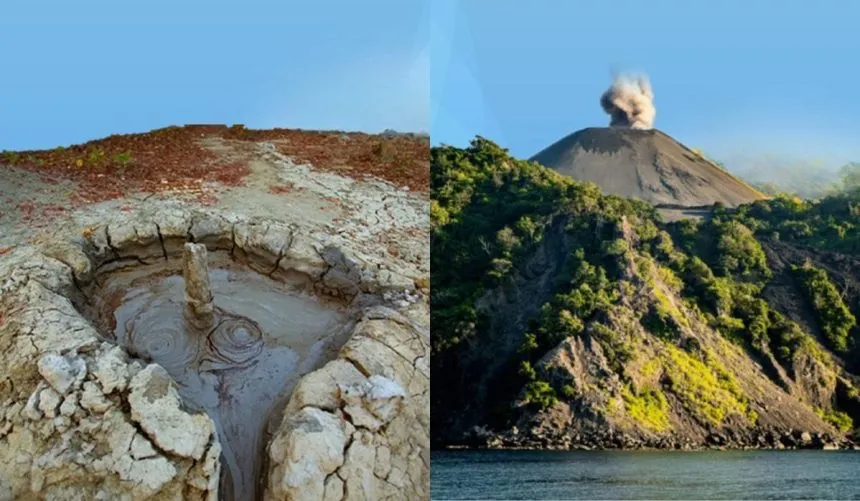
Now, several of these remarkable places are attracting international attention. India’s UNESCO Tentative List has expanded in 2026, with two particularly fascinating natural heritage additions in the Andaman and Nicobar Islands: the Karst-Mud-Volcano Complex of Baratang and the Andaman Subduction Volcanoes, comprising Barren and Narcondam islands.
These additions build on seven natural heritage properties submitted in August 2025, taking the story beyond a handful of destinations to a remarkable cross-section of India’s geological history.
But what makes these places special, where can travellers experience them, and what should visitors know before setting out? More importantly, how can we explore them without damaging the very landscapes that make them extraordinary?
A landscape shaped by two kinds of volcanoes
The first of the two new natural properties is the Karst-Mud-Volcano Complex of Baratang, on Great Andaman Island, about 100 km north of Sri Vijaya Puram (Port Blair).
Picture a forested island where the ground opens into limestone caves, narrow fissures, and underground chambers. Over millions of years, marine organisms, including shells and corals, accumulated and compacted to form the limestone. Rainwater gradually dissolved parts of this rock, creating the intricate cave systems found here.
But the island has another geological surprise. Its mud volcanoes, locally called Jalki, release slurries of mud, water, and gases rather than molten rock. Unlike conventional volcanoes, these formations do not erupt magma. They are driven by pressure and movement within underground sediment layers.
After remaining dormant for around 20 years, Baratang’s mud volcanoes became active again in 2025. The Geological Survey of India identified the mud volcano as a Geo-Heritage Site that year. The caves also support specialised subterranean ecosystems, making their conservation important beyond their geological appeal.
The second property, Andaman Subduction Volcanoes, brings together Barren Island and Narcondam Island. Both emerged from the tectonic processes associated with the Indian Plate moving beneath the Burma microplate.
Barren Island, approximately 138 km northeast of Sri Vijaya Puram, is South Asia’s only active volcano. Its first recorded eruption dates to 1787. More recently, it recorded mild eruptions in September 2025, followed by an ash plume rising approximately 1.2 km in January 2026.

Narcondam, meanwhile, presents a different picture. Its densely forested volcanic landscape rises 710 metres above sea level and supports species found nowhere else, including the Narcondam hornbill. Unlike Barren Island, which is known for its surrounding marine environment, Narcondam is not open to tourism. Access is restricted, and visitors should not attempt independent trips or landings.
These islands are important precisely because their ecosystems remain relatively undisturbed. A UNESCO listing should not be mistaken for an invitation to explore every part of them.
Seven more landscapes that tell India’s geological story
The two Andaman additions join seven natural properties submitted to UNESCO in August 2025. Together, they reveal just how varied India’s geological heritage is.
In Maharashtra, the Deccan Traps at Panchgani and Mahabaleshwar preserve evidence of enormous volcanic eruptions around 66 million years ago. Their successive lava flows created the distinctive stepped rock formations of the region. Visitors should stick to established viewpoints and avoid disturbing exposed geological formations.

Off Karnataka’s Malpe coast, the St Mary’s Island Cluster is famous for its unusual columnar basalt formations. These polygonal rock structures developed as molten lava cooled and contracted approximately 85 million years ago. The islands are accessible by ferry, subject to seasonal conditions. Resist the temptation to collect rock fragments or climb fragile formations.
Meghalaya’s Meghalayan Age Caves include Mawmluh, Mawsmai, Arwah and Krem Puri. Mawmluh Cave is particularly significant because a mineral deposit found there helped establish the Meghalayan Age, the youngest stage of the Holocene geological epoch. Cave formations take thousands of years to develop, so visitors should never touch, scratch or break them. Explore with authorised guides.
Nagaland’s Naga Hill Ophiolite in Kiphire district offers a glimpse into the Earth’s ancient oceanic crust and upper mantle. Ophiolites are fragments of ocean floor pushed onto land through tectonic activity. The landscape also has ecological significance, making local guidance and respect for wildlife essential.
In Andhra Pradesh, Erra Matti Dibbalu, or the Red Sand Hills, near Visakhapatnam, displays striking red and brown sedimentary formations. Wind and water erosion have shaped these hills over time, preserving evidence of changing environmental and climatic conditions. Visitors should avoid walking over unstable formations or leaving waste behind.
Further south, the Natural Heritage of Tirumala Hills includes the Eparchaean Unconformity and the Silathoranam natural rock arch. The latter is particularly fascinating: its formation represents an exceptionally old geological history, with the rocks in the region recording more than a billion years of Earth’s past. The surrounding hills also carry religious significance, so visitors must respect temple and forest regulations.

Finally, Kerala’s Varkala Cliffs expose layers of the Warkalli Formation, dating to the Mio-Pliocene period. Their striking sedimentary bands overlook the Arabian Sea, while natural springs add to their geological importance. However, the cliffs face pressure from increasing tourism and construction. Visitors should keep away from unstable edges and follow safety instructions.
The responsibility that comes with discovery
A place becoming popular can bring income to nearby communities, but it can also put pressure on fragile ecosystems. The challenge is to ensure that tourism does not destroy what makes these destinations worth visiting.
Before travelling, check local entry permissions, seasonal restrictions, and forest department guidelines. Some locations, particularly caves and protected islands, have restricted access. Never assume that a place being on UNESCO’s Tentative List means it is open to unrestricted tourism.

Choose local guides and community-run stays wherever possible. Carry reusable water bottles, avoid single-use plastics, and take all waste back with you. Do not collect rocks, fossils, shells or other natural material. At coastal destinations, avoid disturbing marine habitats, and at forest sites, keep noise levels low and maintain a safe distance from wildlife.
There are already examples of tourism supporting conservation across India. In Nagaland’s Khonoma village, community-led tourism allows visitors to experience local culture while supporting conservation efforts. Similarly, community-led travel companies are creating opportunities for travellers to contribute directly to local livelihoods.
Travellers can also take inspiration from five Indian journeys that support wildlife and nature conservation and learn from sustainable travel practices that minimise waste and respect local ecosystems.
India’s geological heritage is not simply a collection of spectacular views. These landscapes preserve evidence of volcanic eruptions, shifting tectonic plates, ancient oceans and evolving ecosystems. Their importance extends far beyond their potential as tourist destinations.
Being included on UNESCO’s Tentative List is an important step towards international recognition, but it is not the finish line. The real achievement will be ensuring that these places remain intact for generations to come.
After all, the best way to experience a natural wonder is to leave it just as wonderful for the next person.
Sources
‘Seven Natural Heritage Sites from India Added to UNESCO’s Tentative List of World Heritage‘: by Ministry of Culture for Press Information Bureau, Published on 18 September 2025.
‘Sustainable Tourism: Travel with Purpose‘: by Meghalaya Tourism, official tourism website, undated
Disclaimer : This story is auto aggregated by a computer programme and has not been created or edited by DOWNTHENEWS. Publisher: thebetterindia.com