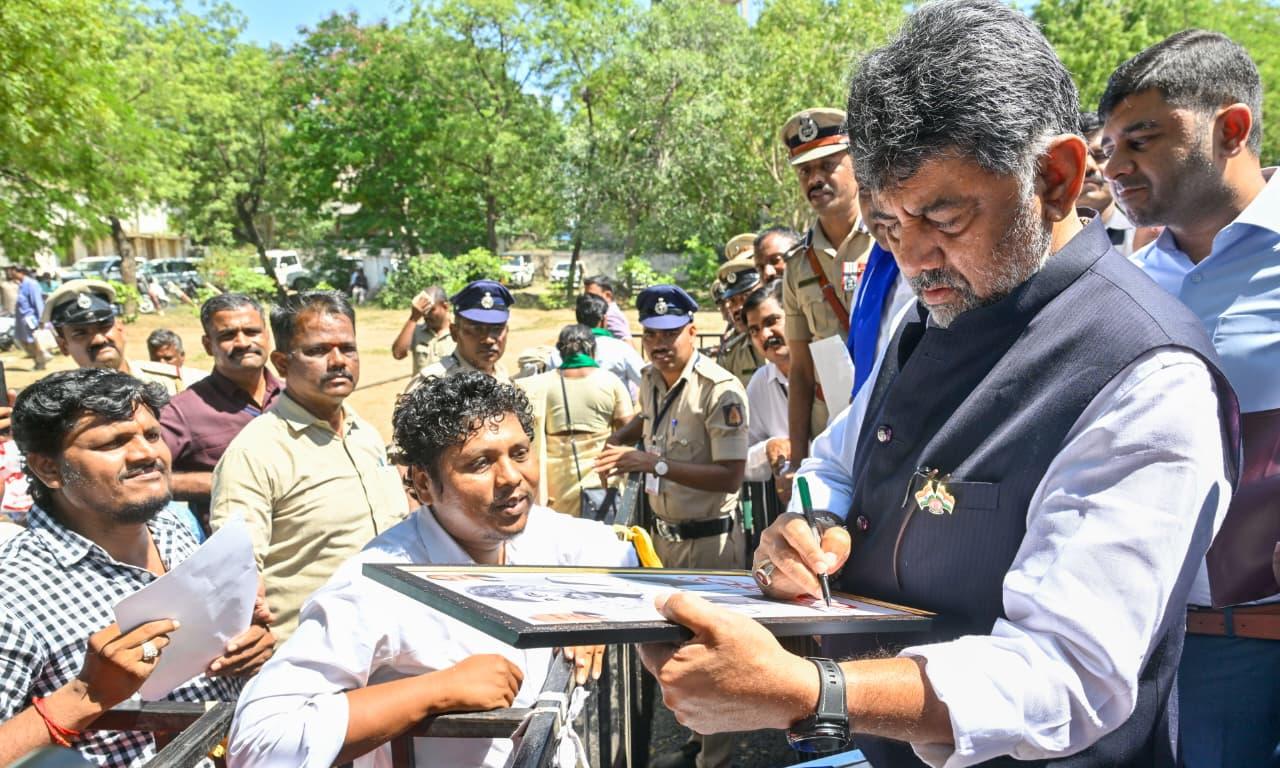
Bengaluru: In a major housing initiative aimed at providing residential security to homeless and landless families, the Karnataka Cabinet has approved a plan to distribute 15 lakh free residential sites across the state and construct one lakh new houses at an estimated cost of Rs 2,241 crore.
The decisions were taken at the 26th meeting of the State Cabinet, chaired by Chief Minister DK Shivakumar on November 19, 2026.
The initiatives are part of the government’s efforts to ensure that economically weaker families, including former defence personnel and vulnerable sections, have access to land and housing.
Under the proposed ‘Bhooguarantee’ initiative, the government plans to provide 15 lakh free residential sites to eligible landless families. The first phase will cover five lakh sites, with an estimated development expenditure of Rs 1,000 crore.
Alongside this, the Cabinet has approved the construction of one lakh new houses under various state housing schemes during 2026-27, with financial assistance to beneficiaries substantially increased to account for rising construction costs.
The government estimates that nearly 14.4 lakh people in Karnataka may be without residential sites, based on the state’s estimated population of 7.2 crore. To address this requirement, it has set a target of developing 15 lakh sites across rural and urban areas.
Of the proposed sites, nine lakh are planned in rural areas, requiring approximately 45,000 acres. In urban areas, five lakh beneficiaries are proposed to be accommodated through a G+3 housing model on around 5,000 acres.
District administrations have been directed to identify and reserve suitable government land under Section 71 of the Karnataka Land Revenue Act, 1964.
The government has already identified approximately 23,500 acres of government land across all 31 districts, which is estimated to be sufficient for developing around 4.70 lakh residential sites.
In the first phase, five lakh sites will be developed across approximately 25,000 acres at an estimated cost of Rs 20,000 per site, taking the total expenditure to Rs 1,000 crore.
Around Rs 400 crore, or 40 per cent of the expenditure, is proposed to be mobilised through convergence of funds from various sources, including VB-G-RAM-G, Scheduled Caste Sub-Plan (SCP), Tribal Sub-Plan (TSP), District Mineral Foundation (DMF), Kalyana Karnataka Regional Development Board (KKRDB), Malnad Development Board and the local area development funds of MPs and MLAs.
The remaining amount is proposed to be mobilised through available government funding sources. The Finance Department has advised the Housing Department to explore different funding avenues during the current financial year and suggested that ₹200 crore could be provided in the 2027-28 Budget.
The proposed Niveshana Yojane (Residential Site Scheme), under the Sainik Samman Yojane, will provide free residential sites to eligible landless families, including former defence personnel.
A three per cent reservation has been proposed for ex-servicemen. Priority will also be given to senior citizens, widows, widowers, divorced persons, single mothers, persons with disabilities and transgender persons.
The proposed category-wise reservation includes 19.5 per cent for Scheduled Castes and 7.5 per cent for Scheduled Tribes. The Rajiv Gandhi Housing Corporation Limited (RGHCL) has also referred to a reservation pattern of 17.15 per cent for SCs and 6.95 per cent for STs.
Horizontal reservations proposed under the scheme include three per cent for ex-servicemen, two per cent for senior citizens, three per cent for widows, widowers and divorced persons, five per cent for persons with disabilities and one per cent for transgender persons.
The Chief Minister has also directed the department to take steps to provide reservation for Backwards Classes.
Under the proposed scheme, only one residential site will be provided to each eligible family holding a Priority Household (PHH) or Antyodaya Anna Yojana (AAY) ration card.
The annual family income should not exceed Rs 1.20 lakh in rural areas and Rs 2 lakh in urban areas.
Where both husband and wife are alive, they must submit a joint application, and the ownership document will be issued in their joint names.
Widows, widowers, divorced persons, single mothers, persons with disabilities and transgender applicants will be permitted to apply individually under the priority category.
Fresh online applications will be invited through Nadakacheri, Bapuji Seva Kendras, Grama One and Karnataka One centres. Aadhaar-based e-KYC will be used to verify applicants and prevent duplication.
Around 5.8 lakh rural applications have been pending with RGHCL since 2018. The government has decided to undertake fresh verification as some applicants may have died or may no longer meet the eligibility conditions.
However, eligible applicants already included in the existing list will not be excluded merely because they do not submit a fresh application. Their eligibility will be verified through field inspections.
The Bhoomi Monitoring Cell software will cross-check applicant details against databases, including Kutumba, Ashraya, e-Swathu, e-Aasthi, Section 94-D records, Jal Jeevan Mission and Gruha Jyothi, to identify duplicate applications and families that have already received housing benefits.
The government has also proposed measures to ensure that beneficiaries receive proper ownership documents without additional financial burden.
Residential layouts will be developed with basic infrastructure, including roads and drainage facilities. Boundary stones will be installed at all four corners of each site, while Village Administrative Officers will use a mobile application to capture geo-tagged photographs.
Digital ownership documents will be issued by the respective Tahsildars under Section 94-D of the Karnataka Land Revenue Act, 1964.
In a significant relief to beneficiaries, the government has decided to waive stamp duty and registration charges for registrations through the Kaveri 2.0 system.
Following registration, the e-Swathu software will automatically generate and update Form-9 and Form-11A records, facilitating the issuance of property documents to beneficiaries without additional charges.
Separately, the Cabinet has approved the construction of one lakh new houses during 2026-27 under various state housing schemes, including Basava Vasati Yojane, B R Ambedkar Nivas Yojane, Devaraj Urs Housing Scheme and Vajpayee Urban Housing Scheme.
The houses will be constructed under the Beneficiary-Led Construction (BLC) model, under which beneficiaries build houses on their eligible land with financial assistance from the government.
The total estimated expenditure is Rs 2,241 crore, as envisaged in Paragraph 237 of the 2026-27 Budget speech.
Taking into account the increase in construction material costs, the government has decided to enhance financial assistance from Rs 1.20 lakh to Rs 2 lakh for general category beneficiaries and from Rs 2 lakh to Rs 3 lakh for Scheduled Caste and Scheduled Tribe beneficiaries.
This represents an additional assistance of Rs 80,000 for general category beneficiaries and Rs 1 lakh for SC/ST beneficiaries.
The enhanced assistance will apply only to the one lakh newly approved houses and will not automatically extend to houses sanctioned under earlier schemes.
Of the one lakh houses, 68,000 units will be allocated to rural areas and 32,000 to urban areas, in proportion to the housing demand identified through surveys.
According to the 2018 rural survey and 2016 urban demand survey, Karnataka has approximately 14.89 lakh homeless families, including 13.42 lakh in rural areas and 1.47 lakh in urban areas.
The surveys have also identified around 13.36 lakh families without residential sites, comprising 5.81 lakh in rural areas and 7.54 lakh in urban areas.
Together, the estimated number of beneficiaries without either a house or a residential site stands at approximately 28.25 lakh.The allocation targets will be distributed among Gram Panchayats and Urban Local Bodies within their respective Assembly constituencies.
Of the one lakh houses, 17,150 will be allotted to Scheduled Caste beneficiaries at an estimated cost of Rs 514.50 crore, while 6,950 houses will be earmarked for Scheduled Tribe beneficiaries at Rs 208.50 crore.
Another 15,000 houses will be allocated to minority communities at an estimated cost of Rs 300 crore. The remaining 60,900 houses will be allotted to the general category, involving an expenditure of Rs 1,218 crore.
The combined allocation for SC and ST beneficiaries will be 24,100 houses, accounting for 24.10 per cent of the total target.
The Finance Department has agreed to the proposal subject to certain financial conditions.
The expenditure during 2026-27 will be met from the existing allocation of Rs 987.50 crore. The remaining Rs 1,253.50 crore will have to be adjusted in phases through the Housing Department’s overall budget allocations in subsequent years.
The department has also been asked to review previously sanctioned houses where construction has not commenced. Such sanctions may be cancelled wherever necessary, with the resulting savings utilised to meet the expenditure on the new housing target.
The enhanced assistance rates will remain restricted to the one lakh newly approved houses.
The two Cabinet decisions seek to address different dimensions of the housing challenge in Karnataka. While the Bhooguarantee initiative aims to provide land to families without residential sites, the one lakh new houses programme seeks to assist families who already have eligible land but lack the financial resources to construct a home.
With online applications, Aadhaar-based verification, digital ownership documents and exemption from stamp duty and registration charges, the government has also proposed measures to streamline implementation and improve transparency.
The immediate focus will be on mobilising funds, developing identified government land, completing beneficiary verification and ensuring that eligible families receive residential sites and housing assistance.
Disclaimer : This story is auto aggregated by a computer programme and has not been created or edited by DOWNTHENEWS. Publisher: deccanchronicle.com