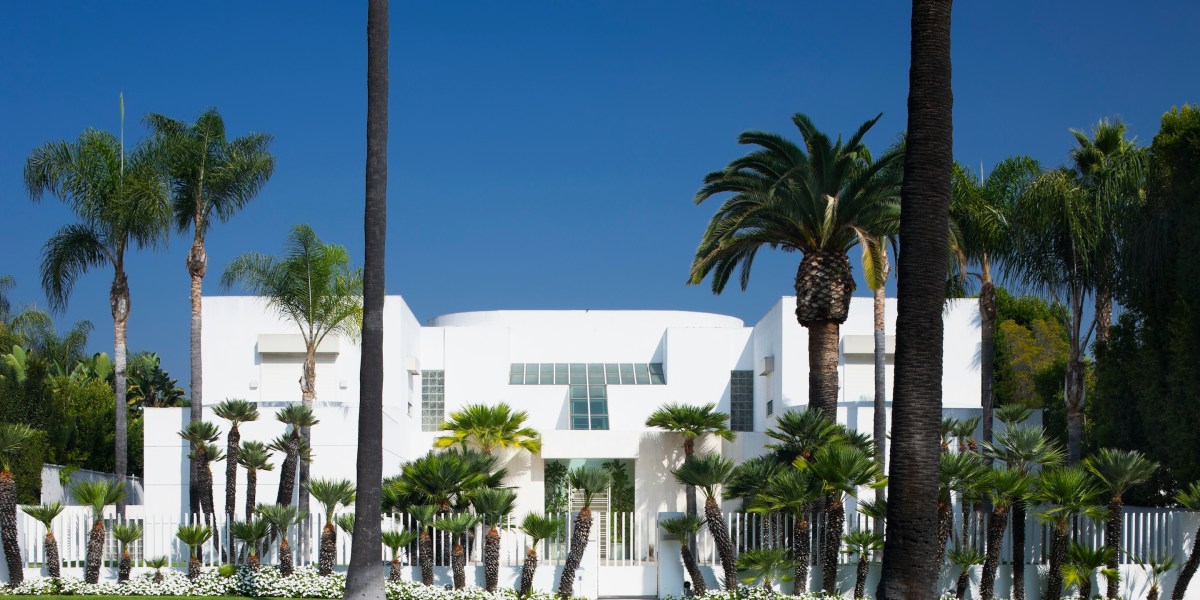
California’s rich are rebuilding Los Angeles into a mecca of palatial opulence, and the very richest are pushing everyone else out of the way, including ordinary millionaires.
While the broader housing market is losing buyers as mortgage rates climb toward 7%, L.A.’s wealthiest residents are still throwing down for their dream estates. Not even the prospect of a billionaire tax slowed them. A handful of billionaires left the state ahead of the vote, but California voters rejected Proposition 40, a proposed one-time 5% tax on billionaires’ net worth, on Nov. 3.
With open lots hard to come by, the ultra-wealthy have found their own solution: buy an existing (and already expensive) home, tear it down, and build a far bigger one in its place. The result is a widening split at the top of the market, where billionaires are outbidding the merely rich for a shrinking supply of trophy land.
“They’re shopping for privacy and acreage – and then also things like ocean views, security, and the ability to build exactly what they want,” says Daniel Amodeo, president of Amo Realty in Los Angeles. “A multimillion-dollar house might be purchased just to tear it down and build something substantially larger. When money isn’t an object, the value of the existing house can become secondary to the land underneath it.”
The money is concentrated in a handful of ZIP codes
California claims six of the 10 most expensive ZIP codes in the country, according to a Realtor.com ranking of January 2026 listings. Newport Coast tops the list with a median list price of $12.5 million, followed by Beverly Hills at No. 3 with $10.5 million. Bel-Air comes in at $7.9 million, and Montecito, where Oprah Winfrey and Prince Harry live, at $6.5 million. Rancho Santa Fe and Newport Beach round out the state’s share of the top 10.
The same pressure shows up across the state’s biggest metros. In a 2025 analysis, Zillow ranked San Jose, Los Angeles and San Francisco as the three most expensive U.S. metros for luxury homes.
“We’re seeing a growing divide at the very top of California’s luxury real estate market,” says Mauricio Umansky, CEO and founder of The Agency. “Billionaire buyers are willing to pay a premium for privacy, prime locations and larger estates, particularly in areas like Beverly Hills, Bel Air and Malibu. That’s driving up prices and creating more competition for a limited number of properties.”
It’s not all old wealth, either. Much of it is new tech money. Former Google CEO Eric Schmidt and his wife, Wendy, paid $110 million for the Spelling Manor in Holmby Hills in 2025. Coinbase CEO Brian Armstrong is the proud owner of a $133 million Bel-Air estate he bought in late 2021. And Amazon’s Jeff Bezos snapped up the historic Warner Estate in Beverly Hills for $165 million in 2020.
“The world’s wealthiest buyers are increasingly looking beyond traditional measures of size and finishes and placing a premium on scarcity, exclusivity and the ability to create a truly individual living experience,” says Kristina Quesada, co-founder of the Yost Quesada Team at Douglas Elliman in Del Mar.
For some billionaires, one home isn’t enough. WhatsApp cofounder Brian Acton spent $86.3 million on seven houses in Palo Alto, while cofounder Jan Koum spent $57 million across five deals to assemble a compound in Atherton. Meta’s Mark Zuckerberg spent more than $110 million on at least 11 houses in Palo Alto’s Crescent Park neighborhood.
Wildfires turned burned lots into a land market
The January 2025 fires, which helped make last year the costliest wildfire year on record, opened up a new supply of land. Investors bought roughly 40% of the vacant lots that sold in Pacific Palisades, Altadena and Malibu in the third quarter of 2025, according to Redfin.
New Zealand billionaires Mat and Nick Mowbray, founders of toymaker Zuru, bought 16 burned beachfront lots in Malibu and plan to fill them with prefab homes made in their company’s factory, a plan that has unsettled longtime residents. Powerball winner Edwin Castro took a different approach, spending about $10 million on 15 Eaton Fire lots in his hometown of Altadena to rebuild homes and sell them to families who want to live there.
The Los Angeles Times calls the broader trend gentrification by billionaire, but it goes by other names, too, depending on whom you ask. Developers call it spec redevelopment. Opponents call it mansionization.
“At the highest end, buyers aren’t simply looking for a bigger house,” says Quesada. “They’re looking for something they cannot easily replicate elsewhere, whether that’s an extraordinary parcel of land, a protected ocean view or the ability to create a completely customized residence.”
Neighbors and regulators are pushing back
Not everyone is thrilled with this wave of hyper-development. Neighbors complain about encroaching mansions that block their views, environmentalists warn of ecological damage, and preservationists fight the sale and demolition of historic properties.
Sometimes the fight goes to court. Milwaukee Brewers owner Mark Attanasio was accused in 2024 of taking sand from Malibu’s public Broad Beach to shore up his roughly $30 million beachfront property. This fall, his company agreed with the California Coastal Commission to restore the shoreline and dedicate a $2 million beachfront lot to the public.
Homeowner groups are using zoning, too. In Beverly Grove, residents spent the better part of a decade fighting teardowns before winning a 2013 city ordinance that caps home size in the neighborhood. Other neighborhood associations have pursued historic preservation overlay zones to slow demolitions.
“Even buyers with $10 million or $20 million to spend are finding that their money doesn’t go as far as it once did in these markets,” says Umansky.
A state of extremes
The building boom comes as high earners, not a supply shortage, are driving up home prices, according to researchers, and most Californians are struggling to keep up. In 2024, nearly one in five California adults, about 5.9 million people, worried very or somewhat often about paying their rent or mortgage, according to UCLA’s California Health Interview Survey.
The state also counted 181,934 people experiencing homelessness on a given night, even as some of its metros rank among the nation’s wealthiest. The San Francisco metro’s median household earned $135,590 in 2024, and the San Jose metro’s median household earned $162,111, compared with $81,604 nationally.
“What’s happening in California luxury real estate is interesting because we’re seeing a growing divide between wealthy buyers and the mega ultrawealthy,” says Amodeo. “Someone with a net worth of $10 million…is considered extremely wealthy pretty much everywhere in the country, but [in] California, it’s another ballgame; they’re competing against billionaires who can spend $30 million, $50 million, or even $100 million on a property without thinking twice about it.”
As long as there’s land to be had, billionaires will keep building the homes of their dreams, even if it means pushing out existing millionaires. They’re the new kids on the block, with the pockets to outlast taxes, loans and disgruntled neighbors.
“While demand remains strong, there’s no question that the bar for entry in California’s most exclusive neighborhoods continues to rise,” says Umansky.
Disclaimer : This story is auto aggregated by a computer programme and has not been created or edited by DOWNTHENEWS. Publisher: fortune.com