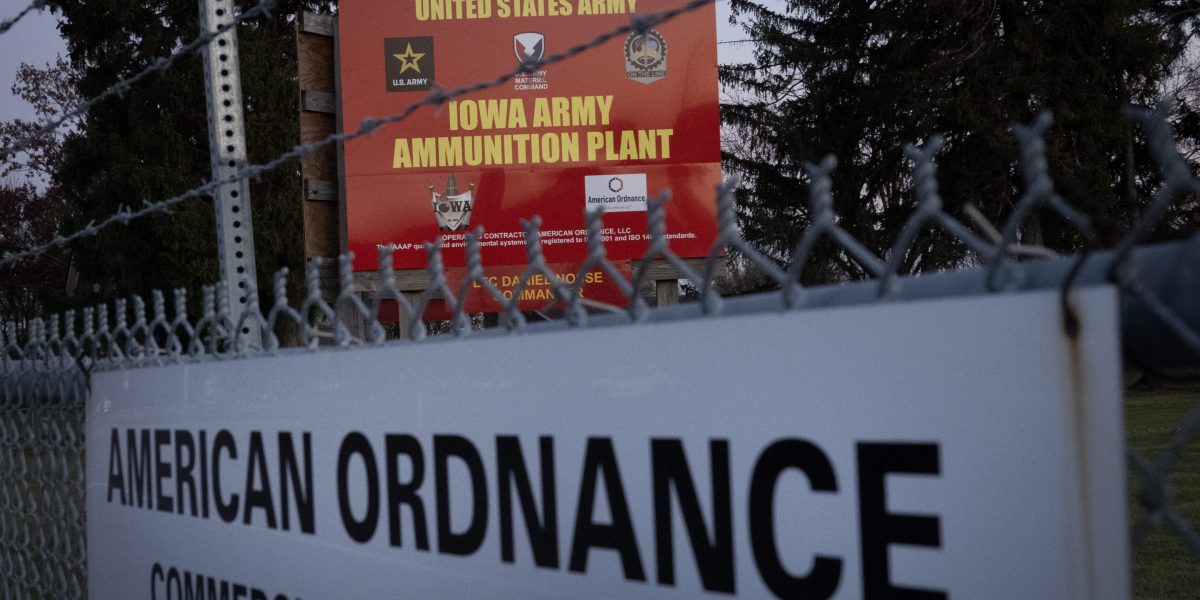
A federal appeals court has paused the emergency permit authorizing the U.S. Army to blow up nearly five tons of degraded lead azide at the Iowa Army Ammunition Plant in Middletown, Iowa. But the Justice Department told the court Friday that the Army may be able to proceed without it.
In a notice filed on behalf of the Environmental Protection Agency, government lawyers said they would oppose a motion by two environmental groups to keep the permit on hold. The notice added that “in qualifying emergency situations,” EPA regulations authorize the Army, which is not a party to the case, “to implement waste treatment activity without an EPA permit” when there is “an immediate threat to human health, public safety, property, or the environment.”
The notice did not say whether the Army plans to go ahead with the detonation, now set for Monday, Nov. 23. An Army Sustainment Command spokesperson did not respond Friday when asked whether the Army would proceed while the stay is in place, the Iowa Capital Dispatch reported. On Friday evening, Iowa Gov. Kim Reynolds activated the State Emergency Operations Center to coordinate state, federal, and local agencies ahead of the planned blast.
Thien Chau, a senior attorney at Earthjustice, which represents the groups, called the emergency provision “an extraordinary and extreme backstop” and said the groups “strongly urge” the Army not to rely on it.
The standoff leaves residents of southeastern Iowa and western Illinois facing a weekend of uncertainty over whether a plume of lead-laden dust will drift across their towns and farmland on Monday.
A one-sentence order
The U.S. Court of Appeals for the Eighth Circuit issued its order late Thursday, pausing the permit the EPA issued to the Army on Nov. 13 after finding the material posed an “imminent and substantial endangerment to human health and the environment.” The pause lasts until the court rules on the groups’ emergency motion, which asks it to keep the permit on hold while it decides the case. The government said it would file its full response by Sunday.
Cody Smith, director of climate initiatives at the Iowa Environmental Council, one of the groups that filed the lawsuit, said detonating without the court’s approval would be unlawful. The council and the Sierra Club Iowa Chapter argue that the permit lacks adequate protections for health and the environment, that the EPA did not fully consider alternatives, and that it was issued without the public notice and comment they say the rules require.
Hours before the court acted, the Army postponed the detonation from Friday to Monday. Acting Army Secretary Adam Telle said Monday was the “latest possible moment prior to a forecasted temperature drop, which would risk further destabilization of the material.”
The 68 drums of lead azide, an explosive used to set off munitions, were stored on site for more than 20 years in a bath of ethanol and water. The Army says the material degraded and recrystallized, leaving it highly sensitive to friction and shock.
Who knew, and when
The blast is expected to release a plume of dust containing lead. Army maps modeled for a Friday detonation projected the dust settling across a roughly 25-mile stretch north of the plant, with low levels of airborne lead traveling farther. The Army asked some residents of Middletown, a town of about 360, to leave their homes during the blast because it could shatter windows.
The permit required the Army to model the plume using conservative assumptions so as not to “under-predict” potential impacts, and it states that EPA and Army experts agree the modeling is “not necessarily representative of actual conditions.”
The Army held a public open house about the planned detonation in mid-October. On Nov. 15, five days before the original blast date, it released the detonation date and plume maps, meeting the permit’s requirement to publish a preliminary forecast at least five days in advance.
Smith said the council began receiving calls from concerned residents on Monday, Nov. 16, and when it contacted state and local officials, “We were telling them for the first time.” Reynolds’ office has said neither the governor nor any state agency was told of the plans before the Army’s Nov. 15 announcement, Little Village reported.
“This lawsuit is largely the outcome of a last resort,” Smith said.
A letter from the EPA paints a different picture. Writing to Reynolds on Friday, Jim Macy, who heads the EPA’s Region 7 office, said the agency issued three emergency permits for the lead azide between April and September and notified Iowa’s congressional delegation, state lawmakers, and local officials each time, and again on Nov. 13 when it approved the detonation.
Illinois Gov. JB Pritzker, Illinois Sens. Dick Durbin and Tammy Duckworth, and Iowa Sen.-elect Josh Turek were among a bipartisan group of officials who wrote to Telle and EPA Administrator Lee Zeldin urging a delay. “We call on you to consider delaying this detonation until there is an opportunity to explore safer alternatives,” they wrote, according to CBS News.
Why the Army chose to blow it up
The Army’s environmental assessment considered chemical neutralization, which would avoid a blast plume, but rejected it. The assessment concluded that the 7 to 22 days of handling it would require created an unacceptable risk of a fatal accidental detonation, with no guarantee that neutralization would work.
Macy’s letter said the Army also weighed building a structure over the material, moving it to the plant’s open detonation unit, and leaving the drums in place, and found each posed “an unacceptable safety risk” because of “advanced crystallization.” The Army, he wrote, “concluded the only viable option was a controlled detonation in place with extensive mitigation measures.”
The environmental groups say the Army chose detonation “without full consideration of less dangerous alternatives that would avoid widespread dispersal and deposition of toxic lead.”
“It’s not our role to recommend to the Army or the EPA how to deal with explosives most effectively,” Smith said. “As far as we can tell, it’s been stored on site for at least 20 years, and they’ve known about this for at least the last several months. And they decided to wait until the very last minute to issue that permit and make it publicly known.”
In September 2025, the Army posted a federal contracting notice saying it planned to have American Ordnance LLC, which operates the plant, perform “lead azide neutralization.” The notice did not describe the method. The Army’s environmental assessment says the material’s degradation was discovered in March 2026. The Army has not responded to requests for clarification about the notice.
‘Hose that off’
Army spokesperson Justine Barati told Radio Iowa on Nov. 17 that residents worried about lead dust on their property had a simple remedy: “The good thing is, if people have concerns about it being on their property, all they have to do is hose that off, and it’s gone.” The station reported that fine lead particles could reach as far north as Maquoketa.
Smith said that advice, including the Army’s guidance to hose off playground equipment and wash cars, is inconsistent with how lead persists in the environment. The groups’ court filings called the idea that lead can be washed away “absurd, counterfactual, and extremely harmful misinformation to share with the public.” Iowa health officials say no safe level of lead exposure has been identified.
In his letter, Macy said EPA staff have been in Middletown since Nov. 16 testing drinking water and watersheds, and that the EPA and Army will provide filters to homeowners on public water systems if testing finds elevated lead.
“People have really been scrambling for information about what to do,” Smith said.
The court could rule before Monday. If it grants the groups’ motion, the permit stays on hold while the case proceeds. If it denies the motion, the pause ends and the Army is free to proceed under the permit. Whether the Army would invoke the emergency exception if the court rules against it remains an open question.
Disclaimer : This story is auto aggregated by a computer programme and has not been created or edited by DOWNTHENEWS. Publisher: fortune.com