TEHRAN – The Iraqi government has backed down from threats to deploy the army and forcibly remove Kataib Hezbollah members from a town near Baghdad.
The agreement reached between the two sides is essentially a phased redeployment arrangement by Kataib Hezbollah in the town of Jurf al-Nasr, rather than a complete withdrawal or disarmament.
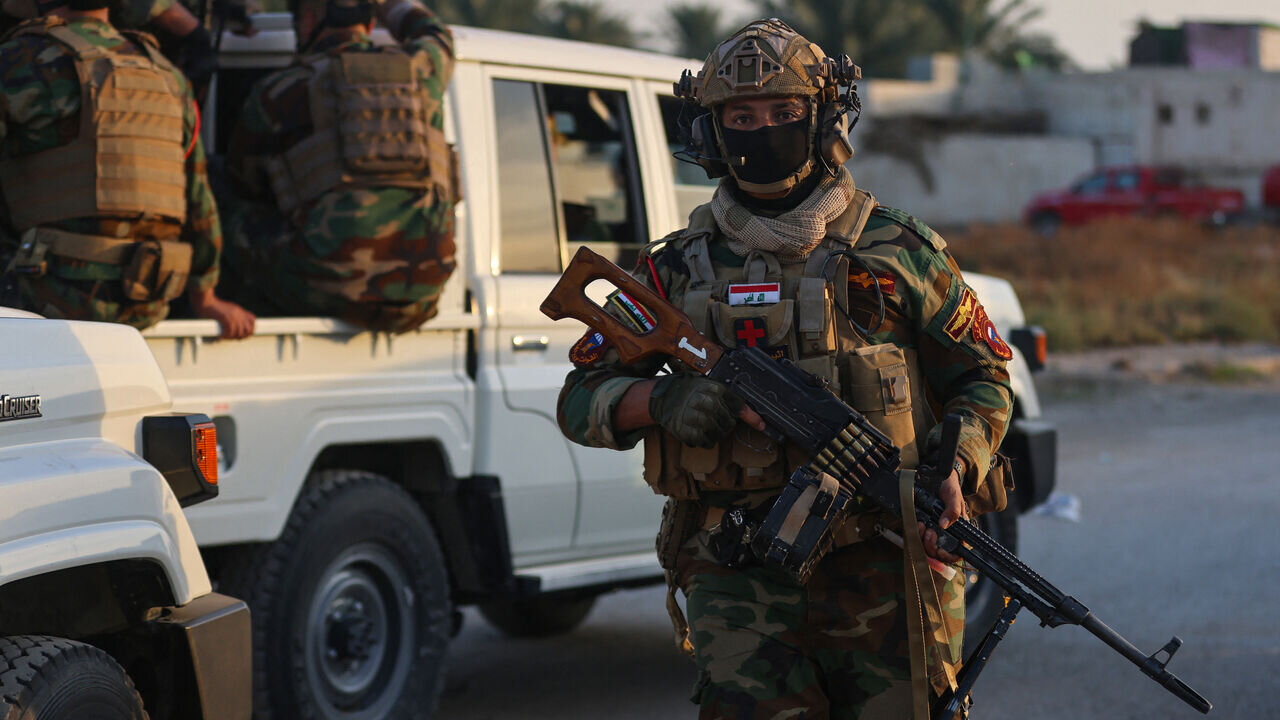
According to the arrangement, the deployed government forces include an Iraqi army unit, federal police, energy police, and two Popular Mobilization Brigades: the 72nd and 79th Brigades. The entrance of the forces was described as very smooth.
A new joint command headquarters has been established and is under the control of the federal police.
Iraqi Army Chief of Staff Abdul Amir Rashid Yarallah personally visited the area to oversee the redeployment of military units and the transfer of security responsibilities.
Saad Maan, head of the Security Media Cell, stated that a new command headquarters has been opened under the leadership of the Federal Police.
The agreement came after approximately two months of “in-depth negotiations”. The government had previously issued a Friday deadline for Kataib Hezbollah to leave, but under the agreement reached, the group is expected to complete its withdrawal within one month.
A Kataib Hezbollah source has been cited as saying that the group “allowed the government a way out of the predicament it created,” but insisted the resistance movement would not leave Jurf al-Nasr.
The movement’s military spokesman, Jaafar al-Husseini, stated that the issues with the government “will be resolved through private channels,” adopting a less aggressive tone.
The mediation was a multi-party effort rather than the work of a single envoy. Iraqi media cited security officials as saying the agreement was “brokered by senior Shia political leaders.”
Hadi al-Amiri, leader of the Badr Organization, and Falih al-Fayyadh, chairman of the Popular Mobilization Forces (PMF), both attended meetings with Kataib Hezbollah leader Hamidawi and were thanked by him for their mediation efforts.
Abdul Aziz al-Muhammadawi, PMF chief of staff, was also thanked by Hamidawi for his work to prevent bloodshed. Tribal elders and prominent figures from Baghdad and the Central Euphrates region held a tribal conference in Jurf al-Nasr, north of Babil Province, announcing their support for the security forces, the PMF, and the resistance factions.
From Kataib Hezbollah’s perspective, the core interest preserved by this agreement is avoiding military confrontation and retaining its weapons.
The government, in turn, can claim to have restored state authority and gained a foothold for investigating alleged oil smuggling. Prime Minister al-Zaidi stated to the deployed forces: “We are not waging war. Everyone there is your brother… the sons of this nation, their blood is our blood.” But he insisted that the decision to restrict weapons to state control is “final”.
An Iraqi analyst stated that the agreement provides for the “phased redeployment” of Kataib Hezbollah fighters from Jurf al-Nasr (also known as Jurf al-Sakhr), with some members moving to Anbar province near the Syrian border.
This process could take several weeks, and some fighters will remain. The analyst explicitly stated: “At present, there is no discussion or action regarding the disarmament of Kataib Hezbollah. This is a redeployment.” The analyst also noted that the area contains barracks, factories, and fuel storage facilities, constituting “a whole military-industrial complex,” so the handover is unlikely to be completed quickly.
The dispute between the Iraqi government and Kataib Hezbollah over Jurf al-Nasr erupted in November, with the core accusation being that the group was operating an oil smuggling network in the area.
A government investigation committee stated it found “clear tampering” with oil pipelines passing through the area, along with attempts to bury and conceal traces, and identified two refineries, tankers and storage tanks.
Al-Zaidi spokesman had previously declared that “there is a deadline for the armed faction to leave Jurf al-Nasr,” claiming that this was an exercise of the state’s constitutional responsibility to protect public funds.
Kataib Hezbollah categorically rejected these accusations, calling the investigation a “lie” and accusing the Prime Minister’s office of “blackmail”.
The resistance movement stated that the investigative committee’s visit to the area on November 15 “found no violations whatsoever of the oil pipelines.”
It explained that the facilities shown in footage published by the government were not oil-smuggling sites, but fuel storage tanks and a fuel-treatment facility used to improve fuel quality. These facilities, it said, supplied military vehicles, generators, and equipment with fuel.
More fundamentally, Kataib Hezbollah slammed the accusations as political blackmail: “Since they were unable in practice to twist our arm with the slogan of surrendering weapons, they resorted to weakening us with the slogan of, God forbid, smuggling oil”.
Commander Abu Talib al-Saeedi explicitly held U.S. Special Envoy for Iraq and Syria Tom Barrack responsible for the “escalation,” accusing Prime Minister al-Zaidi of yielding to pressure from the United States, Saudi Arabia, and the UAE.
Kataib Hezbollah also emphasized that “understandings were reached at the end of September” regarding its weapons, but the government refused to make the agreement public.
The significance of Jurf al-Nasr to Kataib Hezbollah is, first and foremost, military and geographic. The area is located approximately 50 to 60 kilometers southwest of Baghdad, sitting on the route connecting the capital to the holy cities of Karbala and Najaf.
In the summer of 2014, Daesh captured Jurf al-Sakhr and used it as a launchpad for attacks on other parts of Iraq.
The most urgent security concern at the time was that Daesh could advance on the holy cities of Karbala and Najaf, where millions of Shia pilgrims were gathering for Ashura commemorations, and carry out attacks.
Iraqi security officials at the time stated that Jurf al-Sakhr “posed a major threat to Karbala” and that clearing the area was “a key priority before Ashura”.
The collapse of Iraqi security forces in the summer of 2014 was as swift as it was shocking.
On June 10, 2014, Daesh terrorists captured Mosul, Iraq’s second-largest city. The defending government army force was estimated at around 30,000 soldiers, yet they crumbled before an assault force of several thousand terrorists.
A report from the scene quoted an officer: “It’s a total collapse of the security forces”.
The terrorists then swept south down the main highway toward Baghdad and the Green Zone, the fortified enclave housing embassies and government offices. The fear in Baghdad was palpable, and government officials inside the Green Zone prepared for emergency evacuation as the terrorists advanced.
It was in this vacuum that Kataib Hezbollah and other Shia factions stepped up to save Iraq. As the regular army disintegrated, the factions mobilized, filling the gap left by the collapsing state forces.
Jurf al-Nasr had fallen to Daesh in June 2014 and was being used as a launchpad for attacks on the capital and the southern holy cities. For Kataib Hezbollah and its allies, retaking the area was an existential necessity to protect southern Iraq and Baghdad.
In late October 2014, Kataib Hezbollah participated in Operation Ashura, which recaptured Jurf al-Sakhr from Daesh. The group’s sacrifice is central to its justification for staying.
Commander Abu Talib al-Saeedi later declared that the dream of Kataib Hezbollah withdrawing from Jurf al-Sakhr “will never be realized, even over our dead bodies, our blood, our legacy, our wounded and our martyrs”.
The resistance movement maintains that it has never sought and does not want an Iraqi-on-Iraqi confrontation, arguing that such infighting would only serve U.S. interests in weakening Iraq.
From its perspective, the area was liberated, and Baghdad secured through its own sacrifices at a time when the state had failed, and its continued presence is a security guarantee against ongoing threats.
These include the brazen U.S. and Israeli violations of Iraqi airspace. Critics say the government lacks the capability or the willpower to confront these threats.
Kataib Hezbollah insists its weapons have targeted, and will continue to target, foreign threats alone, with history to prove it.
Infighting only serves U.S.-Zionist regime interests in weakening Iraq. Critics argue the U.S. has no moral or political authority to lecture Iraq about sovereignty while simultaneously using economic threats, diplomatic pressure and the prospect of military action to dictate how the government manages its own security institutions.
Disclaimer : This story is auto aggregated by a computer programme and has not been created or edited by DOWNTHENEWS. Publisher: tehrantimes.com