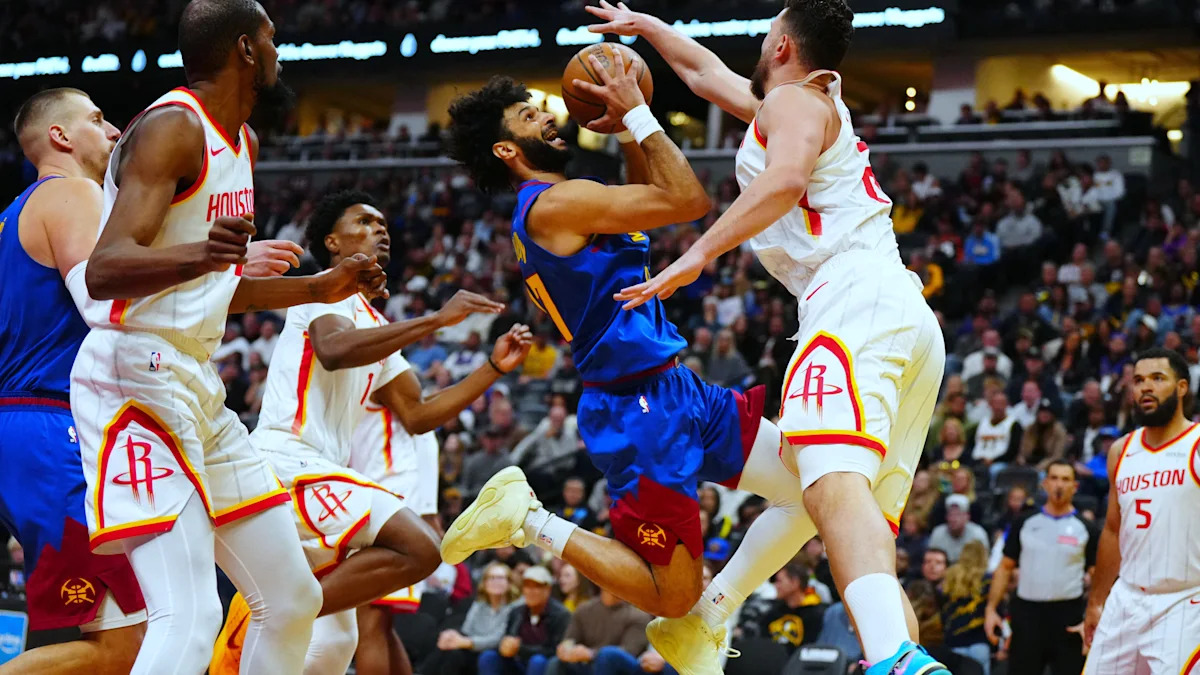
The Rockets were far from perfect in Friday’s 133-124 loss at Denver (box score), but it was a strong offensive showing that — on most nights — would be enough to win.
Sure, the Rockets made only 23-of-35 free throws (65.7%), just as Denver shot 26-of-28 (92.9%). Meanwhile, the Nuggets scored 23 points off 16 Houston turnovers, far better than the 13 points that Houston generated from 10 Denver turnovers. Statistically, it can certainly be argued that those categories were the difference in the game.
Advertisement
Then again, the Rockets shot 46-of-83 from the field (55.4%), and four different starters scored at least 21 points. Alperen Sengun was dynamic with a triple double (28 points, 11 rebounds, 10 assists), while Fred VanVleet had 25 points and 9 assists.
Houston had more offensive rebounds, as well, and that remains a priority statistic for head coach Ime Udoka.
For the 2026-27 season overall, Houston continues to rank No. 2 in the league in offensive rating (121.1), and the Rockets are very close to passing Memphis (121.2) for the outright lead. So, for the most part, any issues on that end are relative outliers and unlikely to repeat.
It’s the other side of the court where issues are more troubling and persistent, and the trend is only accelerating in recent weeks. Defensively, the Rockets are now No. 12 in defensive rating (113.2), and they’ve slipped to No. 23 (117.5) over their past nine games.
Advertisement
To no surprise, the Rockets (12-5) are 5-4 in those contests, a considerably worse pace than their 7-1 start. Their 130.4 defensive rating versus Denver is ranked No. 29 in the NBA among each team’s most recent game.
“There’s no effort or any attention to detail on the defensive end at all,” said Udoka, per Varun Shankar of the Houston Chronicle. “Offense was good enough. We scored 124. Defense was as bad as I’ve seen it.”
When the Rockets started 7-1, they had the same No. 2 ranking on offense. But defensively, they were at No. 6 among the NBA’s 30 teams.
A season ago, Houston had relatively balanced metrics, as it finished at No. 8 in offensive rating (117.5) and No. 6 in defensive rating (112.1). In the subsequent offseason, the idea was that the return of Fred VanVleet (who missed 2025-26 due to injury) and the signing of Marcus Smart would provide steady ball-handling and more veteran savvy, and the team’s offense has definitely taken a leap since.
Advertisement
But for whatever reason, the defense not only hasn’t improved — it’s getting worse. And the challenge for Udoka is finding the right five-man combinations to succeed on both ends simultaneously.
In that woeful nine-game stretch, the Rockets are 5.4 points worse in net defensive rating when Sengun plays, and they are 4.9 worse with Reed Sheppard. But they’re 6.9 points better in net offensive rating with Sheppard and 1.1 better with Sengun.
Among defensive standouts over that span, the Rockets are 10.4 points better when Smart plays, by far the best of anyone on the team. Tari Eason is third-best at +6.7. But there are tradeoffs, as Smart (-13.9) and Eason (-12.7) own by far the team’s two worst offensive rating differentials in their minutes.
Excluding centers, Eason has Houston’s worst 3-point percentage (27.4%) among rotation players, and Smart owns the weakest two-point percentage (45.0%).
Advertisement
In that same nine-game window, Amen Thompson is just behind Eason at +6.2 in defensive rating differential, and he brings better balance (+5.7 on offense) in his minutes. But as a former NBA All-Defensive First Team selection, Thompson told the Houston Chronicle that he needs to not concede defensive switches as easily as he’s done this season.
“I could be better just staying with my man,” Thompson said. “I know I’ve got to guard the best player every night, and it’s too (many) times I’m just not on them.”
Going forward, the challenge for Udoka and the Rockets is whether they can stop the defensive slide without robbing Peter to pay Paul. In other words, while giving more minutes to the likes of Eason and Smart might make Houston a better defense, it may not be worth it if it significantly harms the foundation of an elite offense.
Advertisement
The question is whether Udoka can find the right units to maintain the offensive excellence while giving the defense a better chance to get back to last season’s form.
It is worth noting that to date, the Rockets own the NBA’s fifth-toughest strength of schedule, and they’re currently tied for the most games played (17). It’s at least possible that as the schedule eases and becomes more spaced out, Houston might find a second wind on defense.
Upcoming games won’t be played at altitude, and many opponents won’t have superstar talents like Denver’s Nikola Jokic and Jamal Murray — who combined for 34 points and 8 assists in Friday’s second half on 12-of-17 shooting (70.6%).
But the Rockets are focused on controlling what they can control and holding themselves accountable, and that process will begin with a review of the recent film and all relevant data points.
Advertisement
“Not our best basketball,” VanVleet said postgame. “We got to look at the film and see… where the slippage is, and get back to guarding the way we know how.”
If there’s any silver lining, it’s that Houston has defended better at home (110.5 rating, No. 11) than on the road (115.5, No. 19), and the Rockets will open up a prolonged homestand with Monday’s visit from the 4-10 Los Angeles Clippers.
At five games in length, the upcoming Toyota Center homestand is tied for Houston’s longest of the 2026-27 sason.
More: Ime Udoka reveals his statistical priorities for the Rockets
This article originally appeared on Rockets Wire: ‘No attention to detail’: Behind the numbers of Houston’s defensive slide
Disclaimer : This story is auto aggregated by a computer programme and has not been created or edited by DOWNTHENEWS. Publisher: Sports.yahoo.com