United Nations climate talks have failed to secure a deal on how to deal with climate change, prompting UN Secretary-General Antonio Guterres to express “a very profound frustration”.
Multiple countries and negotiating blocs said on Sunday that the final draft, presented by COP31 presidents Turkiye and Australia, was too weak to fight global warming.
Recommended Stories
list of 4 itemsend of list
If the text had been approved, it would have acknowledged for the first time that global warming is on course to exceed the 1.5 degrees Celsius (2.7 degrees Fahrenheit) threshold that countries had sought to preserve from the 2015 Paris Agreement.
The talks had extended into overtime after key oil- and gas-producing countries opposed mentions of “fossil fuels” in the final text. The revised text also dropped a $120bn target for funds to help poorer countries adapt to climate change.
The last time the annual UN climate talks failed to end in an agreement was in Copenhagen in 2009.
Here’s how countries and key parties reacted to the deal’s failure:
UN chief Guterres
“I am deeply disappointed that COP31 has ended without consensus on an overarching outcome. I share the very profound frustration of all those who expected governments to rise to the moment the climate crisis demands,” Guterres said.
The UN chief criticised powerful fossil fuel interests for obstructing climate action, accusing them of distorting scientific evidence, delaying policies and prioritising profits.
EU delegation
The European Union said it will not endorse a deal that “does not even mention fossil fuels, which is the key driver of climate change, and we will not accept negotiating backward in time, and we will not accept a COP that greenwashes fossil fuel”.
Advertisement
A spokesman added that the draft deal “does not begin to address the climate emergency that we face”.
Denmark’s climate minister
Samira Nawa said the EU was willing to accept clauses on adaptation finance but argued that the text did not go far enough.
“This is about the mitigation. It’s about the fossil fuels not being mentioned. It’s the language on science not being strong enough.”
United Kingdom lead climate negotiator
Kate Hughes said the draft text “moves us backwards on the science” and does not acknowledge the urgency or scale of the climate crisis.
“It should have been instead presenting bold, collective ambition on climate action.”
Least Developed Countries group
The Least Developed Countries group said: “We struggled to find meaningful outcomes that respond to the priorities of the most vulnerable countries like us. … We cannot afford to see backsliding.”
The group is composed of 44 countries that are the most vulnerable to climate change and have contributed relatively little in carbon emissions.
They represent more than 1 billion people and include Pacific island nations, such as Tuvalu and Kiribati, as well as other countries most at risk to the effects of climate change, such as Bangladesh, Nepal and the Democratic Republic of the Congo.
Marshall Islands delegation
“We have been let down on all sides,” the Marshall Islands said. “We were presented with the worst possible response to overshoot, a response to enhance oil and gas. We will not be forced to accept false solutions. We will not compromise our future to benefit fossil fuel interests. We will not accept an outcome that undermines our security and threatens our future.”
Vanuatu delegation
The delegation for the Pacific island nation said: “This text falls short of what international law requires, what science demands and what our vulnerable communities urgently need.”
It called it “unacceptable” that the text was “silent” on fossil fuels.
Kenya delegation
Kenya’s delegation complained that the deal did not specifically mention Africa and did not take into account “Africa’s special needs and circumstances”.
“Those who took the lead in emissions cuts take the lead in support.”
Iraq delegation
The Iraq delegation expressed its “deep concern with some pathways that were taken to divert from [the] Paris Agreement”.
Russia delegation
Sergei Kononuchenko, a Russian delegate, argued that if oil and gas supplies shrink, it would lead to a “switch to dirtier types of fuel and energy poverty, … and the first to suffer would be the poorest”.
Advertisement
“For that reason, we cannot agree to any formulation on fossil fuel.”
Saudi Arabia delegation
The Saudi delegation said it believed “climate change requires all solutions on the table” and it made no sense for “concrete solutions” to be “taken off the table”.
COP31 president
Murat Kurum, Turkiye’s minister of environment, urbanisation and climate change, said: “We did everything we could. You should not hurt people in the world who really expect something out of this by just being hung up on one word or phrase. … There is no benefit for anyone in a system where you go into negotiations with no result.”
“There will be no new text from now on. We will not be carrying out work on a new text in an environment where there is no consensus. We will implement existing decisions.”
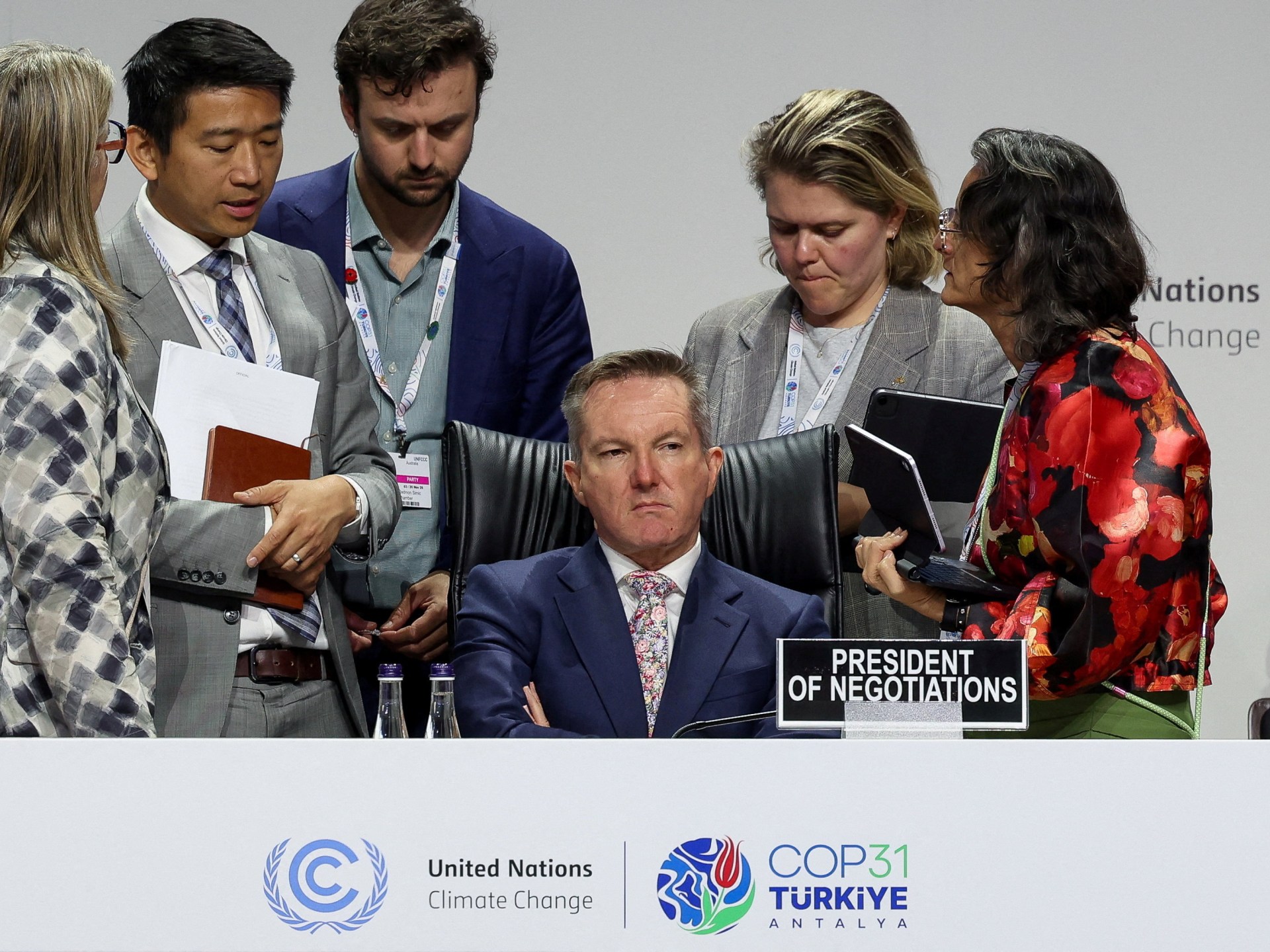
COP31 president of negotiations
Chris Bowen, Australia’s minister of climate change and energy, called the collapse of the talks “very disappointing”.
“A lot of good things happened this COP, a lot of events which told the clean energy story, a lot of commitments made – like the more than 90 countries that signed the electrification pledge, for example. And all that is good work and a great thing but not enough when it comes to climate action,” he said.
“An obvious issue is the transition away from fossil fuels, where some parties insisted that must be mentioned. Other parties insisted that if it was mentioned, they would veto.”
Disclaimer : This story is auto aggregated by a computer programme and has not been created or edited by DOWNTHENEWS. Publisher: aljazeera.com