So-called “health” foods are flooding supermarket shelves, so which ones aren’t quite what they claim, and how can you tell? A dietitian explains.

From low-carb to high-protein, low in calories to higher in fibre, many new “healthy” foods are added to supermarket shelves every week.
You’d be forgiven for thinking such products are good options to include in a healthy and balanced diet, especially when they are positioned in the health food aisle.
The thing is, though, what marketers consider healthy does not necessarily correlate with what a dietitian does. So based on nutritional science, here are some foods many consider healthy that I would not be adding to my supermarket trolley, ever.
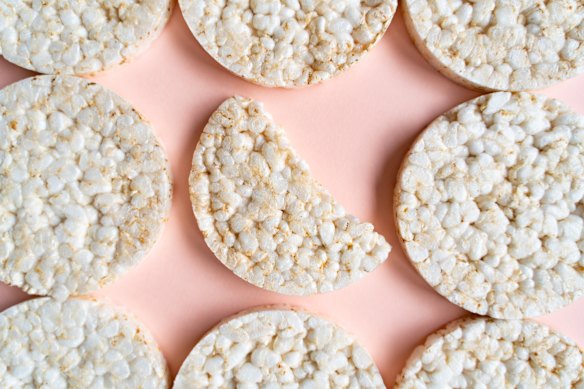
Rice-based snacks
Whether it is rice crackers, rice-based chips or flavoured snacks, snacks with a white or brown rice base are not a food known for any specific health benefits.
The best recipes from Australia’s leading chefs straight to your inbox.
Not only is processed rice an extremely dense source of carbohydrates, with just 10 rice crackers containing a similar amount of carbs as two slices of bread, rice also has an extremely high glycaemic index, which means that it releases glucose extremely quickly into the bloodstream. High glucose levels over time are not good for the health of our cells or weight control.
There is also concern regarding the amount of arsenic in rice-based snacks, which tends to be even higher than that found in cooked rice. For this reason, wholegrain crackers or corn-based snacks are generally better options than processed forms of rice made into snack food.
Low-carb wraps
Wraps are generally considered healthy, perhaps as they appear to be a lighter version of bread. Nutritionally, however, this is far from the truth.
Compared to regular sliced bread, wraps are generally much higher in refined carbohydrates, lower in fibre and full of the processed ingredients required to create a flat, sticky wrap.
When it comes to low-carb wraps, not only are you missing out on the whole grains that quality carbs usually deliver in the diet, you’re also eating myriad processed ingredients, which are used to create a low-carb version of a carbohydrate-based food.
A quick check of the ingredient list of any low-carb wrap will reveal a long list of ultra-processed ingredients, including forms of protein and dietary fibre that do not nourish the gut in the same way whole, natural proteins and fibres do. If wraps are your thing, choose a plain wholegrain option, and if you want to eat low carb, forget eating wraps.
Protein-based snack bars
If you were comparing a protein-based snack bar to a chocolate bar as a snack option, then yes, the protein bar would be a healthier choice.
But, ultimately, it takes an enormous amount of processing to create a palatable protein-based snack bar and few, if any, have overly strong nutritional profiles. Often high in saturated fat and made with a long list of ultra-processed ingredients, these bars are down the list of healthy, minimally processed food options.
When you also consider that you are paying $4-5 for 10-20g of protein, whole foods including yoghurt, milk and tinned fish are all better options nutritionally, at a much cheaper price point.
Cholesterol-lowering margarine
Popular 20 years ago when they were released and marketed as an easy way to lower your cholesterol naturally, cholesterol-lowering margarines are clinically proven to lower cholesterol by as much as 10 per cent.
What is not as clearly explained is that to achieve this result you need to add a significant amount of this spread to your daily diet, or an extra 30-40g of fat each day.
When you consider that margarine is made from refined vegetable oils, adding this much processed fat into the diet to lower cholesterol seems a little counterintuitive when you could simply eat more oily fish, legumes and walnuts instead.
Processed meat
When the World Health Organisation classifies food as a group 1 carcinogen, it is probably a good idea to cut back on that food.
This is the case with processed meats including bacon, salami, jerky, sausages, ham and the other processed meats we like to fill antipasto platters with.
Associated with an increased risk of cancers of the digestive tract, it seems odd that despite the recommendations for these foods to be proactively limited in the diet, we continue to see a growing number of snacks that are made with forms of processed meat.
Ultimately, for all of us, the less processed meat we eat, the better it is for our gut health.
Fruit yoghurt
This one may come as a surprise, as yoghurt is generally considered a very healthy food, and indeed, there is a growing range of yoghurt options that are high in protein and calcium and low in sugar, which are hard to fault nutritionally. This is not the yoghurt I am referring to.
Rather, I’m talking about dessert-style fruit yoghurts commonly described as “thick”, “creamy” and indulgent, and that come with plenty of extra fat and sugar. While these yoghurts are delicious, they often have added cream, which bumps up their saturated fat content, as well as several types of added sugars. This means a yoghurt that can have 10g of fat per serve and up to 30g of added sugars.
 Susie Burrell is an accredited practising dietitian and nutritionist.
From our partners
Disclaimer : This story is auto aggregated by a computer programme and has not been created or edited by DOWNTHENEWS. Publisher: www.smh.com.au