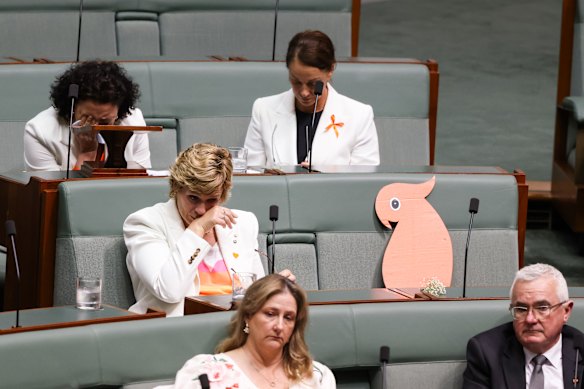

Seven in 10 Australian MPs say politics has damaged their mental health, with some admitting they have contemplated suicide and others silenced by fears for their safety, in a landmark study exposing the human cost of public office.
The findings, to be released at Parliament House on Monday, reveal a political culture in which online abuse, personal threats and toxic workplace behaviour are taking a profound toll on elected representatives and, increasingly, the democratic system they serve.
Almost 40 per cent of state and federal parliamentarians whose wellbeing had suffered said the pressures of the job had stopped them speaking publicly on issues they believed in, while about one in five affected politicians and councillors reported thoughts of self-harm or suicide.
The Fit to Lead study, conducted by the Better Politics Foundation, is believed to be the largest examination of the mental health and safety of Australian politicians, drawing on responses from 288 current and former elected representatives across all three levels of government.
Its release comes just five weeks after independent MP Helen Haines lost both legs in an alleged targeted attack outside her Wangaratta electorate office, an incident that has intensified concerns about the growing threat of political violence.
Haines, who has since been discharged from hospital and begun rehabilitation in Melbourne, was an early champion of the research and had warned months before the October attack that politicians were increasingly being forced to endure unacceptable threats.
“We don’t want to make politics comfortable, but we do want it to be safe. You shouldn’t have to wear a flak jacket, emotionally or physically, to do the job,” she told the study’s organisers in June.
The research found 44 per cent of affected state and federal parliamentarians said fears for their own safety, or that of their families and staff, had significantly damaged their wellbeing. That figure climbed to 51 per cent among women, compared with 35 per cent of men.
The survey was conducted between February 2025 and February 2026, before the attack on Haines. Of the 288 participants, 267 provided responses beyond demographic questions, including 36 federal parliamentarians, 96 state parliamentarians and 135 councillors.
Respondents described stalking, threats of sexual and physical violence, harassment of partners and children, and being forced to avoid public appearances.
“I am frequently threatened with physical or sexual violence by people that disagree with my views and my male colleagues do not have this experience,” one female federal MP told researchers.
British political strategist Alastair Campbell, who will launch the report in Canberra, warned that democracies were failing the people entrusted to lead them.
“We need good and effective politicians more than ever and this report suggests we are failing those who serve, and deterring others from wanting to serve in the first place. This harms us all,” said Campbell, who co-hosts the popular podcast The Rest Is Politics.
The Fit to Lead study found social media was the single greatest source of stress, with 97 per cent of affected state and federal parliamentarians reporting that online negativity and abuse had harmed their wellbeing.
Almost three-quarters of MPs surveyed said standards of behaviour in parliament were worse than in other workplaces, while 60 per cent believed there were no effective mechanisms to challenge unacceptable conduct.
The findings also expose serious gaps in support services. Just 11 per cent of affected parliamentarians said they had access to mentoring programs even though almost half wanted them.
“None of the leaders I interviewed want a pity party. They are asking for political leadership to be survivable, for them and for the leaders this country needs next. This is a democratic issue, not a wellness one,” McArthur said.
Despite the abuse, safety concerns and psychological pressures, 85 per cent of respondents told the survey they would still encourage someone else to stand for elected office, and 84 per cent reported enjoying their role.
If you or anyone you know needs support call Lifeline 131 114, or Beyond Blue 1300 224 636.
Cut through the noise of federal politics with news, views and expert analysis. Subscribers can sign up to our weekly Inside Politics newsletter.
 Rob Harris is the national correspondent for The Sydney Morning Herald and The Age based in Canberra. He is a former Europe correspondent.Connect via email.
From our partners
Disclaimer : This story is auto aggregated by a computer programme and has not been created or edited by DOWNTHENEWS. Publisher: www.smh.com.au