
Updated ,first published
Global climate talks led by Climate Change and Energy Minister Chris Bowen have failed to secure an agreement in Turkey after a stand-off between oil producing nations led by Saudi Arabia and nations seeking more ambitious action on climate change, including Europe.
Bowen described the outcome as “very disappointing” and said disagreements over fuels and climate finance were the dealbreakers.
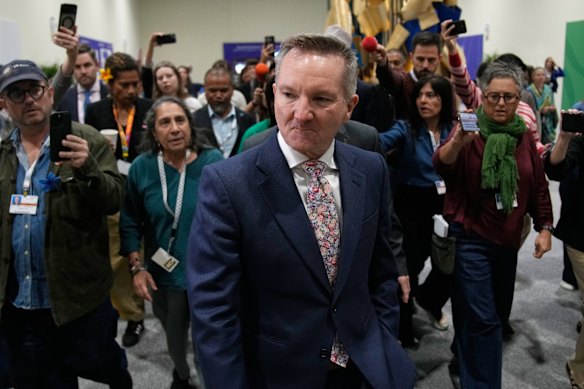
Telling reporters he had not slept since Friday as he worked with negotiators to try and salvage the talks, Bowen said he took his “share of responsibility. Ultimately, you know, people can judge what could have been done or couldn’t have been done. Ultimately, it’s a party-driven process”.
After more than two weeks of negotiations that dragged two days into overtime – making it the longest COP on record – Turkey’s conference president Murat Kurum said at the closing plenary that he could see there was no agreement and confirmed he would not advance any new text.
“There is nothing to do, we did all that we could,” he said. “There will be no new text from now on.”
On Sunday (Turkey time), the Saudi-led bloc backed by Russia rejected a final agreement – known as a cover decision – that repeated calls for a transition away from fossil fuels. The European Union said it could not support an agreement that would take backwards steps by refusing to address the need to do so.
Further objections were raised by other nations over the inclusion of a call to increase the use of controversial climate capture and storage (CCS) technology, also championed by the Saudi-led bloc, and by the failure of developed nations to pledge more financial support for poorer nations hardest hit by climate impacts.
Cover decisions at UN climate talks can only be adopted by consensus of all parties.
Bowen attributed the collapse of the talks to the “red lines” on fossil fuels where nations would not compromise.
“Despite many, many attempts, and on-reflection, those red lines, on behalf of different parties, were just not able to be met,” Bowen told reporters at the conference. “An obvious issue is the transition away from fossil fuels, where some parties insisted that it must be mentioned, other parties insisted that if it was mentioned they would not be involved.“
The failure of negotiators to arrive at an agreement comes as a huge blow to the COP process, at which almost 200 parties to the Paris Agreement sought to advance climate action, and to Bowen, who secured the role of president of negotiations when the bid he led for Australia to host the talks failed last year at talks in Brazil.
While Prime Minister Anthony Albanese described the COP31 outcome as evidence of difficult geopolitical times and Environment Minister Murray Watt said Australia had no veto powers, the Coalition is already calling for Bowen to resign over the failure.
“It’s pretty extraordinary, isn’t it? We’ve spent $150 million to get Chris Bowen to COP, to host COP. Then we found out it was actually a co-host deal. Now we’re walking away without a deal at all,” Deputy Opposition Leader Jane Hume told News24.
Bowen had sought to sidestep the stand-off over references to fossil fuel in the cover decision by including language recognising the agreement made at previous talks in Dubai, where the world pledged to “transition away from fossil fuels”.
He commended delegations for pulling all-nighters to try to reach a deal, but said “the situation coming into this COP was the most complicated and fraught geopolitical environment in living memory.
“An obvious issue is the transition away from fossil fuels, where some parties insisted that must be mentioned, other parties insisted that if it was mentioned they would veto.”
While many representatives paid tribute to Bowen’s work, others were more critical.
Mary Robinson, former president of Ireland and a member of The Elders, an independent group of global leaders founded by Nelson Mandela in 2007 to work on peace, human rights, and global challenges like climate change was scathing.
“Recognition of the dangers of overshoot should have shaken leaders into action, instead COP31 saw a shameful lack of urgency and leadership from the co-presidencies Turkey and Australia,” she said in a statement. “This was compounded by disturbing politicised attacks on the science from those still clinging to fossil fuels and looking to sabotage climate action.”
Speaking on behalf of the EU, Darragh O’Brien, Ireland’s minister for climate, energy and the Environment, rejected the draft agreement on the floor of the final plenary session.
“We will not endorse a cover decision, or an Antalya Pact, that does not even mention fossil fuels, which is the key driver of climate change, and we will not accept negotiating backward in time, and we will not accept a COP that greenwashes fossil fuel.
“I do want to, however, Mr President, commend both you and the president of negotiations [Chris Bowen] for your unstinting efforts. However, the draft put before us does not begin to address the climate emergency that we face.
“It is unconscionable that we would have a climate act that makes no reference to fossil fuel, no reference to transitioning away from fossil fuel either. And it is for that reason and those reasons that the European Union strongly objects to this text.”
Speaking after the EU, a member of the Panamanian delegation also rejected the deal, saying: “We need to be clear: our message is not a criticism of the presidencies.
“Our disagreement is with a much deeper problem… One, because it repeats previously agreed commitments without closing the gap between reality and what science demands. Two, because it wages too much upon technologies such as CCS capture storage of carbon instead of calling for deep changes and three because it weakens language agreed in previous decisions. This is a setback, a rollback.”
A representative of the Marshall Islands said her nation had been failed by all sides at the COP. “We were presented with the worst possible response to overshoot, a response to enhance oil and gas. We will not be forced to accept false solutions. We will not compromise our future to benefit fossil fuel interests.
“Over the past two weeks, we have been offered next to nothing. Even as we have said again and again, our needs are so great, the costs are so high, the finance gap keeps growing. We cannot do this on our own. We cannot survive on empty promises. People are dying, seas are rising, ecosystems are collapsing.”
As it became clear that the negotiations had failed Bowen remained silent while Turkish officials oversaw the meeting, with many speakers noting that the talks were being held just weeks after the UN Environment Program had acknowledged that the world was set to miss the Paris target of 1.5 degrees warming and head into what is now being described as climate “overshoot”.
A Russian delegate told the session that Russia stood by the goals of the Paris Agreement, but that the conference made rapid phaseout of fossil fuels that he said should not have been included central to the talks.
He said that the UN’s own scenarios charting a course to limiting warming to 1.5 degrees acknowledged the world would continue to use approximately 40 per cent of the oil and 50 per cent of the gas of the levels of 2019.
A Saudi representative said the 22 member states of the Arab League represented less than 2 per cent of historical greenhouse gas emissions, “whereas other groups are responsible for 55 per cent of those emissions.”
In line with this he said the Arab League had called for a tripling of climate finance from wealthy to poorer nations. “This was removed from the text due to lack of flexibility from some parties on mentioning any quantitative aspects related to climate finance.”
Mohamed Adow, director of Power Shift Africa, took aim at the EU, which he said had failed to offer new financial support to developing nations.
“Europe’s hypocrisy is staggering. Its governments demand fossil fuel road maps from others while expanding fossil fuels themselves and blocking the finance poorer countries need to make the transition. Without money and credible action at home, those demands are hollow. The EU cannot help sabotage the negotiations, then pose as the climate conscience of the world.”
China noted its reservation about some of the content of the agreement, but said to demonstrate unity of collective efforts it had decided to accept the cover decision and called on “all parties to show necessary compromise spirit to push forward our process.”
As president of negotiations Bowen had declared at the pre-COP meeting in Fiji that the presidency would pursue the cover decision that the COP has just rejected, in order to drive more momentum for action than might have been achieved with a series of agreements over individual agenda items.
Australia had hoped that in doing so it would champion the cause of Pacific island nations which view climate change as an existential threat, thereby deepening ties across the region as China’s influence grew.
Fiji’s Minister for Environment and Climate Change Lynda Tabuya said that although the cover decision text was not perfect she regretted it was not adopted.
“Honorable Chris Bowen, you have tried your utmost best, and we have seen it,” she said. “Your commitment, patience, and determination throughout these negotiations have not gone unnoticed.
“This work is hard. Sleepless nights, hours and days of constant negotiations, managing over 190 parties. This is not easy, but we do it. We do it for our people. The failure to reach consensus on the cover decision is not yours to carry. It is a collective responsibility that rests with all parties. Consensus requires compromise, courage, and political will from all of us.”
Get to the heart of what’s happening with climate change and the environment. Sign up for our fortnightly Environment newsletter.
 Nick O’Malley is National Environment and Climate Editor for The Sydney Morning Herald and The Age. He is also a senior writer and a former US correspondent.Connect via email.
From our partners
Disclaimer : This story is auto aggregated by a computer programme and has not been created or edited by DOWNTHENEWS. Publisher: www.smh.com.au