Glenn A. Baker
Music was not something Ian Meldrum, who has died aged 83, ever just listened to. Left on his own as a child, raised primarily by his grandmother, he would crank up the soundtracks of West Side Story, Oklahoma! or even a piece of opera on the family gramophone and madly flail away with a makeshift baton.
At the first Melbourne concert by the Beatles in June 1964, he and friend Ronnie Burns, a rising pop star, were tossed out of Festival Hall by over-zealous security men just before the final song, for screaming too loudly, and spent the duration of Long Tall Sally pounding on the back door in a tearful state of near-collapse. Shortly after, Kiwi chart sensation Dinah Lee, taken home for dinner one night by Burns and introduced to housemate Meldrum, was astonished to encounter the 17-year-old hiding, quivering and barely coherent under a bed.
Over all the years of public life, Ian ‘Molly’ Meldrum remained in the thrall of music and its practitioners. Wearing a great many hats – cub reporter, television mimer, artist manager and publicist, record producer, television presenter and talent co-ordinator, disc jockey, magazine columnist, product endorser, government adviser, record label operator, television producer and confidant to the stars – the former Protestant altar boy became a highly visible part of Australian life, celebrated for his gushing effervescence and his ceaseless championing of Australian music.
Ian Alexander Meldrum was born on January 29, 1943, in Orbost in eastern Victoria, the son of Robert Meldrum and his wife Isobel (nee Geer).
It was while juggling law studies at the University of Melbourne with a job as an ace pop reporter on plucky Go-Set magazine that Meldrum covered the walk-out of the miming stars of the Kommotion pop television show and found himself recruited as a replacement. The name Molly was bestowed by veteran DJ and fellow Go-Set contributor Stan Rofe. It stuck, as a household name that rolled easily off the tongue. In time, it would come tumbling from the lips of Madonna, David Bowie, Elton John, Jon Bon Jovi, Kylie Minogue, Rod Stewart and Michael Jackson, among many others of note.
After travelling to London with popular chart entity The Groop and landing a short stint working within the Beatles’ Apple organisation at the end of the 1960s (when he gained the scoop of John Lennon declaring he’d left the Beatles), Meldrum was ready to stop promoting other people’s music and start creating his own.
He produced a hit for the Melbourne group Somebody’s Image and persuaded vocalist Russell Morris to pursue solo fame with a song by Johnny Young. Before EMI Records had realised what was happening, Meldrum had spent $10,000 of their money (sufficient budget for two to three albums at that time) recording a wizard’s brew of swirling electronic noise and mesmerising chants – a spectacular six-minute epic that the distraught record company presumed to be a B-side.
Meldrum was sacked from the project but refused to let go and when a corporate decision was made to release the single in Victoria to cut costs, he hit the road to Sydney with Morris to persuade influential Harbourside disc jockeys to air the song. In April 1969, The Real Thing was No.1 around Australia, and by the end of the year, the pair had been awarded a rare gold disc.
Over his career, Meldrum produced recordings when the mood took him, his most successful endeavours being Smiley by Ronnie Burns, Day By Day by Colleen Hewitt, Don’t Fall In Love by the Ferretts (which he produccd under the alias Willie Everfinish) and I Like It Both Ways by Supernaut.
Key to his studio approach, indeed to his career in general, was instinct. “It’s the only talent I may have in my life,” he once said. “As a record producer, I always knew what people wanted to listen to, even though I was often faking it technically.”
Meanwhile, the law dimmed as a pursuit as the young Meldrum became immersed in pop and the energy of the times. The front cover of the September 16, 1972, issue of Go-Set carried the headline “Bob Hawke Talks to Ian Meldrum – A Time To Change”. The meeting with the ACTU leader in a pub and at the Trades Hall, was initiated by Meldrum against the wishes of the editor, who thought politics incompatible with pop. In London, Meldrum had been arrested at the “Battle of Grosvenor Square” in March 1968, when police and protesters fought outside the American embassy in London. “I hated the Vietnam War,” he would later say.
The making of Meldrum as a national figure was the arrival in 1975 of the ABC television program Countdown, on which he’d landed the job of talent co-ordinator. He was not the compere, a role which fell to guest hosts, but he did seem to be always there, verbally stumbling over himself, ever exhorting “do yourself a favour” as he thrust this and that record or group forward for attention.
“I know nobody believes this but I’ve never been comfortable about being on television,” he would insist. “In the early days of Countdown , I was told I had to do a rock report and I said no. In the end, it came down to paying the rent. The ABC employed me and they wanted a rock report. That’s how Humdrum happened.”
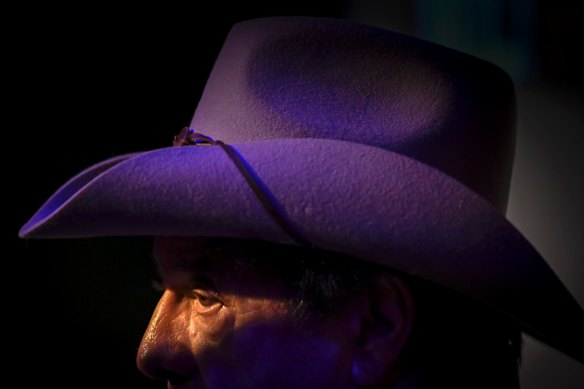
Countdown held court until July 19, 1987, followed by the 1986 Countdown Awards, at the end of which Meldrum appeared wearing a Stetson hat, which he doffed to reveal a shaved head, in imitation of Peter Garrett of Midnight Oil, who had steadfastly refused to appear on the show. Like the nickname, the hat stuck.
Many things about Molly Meldrum stuck, including his fanatical devotion to the St Kilda AFL team and, later, the Melbourne Storm in the NRL. A star all over again on television’s weekly Hey Hey It’s Saturday program, he had the ear of politicians and the pulse of the country. He would be crowned King of Moomba on one hand and renowned for his fascination with the oft-visited Egypt and his vast collection of artefacts of the ancient realm.
Far brighter and more aware of global affairs that was realised, Meldrum managed the not-inconsiderable feat of winning half a million dollars for charity on Who Wants To Be A Millionaire? In 1986, the year after he hosted the Australian leg of the global telecast Live Aid, he was made a member of the Order of Australia for “service to the fostering of international relief and to youth”.
In 1993, the Australian Recording Industry Association bestowed a Special Achievement ARIA award upon him.
Though there was often much that merited it, Australia was pleased to never take Meldrum too seriously, accounting for why the country felt so comfortable with him for so very long. He knew he was charmed. Booked onto the Air India flight that crashed into the Irish Sea in 1985, he was one of the few no-shows. “Rod Stewart and his old manager Billy Gaff after a lot of argument got me to stay over for a dinner party,” he would say afterwards. “By the grace of God, I’m still here. That’s the way you’ve got to look at life. As long as I’m enjoying this, we’ll all have a giggle.”
Meldrum had a more immediate near-death experience in 2011 when he was critically injured in a fall from a ladder at home in Richmond, in inner Melbourne. He was taken to hospital in a coma with a fractured skull, broken ribs, cracked vertebrae and a punctured lung, undergoing surgery for a brain injury.
Spurred by well-wishes from the likes of Madonna, Boy George, Russell Crowe, Ricky Martin and Kylie Minogue, Meldrum recovered after a lengthy rehabilitation.
Five years later, he was seriously injured when he fell outside his hotel while on holidays in Bangkok. The two incidents took a toll on his wellbeing.
Meldrum’s dramatic, colourful life became the subject of an acclaimed TV mini-series, Molly, in which he was played by Samuel Johnson, who won a Logie for his portrayal. Meldrum famously interrupted Johnson’s acceptance speech at the 2017 awards, later apologising for his rambling performance by saying he “got a bit caught up in the moment”.
It was no surprise. Being caught up in the moment had been the essence of his enduring appeal.
From our partners
Disclaimer : This story is auto aggregated by a computer programme and has not been created or edited by DOWNTHENEWS. Publisher: www.smh.com.au