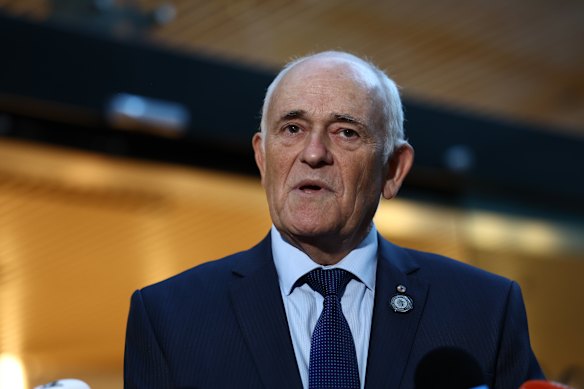

The nation’s peak Jewish body has warned the Albanese government it would be a dangerous distraction to strip religion from the national terrorism definition, as recommended by the national security watchdog.
Independent National Security Legislation Monitor Jake Blight used a major report last week to call for a terrorist act to be defined as violence seeking to advance a political or ideological cause in a move welcomed by peak Muslim groups.
The current definition, introduced after the September 11 attacks, describes terrorism as a violent act seeking to advance a political, religious or ideological cause.
As the nation prepares to commemorate the first anniversary of the Bondi massacre, in which 15 people were killed at a Hanukkah festival in the worst terror attack in Australia’s history, Prime Minister Anthony Albanese’s closest confidant in the Jewish community has urged him not to water down the emphasis on religion in the terror definition.
Peter Wertheim, the co-chief executive of the Executive Council of Australian Jewry, said Blight’s report contained worthy recommendations including defining hostage-taking as a terrorism offence and acknowledging that a terrorist’s motivation can include an incoherent mixture of beliefs.
But he said the “major drawback in the report is the recommendation that only an intention to advance an ideological cause be a defined element of terrorism, but not an intention to advance a religious cause”.
“This makes little sense when so many notorious terrorist acts have featured motifs, words and images that unmistakably refer to religious doctrines and beliefs,” he said.
“It is clearly not appropriate for Australian law to decide which beliefs are an authentic expression of a religion and which are not. Even the adherents of a religion may have divergent views about such matters.”
Wertheim said that Blight’s reference to faith in his proposed definition of ideology as a set of beliefs or ideas did not reflect the centrality of a religious motivation to many terrorist acts.
“Faith is not the same as religion and religion is more than an ideology,” he said. “In order to counteract and prevent terrorism effectively we need to be clear about what is driving it and how it is manifesting.”
Attorney-General Michelle Rowland said the government would consider the findings of the report, but senior ministers, spy agency ASIO and the Australian Federal Police have resisted the idea of changing the current terror definition.
Blight argued in his report that singling out religion as a motivation for violent acts gives “terrorists false credibility and reinforces their narrative that they are doing holy work” and has contributed to discrimination and violence against religious minorities, especially Muslim Australians.
ASIO has backed retaining the current definition, including the mention of religion.
“Obscuring such motivations could consequently risk the implementation of effective interventions or preventative actions, with potentially catastrophic consequences,” the agency warned in a submission to Blight’s review.
ASIO noted that 13 of the 16 terrorist attacks Australia had experienced since 2014 were religiously motivated, including 12 acts of Islamist violent extremism and one act of Christian violent extremism.
Sydney man Nowroz Amin was arrested and charged by the Australian Federal Police on Friday over allegations he sourced instructions on how to construct a car bomb for a potential terrorist attack and was in possession of Islamic State-inspired extremist material.
Cut through the noise of federal politics with news, views and expert analysis. Subscribers can sign up to our weekly Inside Politics newsletter.
 Matthew Knott is the foreign affairs and national security correspondent for The Sydney Morning Herald and The Age.Connect via X, Facebook or email.
From our partners
Disclaimer : This story is auto aggregated by a computer programme and has not been created or edited by DOWNTHENEWS. Publisher: www.smh.com.au