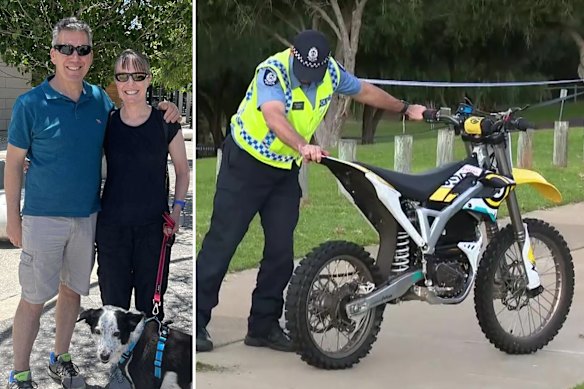

A teenager who fatally struck a pedestrian in Edgewater while riding an electric motorbike in July last year was allegedly under the influence cannabis and carrying more than two ounces of the drug at the time of the crash, a Perth court has heard.
The teenager, who cannot be named due to his age at the time of the incident, was originally charged with manslaughter, no authority to drive and using an unlicensed vehicle on a road.
Earlier this year, he pleaded guilty to dangerous driving in Perth Children’s Court, and is fighting the manslaughter charge at trial, which began on Monday.
Shelley Spinks, 59, died after she was struck by the then-17-year-old rider, who police alleged was riding the unregistered off-road electric motorbike and “travelling erratically” when the crash happened at a park in the northern Perth suburb.
During his opening remarks on Monday, prosecutor James Nicholls told the court that, following the crash, the teenager was taken to Joondalup Health Campus, where he was asked to give a sample of blood.
“His sample was formally analysed and found to contain THC [at] 9.1 micrograms per litre,” Nicholls said.
“A toxicologist concluded [the accused] was most likely impaired by drugs and unable to control his motorbike at the time of the incident.
“The level of THC would have been much higher at the time of the crash.”
Nicholls also told the court that more than two ounces of cannabis were found in the teenager’s bag following the accident, including two ounces in separate bags and smaller amount of cannabis within a prescription container.
Nicholls also said there was evidence on the 17-year-old’s phone that suggested the two packaged ounces were to be sold later that afternoon.
In his openings, defence lawyer Simon Watters told the court he accepted the teenager had cannabis in his blood at the time of the incident – but insisted it was a “prescribed substance”.
“We accept he had cannabis in his system, but not to the extent that it had an effect on his control of the vehicle,” he said.
“It would be different if you had non-prescribed cannabis in your system.”
Watters said the potential sale of cannabis that afternoon did not aggravate the criminal responsibility to the charge of manslaughter.
“It is up to you your honour, to decide whether the effects of cannabis, which we will allege was prescribed, had an impact on the accident,” he said.
“We say any breach of duty by him was not so egregious as to constitute manslaughter.”
Spinks, a nurse who was originally from New Zealand, was taken to Joondalup Health Campus where she later died from injuries sustained in the collision.
The boy, who the court previously heard had been diagnosed with ADHD and autism spectrum disorder, lived between his father, predominantly, and his mother and teenage brother in regional WA.
The trial continues.
From our partners
Disclaimer : This story is auto aggregated by a computer programme and has not been created or edited by DOWNTHENEWS. Publisher: www.smh.com.au