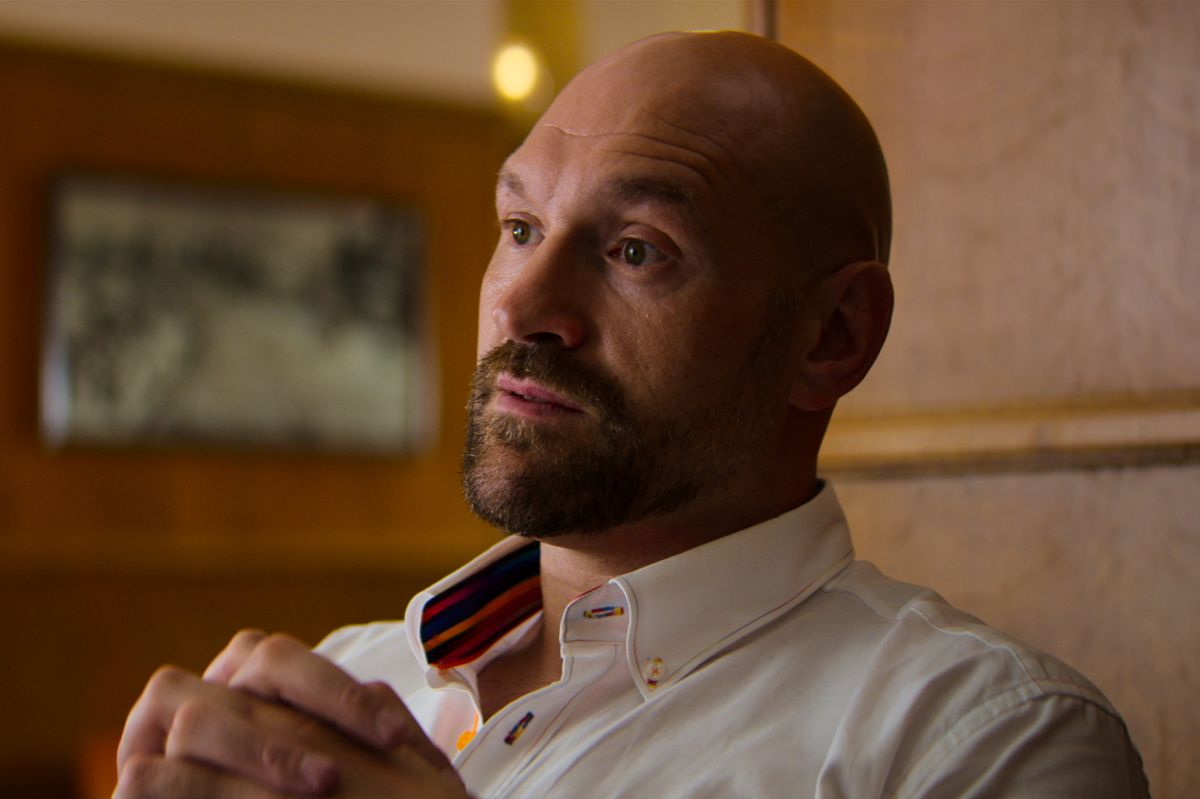
Tyson Fury speaks bravely and honestly about the pain and heartache that has been in his life and how the boxer overcame things in his new Netflix documentary.
When he was still a skinny teenager, Tyson Fury told his girlfriend Paris he was going to be heavyweight champion of the world. At the time she smiled politely and figured it was a nice to have ambition, but he would grow out of boxing.
That seemingly impossible dream was to become an obsession for Tyson, and although he achieved his goal in 2015 beating Vladimir Klitschko, the following two years then became a nightmare that saw his mental health spiral out of control.
Looking back Tyson says: “I’d achieved all my childhood dreams and focused on this one man throughout my full career, a man I knew I could beat. And then when I finally beat this man, It was like my whole point of existence had been taken away.”
The extraordinary rise and fall and rise again of boxer Tyson Fury, 38, is told through his eyes for a new Netflix documentary. It will air this week in the run up to his latest blockbuster fight in Cardiff against Anthony Joshua.
But the fight, and Tyson’s future, could have been very different as he contemplated suicide and heard voices in his head urging him to die at his lowest ebb.
He says: “Words can’t explain the darkness I was in. It was like a living version of the pits of hellfire. And I 100 percent thought at times I’d end up in a padded room with the door locked, and that scared me so much.”
Tyson says he had some anxiety even as a kid but bigger problems in his life began years before hit title fight when he began boxing. First his dad told him he had a second family, complete with two new brothers, who were excited to meet Tyson. Then in 2011 his dad John went to prison for four years.
His uncle Hughie who was also his trainer, died in 2014 and Paris also lost what would have been their third child, five months into a pregnancy around this time. The couple were heartbroken and Tyson says he buried the tiny baby in a grave in the Fury family garden in a hardwood mahogany box.
“I buried it all in the back of my mind,” Tyson says looking back on the catalogue of events. The deepest, darkest locker I could put everything in. They all went down. I buried them deeper in the brain.”
But Tyson pressed on with training and fighting, climaxing in his win in Germany against Klitschko in November 2015.
“It was probably the best day of my life,” he admits.
But in a comment which might confuse some people, the family man also says: “While I’m in that ring, I’m willing to die every time.
“It’s irresponsible and selfish. But when I’m in that ring,… I’m on for it every single time and I’ll fight to the death.”
His dad John, released from prison in February 2015, months before his son’s title fight, says he knew the moment the bout was over his son was a changed man, and not in a good way.
The many blows Tyson had taken outside of the ring suddenly came back into focus after he had ticked off his goal in life.
John says: “I was looking him after the fight. Took his boots off. His feet were obliterated. His boots full of blood. You get them feelings, don’t you? I knew he wasn’t right. He was vacant with it all. He was just, he just distant.”
His family hoped his mood would improve when he got home with his new heavyweight belt, but they were wrong. Wife Paris recalls: “I’d seen Tyson go through lows, but this was just an ongoing daily of a low. There was no high.
“It was like having a stranger around because it was something I’d never seen before. I’d never seen this version. Laying in bed all day, moping around, I’m not wanting to do anything and having no ambition or no interest in life, no interest in anything.
“He keeps asking me, ‘What’s the point?’ Everything was, ‘What’s the point?’
“Then he starts telling me, ‘I don’t want to live.’ And I kept thinking, ‘How can you not want to live?’.”
Tyson then began drinking heavily to numb the pain, something he has never done a lot of in the past, and even had nights out taking cocaine and later boasting about this fact in interviews.
“Didn’t care about myself, my health, my family, my wife, my kids. Nothing. Belts, boxing, nothing mattered.
“Only self-destruct. That’s what mattered. Got that bad. I was hearing voices in my mind. Won’t be able to sit and have a conversation because I’d be hearing stuff in my mind and I’d be seeing stuff and just weirdness. The voices were, ‘Kill yourself’.”
He adds: “I would think if only I could get back to not hearing voices. I just wanted to be what I thought was normal again, what I did get back to before. And I tried so many times and failed and failed and failed and failed and just couldn’t do it.”
His wife was stunned by the changes in him, particularly as he was previously anti-drugs, but she was also very worried he might end his own life.
It was a far cry from the early years together going on dates, sharing cosy Christmas times together with their young growing family.
On another desperate occasion mum-of-seven Paris tried calling Tyson again and again when he was on a night out and he didn’t answer, eventually someone called her and told her to go to the hospital because Tyson was “having a heart attack”.
It turned out to be a severe panic attack, but Tyson was in a bad way mentally.
“The radio starts talking to me,” he says recalling the night in hospital. Literally having a full conversation with me, like no one’s untouchable. We can get you at any time. If you don’t behave yourself, we’re gonna kill your father.
“So I’m thinking, okay, you’re all involved. Your best friend set you up. I’m being drugged with anthrax. I’m dying. I’ve had a heart attack. I’ve been drugged. Something’s happening to me. Am I not really here? Am I dead? I must be dead.”
Tyson saw a psychiatrist, who asked lots of questions and he says diagnosed him with schizophrenia, depression, anxiety, bipolar disorder. His wife Paris recalls: “Even then the penny didn’t drop. Don’t be silly, what’s she on about, schizophrenic? Maniacs are schizophrenic; you’re not schizophrenic. I’d never heard of bipolar, what’s bipolar?”
But when she heard what the symptoms were and it was explained to her, Paris admitted they described her husband “down to a tee”.
After the diagnosis Tyson was still drinking but the turning point came on Halloween in 2017. Out at a bar he had a moment of clarity and left to go home. He says: “I looked and looked around me, and I could see all that young people, and I thought ‘I’d had the world in my hands, and threw it all away, and now I’m just a fat mess, addicted to alcohol’. Go home. So I put the beer down in that moment, I had sanity again, and I went home.”
Tyson began training again the next day, being exhausted after a short jogging session over half a mile. But he stuck at it and got a new trainer, and slowly but surely rebuilt his career.
He also spent time with a therapist, and admits that helped: “I felt focused, and I just kept going. So went down to the psychiatrist, time and time again. I would go down there and talk, and he’d tell me about all this stuff, and I’d listen and I’d tell him what I was feeling. Told him all the stories when I was a kid and everything else, and yeah, I was really looking forward to Fridays coming by the end. It was like a release.”
Tyson would go on to take part in a legendary trilogy of fights with undefeated US boxer Deontay Wilder in 2018, 2020 and 2021.
Tyson still suffers mental health issues but knows he can speak to people now, and may again turn to a therapist if he gets low after the Joshua fight. He has been told by the therapist to try to “maintain a certain way of life”.
The documentary about his life ends with Tyson playing with his kids and urging them to make different choices to him growing up when It comes to discussing any fear or anxiety instead of bottling it up.
He says: “You take a look at my life, there’s a lot of achievements, there’s a lot of good stuff, a lot of success.
“But the most successful thing that I have in my life is my family, my kids, and wife. We’ve got seven kids now. I tell my kids, talk about it all. We’ll deal with the problem today. That’s the most important thing for me.”
* The documentary ‘Tyson Fury’, directed by Lucy Wilcox, launches globally On Netflix on November 27.
When life is difficult, Samaritans are available day or night, 365 days a year. You can call them for free on 116 123 or visit **samaritans.org.
Disclaimer : This story is auto aggregated by a computer programme and has not been created or edited by DOWNTHENEWS. Publisher: mirror.co.uk