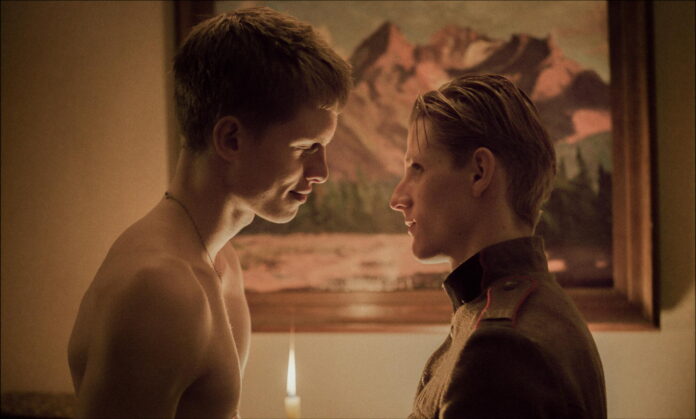
“Coward” is a World War I drama shot in Belgian locations where battles actually occurred during the Great War. Its body count is low, yet it strikes at the core of the stress and trauma of combat. What emerges from that crucible is not the usual macho warrior, however. The film’s heart is not in spectacular battle scenes, but in the intimate struggle of a troupe for the troops — a small band of soldiers putting on cross-dressing, crowd-pleasing performances for the fighters — and the thrilling space it creates for a secret, queer romance to flourish.
“At its heart, it’s about performance,” says writer-director Lukas Dhont. “It’s about how a system demands us also to be performers. And in that sense, I very much look at masculinity as a performance.
“All these men, they learn that to be successful means to be able to move to the violent and to repress what they feel in order to do that. It’s what they rehearse, if you will.”
Dhont’s protagonist is Pierre (Emmanuel Macchia), a sturdy Belgian farm boy who had never been far from home. Now that he’s seeing beyond that frame, he’s also seeing more of himself. That includes the not-insignificant part drawn to the troupe’s flamboyant leader, the serpentine, sophisticated Francis (Valentin Campagne). But while they’re safe in the bubble of their theatrical world, they’re at constant risk of Pierre being sent to the front, or perhaps worse, their passion being discovered by the outside world.
Macchia and Campagne shared the best actor prize at Cannes. “Coward” is now Belgium’s official international feature submission for the 99th Academy Awards.
Emmanuel Macchia, left, and Valentin Campagne in “Coward.”
(Mubi)
The film’s spark came from period photographs of soldiers putting on morale-boosting performances in drag — quite a different visual from the blood and glory that characterizes most war cinema. Dhont says, “When I saw these pictures, I saw an antidote to that imagery. These men expressing themselves much more freely, much more fluidly on that stage and actually celebrating the feminine … that was so incredibly moving.
“I wanted to bring to that genre of film the celebration of what a group of men can achieve when they’re not destroying.”
Remarkably, it manages to feel like a war movie, a secret romance and symbolic social commentary all at once. And at its center is the emotional truth to make, say, a deserting soldier’s execution heartbreaking, or an unlikely love feel real and consequential.
“Emotional truth is sort of a superpower for me. I’ve been, in my personal life, incredibly untrue to my emotions,” says the auteur of growing up gay in a less-than-open-minded part of Belgium. “I’ve feared my own emotions a lot, and I think that goes probably for a lot of people. I feel that cinema is a place where we can be confronted with emotional truth.
“Men are often told not to listen to their hearts, to bury them, because the heart is a dangerous place. It makes you vulnerable and fragile. It is the possibility for defeat. So for me, making films from the heart, more and more, I see as something very political.”

Lukas Dhont.
(Jason Armond / Los Angeles Times)
One of the film’s sociopolitical statements is its subversion of the very idea of “cowardice.” Pierre decides he wants no part of killing strangers or being killed by them. Is he a coward for choosing life over death, and a love in a time and place where it dare not speak its name? Is Francis a coward for being so bold in their bubble and closeted outside it? For Pierre and Francis, the drama is made possible by the troupe.
“Art contains multitudes,” says Dhont. “For me, while art has been a place to escape, which it is for these men — they get to be somewhere else and someone else for a moment — art has also been a place where I found a part of myself. That’s what happens with Pierre. All of a sudden, he understands parts of himself that are new. It opens up his gaze. Art is a window to the world.
“These men try to break away from the narrow, muddy world of death and open up to something much more luminous.”
The film is also unusual in its focus behind the scenes of combat, its characters essentially stagehands to the action.
“A lot of the soldiers had to carry the bombs, the shells, the guns to the front to [resupply] and had to go on the battlefield after the action to bring the bodies back. Now we deal with the aftermath of it all. We have to deal with all the helmets of the soldiers that died. We have to arrange them. We have to bury these bodies.
“So for me, this idea of the backstage of the war, dramaturgically, that’s when it clicked to have the actual action scenes more as smoke clouds on the horizon and hear how those sounds are sometimes felt from the camp, but our artists want to overwhelm them with music.”
It’s in the wings, as it were, that two such different players fall for each other.
“Pierre had led a controlled life. He didn’t use his voice when it wasn’t necessary. He was withdrawn. Enter Francis, who is the opposite, like, ‘Let’s make a spectacle out of it,’ ” Dhont says. “Francis opened up this young man; we see his eyes move from the ground to the sky.
“That’s where Francis is. He’s in the sky. He’s Lucy in the sky with diamonds. He’s everywhere.”
More to Read
Disclaimer : This story is auto aggregated by a computer programme and has not been created or edited by DOWNTHENEWS. Publisher: latimes.com