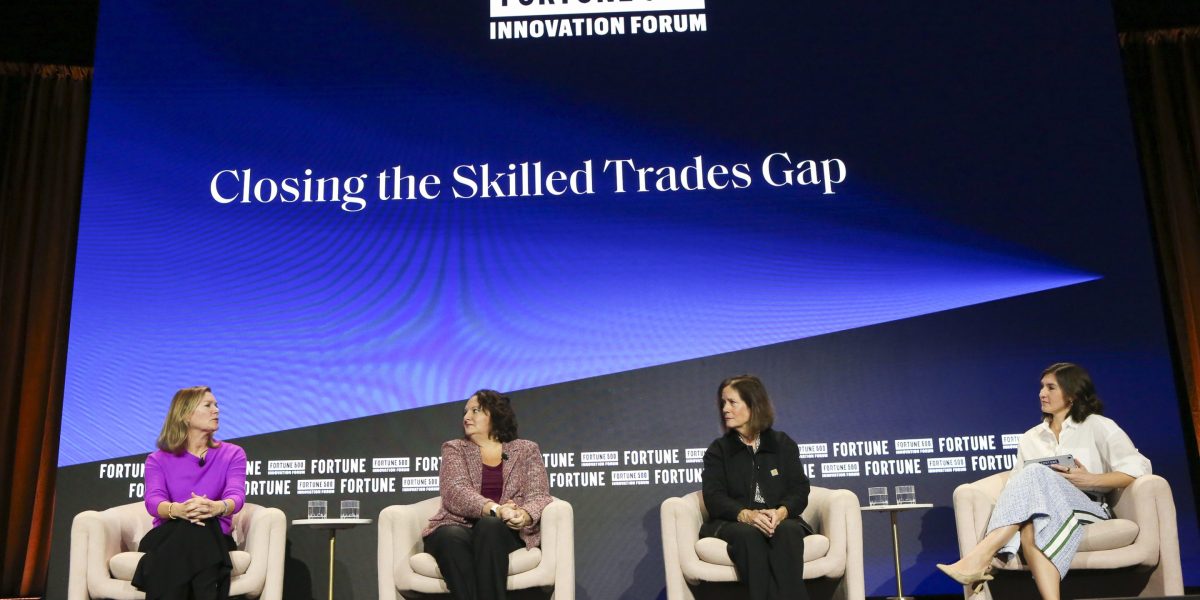
Carhartt CEO Linda Hubbard is proposing an idea she concedes may be “a bit radical” to solve the skilled trades shortage: pay people to learn the jobs employers desperately need to fill.
“I think if companies truly need these workers, then they have to put some money behind it,” Hubbard told me at the Fortune 500 Innovation Forum in Detroit last week.
Employers will need to fill roughly 1.7 million skilled trades openings every year through 2035, according to a report from the Alliance for America’s Skilled Trades. Compounding the problem is that nearly a quarter of skilled tradespeople are over 55 and nearing retirement.
Hubbard wants more companies to embrace an “earn while you learn” model. She pointed to Henry Ford College in Michigan, where students in a two-year auto technician program alternate between eight weeks in the classroom and eight weeks at a dealership. They emerge with a certificate and a well-paying job, Hubbard said. Building that bridge from classroom to career “is how you’re going to get that high retention rate,” she said.
Google and the nonprofit Jobs for the Future are testing a related approach. Last year, they partnered to offer apprentices up to $2,000 to offset childcare, transportation, and housing costs—some of the biggest barriers for those interested in the skilled trades, said Maria Flynn, CEO of Jobs for the Future.
The payments are designed to plug what Flynn calls leaks in the apprenticeship pipeline. Fewer than half of apprentices complete their programs, and only 29 of every 100 who start are still working in a trade five years later, according to the report.
Getting students in the door is its own challenge, even with six-figure salaries on offer in some trades. Flynn and Hubbard pointed to school guidance counselors as a critical bottleneck. While 95% view trade school as a valuable option, only half recommend it to students, and just 28% recommend apprenticeships, according to the report.
“We want to really impress upon people that these are quality jobs,” Flynn said. “These are stepping stones into the middle class.”
Kristin Stoller
Editorial Director, Fortune Live Media
kristin.stoller@fortune.com
Fortune Office Hours
This week, Robert Kaskel, vice president of people at workplace food tech platform ezCater, answers your burning workplace questions. Responses have been edited for length and clarity.
Q: I was hoping to get a promotion and a raise in the latest review cycle. Unfortunately, I did not get a promotion, although I will likely receive a very small raise. I have received good reviews. Would I be better off seeking opportunities elsewhere to move up and get a good salary bump, or am I better off trying again next year?
If I stay, what do I need to do to get promoted? If I go elsewhere to get a title and salary bump, what should I look for to help ensure my advancement doesn’t stall at a new employer?
A: Having a history of strong reviews without receiving a promotion is frustrating, and it’s fair to consider your next steps, which might include leaving your company. Before deciding, sit down with your manager and ask what separated you from a promotion this cycle.
Request clear, measurable expectations, examples of the scope or impact you need to demonstrate, and a timeline for reassessing. Agree on regular check-ins and look for ways to show you’re already operating at the next level. If the answers stay vague, the goalposts move, or there’s no realistic opportunity to take on an enhanced scope, don’t assume another year will change things.
At the same time, explore the market. You can learn what your experience is worth without committing to leaving. Compare roles by responsibilities, level, total compensation, and growth, not title alone.
To avoid stalling at a new employer, ask how promotion decisions are made, what success looks like in the first year, how often people at that level advance, and whether the role has room to grow. Look closely at your future manager’s track record of developing people and ask them for specific examples, not just assurances.
The best choice is the one with the strongest credible path to greater responsibility and fair compensation. Stay if your employer offers clear criteria, meaningful opportunities, and real follow-through. Leave if another role offers a better-defined path, not just a bigger title.
Have a workplace situation that you’re unsure how to navigate or a scenario worth unpacking? Send it our way anonymously via this form.
Watercooler
A round-up of the most important HR headlines from Fortune and beyond.
Rejection reversal. Nearly half of all jobseekers say they wouldn’t apply again to a company that has ghosted them. Fortune
Resume experiment. Job seekers’ latest trick? Getting weird on their resumes and applications. Business Insider
AI bubble. For years, the tech industry sold tools to help workers. In the AI age, it may replace them. New York Times
Disclaimer : This story is auto aggregated by a computer programme and has not been created or edited by DOWNTHENEWS. Publisher: fortune.com