US Army reschedules detonation of toxic explosives at Iowa ammunition plant
-
Published
The US Army plans to move ahead with detonating five tonnes of toxic explosives in Iowa on Wednesday, despite multiple legal challenges and mounting public outcry over the potential health risks to nearby communities.
A court had ordered a pause after environmental groups sued to stop the detonation, arguing the army failed to consider safer alternatives.
But on Saturday, the justice department told the court that the army intends to move forward with its plan, because of an “immediate risk” that those materials could “spontaneously explode”.
Environmental groups have accused the government of skirting the judicial process.
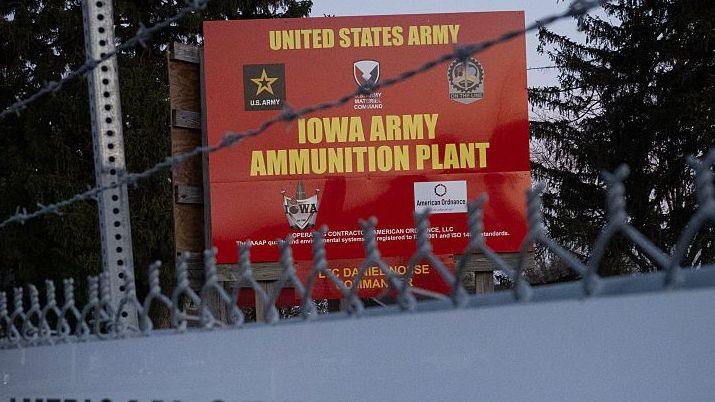
Lead azide is a highly volatile compound used as a detonator. Earlier this year, the Iowa Army Ammunition Plant (IAAAP) found that the material had degraded over time to the point where it was now too risky to move the material, according to Iowa Public Radio.
The Environmental Protection Agency (EPA) says no level of lead exposure is considered safe. Lead exposure through inhalation or ingestion can pose serious health risks to humans and animals, particularly children.
The detonation was originally scheduled for Friday at the Iowa Army Ammunition Plant in Middletown. In its court filing on Saturday, the justice department said the army would carry out the detonation on Tuesday.
Later, in a social media post on Sunday evening, the army announced that the detonation had been rescheduled for Wednesday to allow for “optimal weather conditions and all mitigation measures to be emplaced”.
“The health and safety of all Americans has and always will be our first priority,” it said.
The government has argued that, because this is an event that requires immediate action, the army can move forward without a permit for detonation.
The justice department’s court filing describes this as an “emergency situation” in part because of the incoming cold weather.
“As the outside temperatures drop the risk of an uncontrolled explosion increases because the formed crystals can break more easily in freezing temperatures,” the filing said.
“There is an immediate risk that the lead azide at the Iowa Army Ammunition Plant will explode as temperatures are expected to drop below 30 degrees Fahrenheit (-1C) in the next several days,” the filing stated.
It said that a controlled detonation was necessary to protect the public from an unplanned explosion.
The Iowa Environmental Council and Sierra Club, which filed the lawsuit on Thursday that prompted the court-ordered pause, filed a new motion on Sunday in response to the army’s filing.
The advocacy groups accuse the government of bypassing the judicial process.
“Despite claiming public safety is its top priority and public communication is essential to trust, the Army seemed more concerned over the weekend with finding a way to sidestep the judicial process than on meeting the public’s demands for greater transparency, notice to affected communities, and far stronger protection of people, property, and the environment from serious harm.” said Earthjustice Attorney Thien Chau.
The group asks the court to pause proceedings so that it may submit additional information before the scheduled detonation.
Iowa’s newly elected Democrat Senator Josh Turek has called for a full probe into how the lead azide “was allowed to degrade into this critical state and why safer methods of disposal were not pursued”.
The government has not released details for the rescheduled detonation.
Earlier, the army had warned residents to leave their homes for six hours on the original scheduled day of the explosion, for the duration of the explosion and until the dust settled. An advisory warned “all humans” to avoid being outside in the affected areas while the demolition detonation was set to take place.
On Friday, the military said it was working with the Department of Health and Human Services and the EPA to ensure the explosion was done in the safest manner possible. They also said they had been preparing for the event since March.
“Agencies involved are prepared to take the most extreme mitigation measures available to ensure there is no risk to the public and any disruptions are minimized,” the agencies said in a joint statement released on Friday.
Military and environmental officials determined that detonating it in place was the safest way to eliminate the explosive safety hazard.
The EPA, which granted an emergency permit to detonate 68 drums of the material, said it did so because the explosion risk “presented an imminent and substantial threat to human health and the environment”.
-
-
Published3 days ago

-
Disclaimer : This story is auto aggregated by a computer programme and has not been created or edited by DOWNTHENEWS. Publisher: BBC