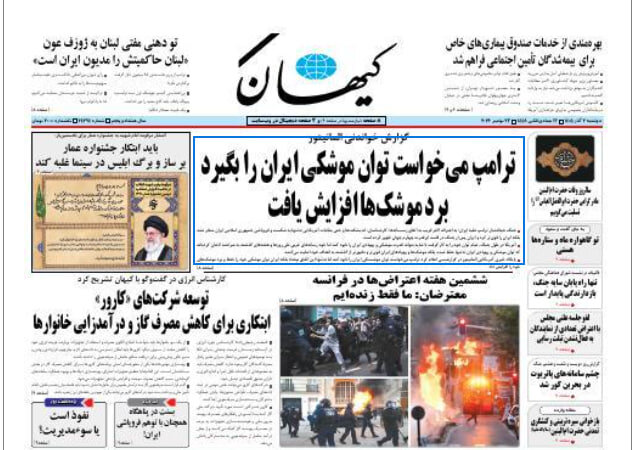
In an article, Kayhan argued that recent US military movements, intelligence allegations, and statements by American officials indicate preparations for a possible new phase of confrontation with Iran. Washington is strengthening military readiness while building political and media narratives to justify further pressure on Tehran.
Aggressive rhetoric from US officials and increased attention in Western media to issues related to Iran’s capabilities form part of a broader strategy. These developments suggest a coordinated effort rather than isolated incidents. Based on this assessment, the newspaper questioned whether Iran should simply wait for its enemies to determine the timing and shape of events. It argued that surrendering the initiative would weaken Tehran’s position and limit its ability to influence developments. Deterrence depends not only on military power but also on maintaining strategic initiative.
Iran: Iran’s puzzle in Shenzhen
The Iran newspaper examined the importance of discussions involving the Islamic Republic during the Shenzhen meeting in which the leaders of China, Russia and the US held a joint meeting. Iran has become a key point where the security, economic, and strategic interests of major powers intersect. International politics is shaped primarily by national interests rather than political declarations or strategic rhetoric. Governments ultimately make decisions based on security concerns, economic priorities, and calculations of power. Countries sharing concerns about a common rival may still differ over how crises should be managed and how costs should be distributed. This reality is essential to understanding Iran’s position in Shenzhen. Although China and Russia often coordinate with Tehran in opposing what they view as US unilateralism, the newspaper stressed that such cooperation does not necessarily mean unconditional support for every Iranian demand. Both countries continue to pursue policies based on their own interests and priorities. The report concluded that Iran’s presence in discussions among major powers reflects its continuing importance in regional and international affairs. At the same time, Tehran should maintain realistic expectations regarding the policies of its partners.
Etemad: Diplomatic initiative remains an important tool
Etemad analyzed Tehran’s relations with Moscow and argued that diplomacy should remain at the center of Iran’s foreign policy. According to the newspaper, Iran and Russia may agree on limiting the risk of a wider conflict, but they do not necessarily share identical priorities. Strategic ties with Moscow and broader relations with Beijing are most effective when they complement Iran’s own diplomatic efforts rather than replace them. In its view, the core issue is not choosing between Russia and the United States but using all available resources to safeguard independence, strengthen security, and improve living standards. Iran’s place in any future international order will depend largely on decisions made in Tehran. No sustainable arrangement concerning Iran can succeed without Iranian participation and consent. Furthermore, Etemad emphasized that strategic partnerships should be measured by practical results, including greater security, economic progress, and public welfare. Diplomatic success, it argued, should ultimately be reflected in tangible benefits for citizens.
Vatan-e-Emrooz: A persistent challenge for the US military
Vatan-e-Emrooz examined reports concerning attacks on two US Patriot air-defense radar systems in Bahrain. Quoting military analyst Mohsen Khodadad, the newspaper said that the incident could affect part of the United States’ regional air defense capability. According to the report, the event highlighted vulnerabilities facing military installations in the region and demonstrated that deployed assets are not insulated from the consequences of escalation. The paper linked the incident to warnings issued by the Islamic Revolution Guard Corps regarding the country’s defensive red lines. It noted that Iranian officials have repeatedly stated that any violation of Iranian airspace would receive a firm response. These messages are part of a deterrence strategy designed to discourage hostile actions and raise costs for potential adversaries. Vatan-e-Emrooz concluded that the reported attack illustrates the challenges facing US military deployments in the region and underscores Iran’s determination to defend its security interests.
Donya-e-Eqtesad: Will confrontation ease?
Donya-e-Eqtesad examined whether tensions between the United States and Iran could decrease in the coming years. The newspaper argued that confrontation with Iran has repeatedly influenced US politics, citing the 1979 hostage crisis and its role in Jimmy Carter’s defeat in the 1980 presidential election. According to the article, Iran continues to affect political debates in the United States. The paper argued that Republican losses in recent elections were partly linked to public concerns about Donald Trump’s confrontational approach toward Iran. The newspaper suggested that Trump’s political challenges, combined with the formation of a new Israeli government, may reduce the likelihood of further escalation. However, it cautioned that a decline in tensions should not be mistaken for peace. Even without a full-scale war, underlying disagreements, strategic competition, and regional disputes are likely to persist. As a result, the newspaper concluded that reduced confrontation would not necessarily bring lasting stability.
Disclaimer : This story is auto aggregated by a computer programme and has not been created or edited by DOWNTHENEWS. Publisher: tehrantimes.com