Why I don’t always tell potential employers I’m dyslexic
-
Published
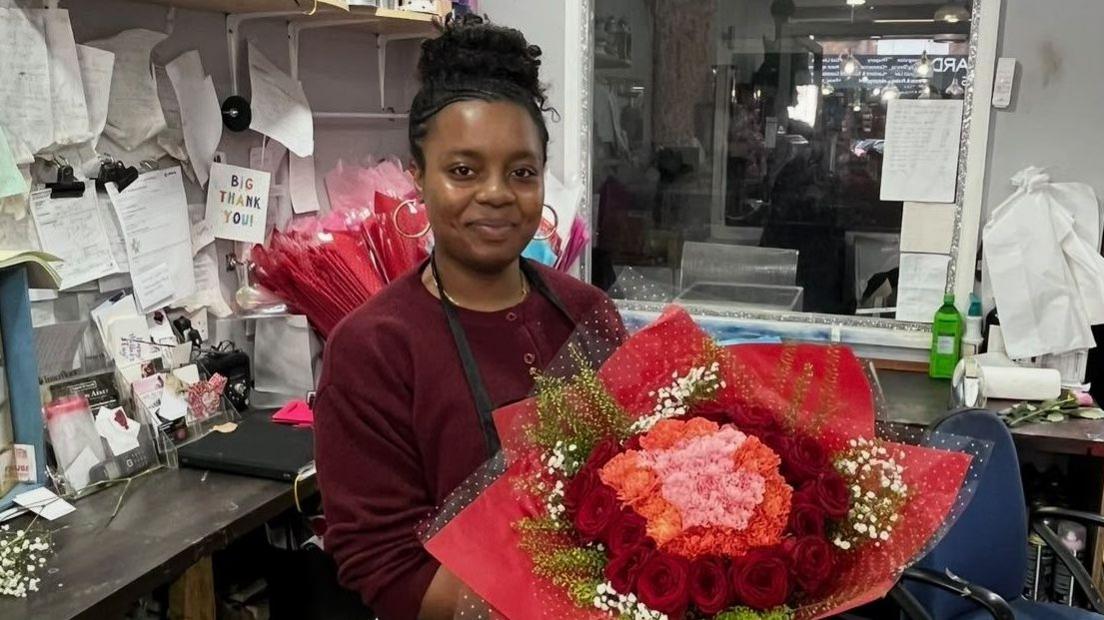
Nineteen-year-old Ayana Bailey doesn’t always disclose her dyslexia in job applications, in case it counts against her.
“It’s not like there’s going to be a target on my back, but I’m just like, ‘maybe they won’t select me’,” says Bailey, a part-time florist.
A British Dyslexia Association (BDA) survey of more than 1,200 working dyslexic adults found Bailey isn’t alone – with 46% hiding their dyslexia at work.
Some 81% believe the condition adds to their work-related stress.
Bailey was diagnosed aged 11 and says she received good support at school, including mentoring, which helped her to understand her strengths and manage low self-esteem.
But the world of work has proved more challenging.
For Bailey, the application process is “daunting”. She says she relies on her mum to go through it with her.
In interviews, Bailey says: “I just shut down. I completely forget who I am.”
One way of coping, she says, is to have a little script, but she admits it doesn’t always work.
Bailey, who studied film and wants to go into the creative arts, says that while dyslexia has sometimes made her feel anxious, it’s also given her opportunities.
“I would definitely say my creativity and thinking outside the box [is my biggest strength].”
She says her dyslexia makes her a visual learner – able to imagine characters before seeing any written descriptions and helping her dream of becoming a casting director.
‘It was majorly affecting me’
For nurse Lisa Daniels, her dyslexia meant leaving work more than an hour late most days just to finish the paperwork.
“I suppressed it. I was like ‘Oh no, everything is fine. It’s not affecting me.'” In reality, she says “it was majorly affecting me”.
Daniels, 37, says a previous manager was dismissive of her request for adjustments.
“When I first started, they said, ‘Oh they are babying some of these nurses’ and I didn’t have the confidence to challenge it.”
 Image source, Lisa Daniels
She says her suggestions of having more accessible fonts and colours on documents were not listened to.
Five years into her career, Daniels’ colleague told her about a staff network on neurodiversity and her confidence grew, along with adjustments such as noise-cancelling headphones.
“I have that resilience that, despite the sometimes lack of support, I’m still gonna show up. I’m still gonna try.”
Daniels says she’s now recovered from her imposter syndrome.
To play this video you need to enable JavaScript in your browser.
This video can not be played
Over half of people surveyed by the BDA say dyslexia makes them feel bad about themselves, while 39% have experienced bad mental health related to it.
The BDA is calling for workplaces to make reasonable adjustments for employees who need them, even without a diagnosis, and wants managers to be trained to understand and support dyslexic employees.
Its report finds dyslexic employees often have to put extra effort into work, finding their own ways to cope if systems, processes and communication are not accessible.
There are 3.3 million dyslexic adults currently in employment, estimates the BDA. Some told the report:
-
“I have to cope with little comments that are seen as banter about my spelling.”
-
“My line manager is actually dyslexic and we happily talk about it. We share best practice and war stories.”
-
“It would be nice to be seen as intellectual. Just because I cannot always write as well as others, doesn’t mean I don’t have the knowledge.”
-
“I revealed my dyslexia quite early on in my employment… I do believe it was used as a stick to beat me with.”
-
“I feel like I have got to do more, be more, show more… because I’ve got this deficit of being dyslexic”.
Employment law solicitor Jenna Ide helped a client win a high-profile dyslexia discrimination case against Starbucks in 2016.
“Many dyslexic employees start a new job already struggling with low self-esteem,” she says.
“That’s especially true of dyslexics who are late-diagnosed and who may have spent years at school and in earlier jobs believing they just weren’t clever enough.
“When an employer doesn’t understand dyslexia, relies on inaccessible ways of working and doesn’t offer support, it reinforces those feelings and can make people more reluctant to ask for help.”
Kate Griggs, founder of UK charity Made By Dyslexia, agrees recruitment can still be a barrier, particularly when it is skewed toward written applications and timed tests.
“My advice to young dyslexics is simple: know your strengths, own them and talk about them with confidence. Ask for the support you need and different ways to show what you can do. Find the roles where those strengths are valued.”
 Image source, Jenna Ide
Ellen Broomé, head of the British Dyslexia Association, said: “Dyslexic people should not have to work harder simply to have the same opportunities as their colleagues.
“Our research reveals the hidden cost many pay, spending additional time and energy compensating for workplaces that fail to understand or support them.
“This is not a question of ability, ambition or talent. It is about the barriers people face and the opportunities lost when workplaces fail to recognise and support different ways of thinking and working.”
Disclaimer : This story is auto aggregated by a computer programme and has not been created or edited by DOWNTHENEWS. Publisher: BBC