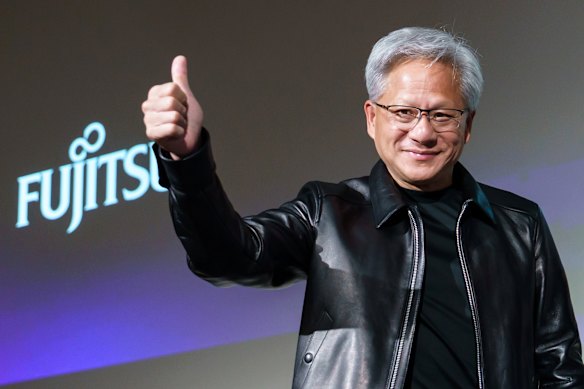

Jensen Huang was too big to fail. Eleven days after he quit Nvidia over an affair with a woman US officials identified as a Chinese intelligence asset, and just a week after his board said he was gone for good, he is back in charge of arguably the world’s most important company.
The investigation into whether Huang was compromised is ongoing, but no matter. The market added about $1.5 trillion to Nvidia’s value anyway. Silicon Valley’s toxic cult of personality is alive and well.
The tech sector has always worshipped its founders, whatever the cost. Steve Jobs was notorious for screaming at Apple staff, yet the company welcomed him back as a saviour in 1997, 12 years after he lost a boardroom fight and walked out. Elizabeth Holmes borrowed Jobs’ black turtlenecks and talked investors into valuing her blood-testing start-up, Theranos, at $US9 billion before she was convicted of defrauding them. Mark Zuckerberg holds enough of Meta’s voting shares that his board could not sack him if it tried.
‘I’d rather torture you into greatness’
At Nvidia’s headquarters on Monday (US time), staff leaned over balconies shouting, “We love you, Jensen.” More than 180,000 people, Elon Musk among them, had signed a petition for his return. Donald Trump shared a doctored version of the photo taken after he was shot in 2024, with Huang in his place, holding a red bra. “We have to protect our geniuses,” the president said.
Protecting its geniuses is Silicon Valley’s modus operandi to a tee.
Beyond the alleged affairs, Huang had a pattern of humiliating staff in front of their colleagues, according to an investigation from The New York Times published days before Nvidia’s board changed its mind. He once told a subordinate he would rip both their arms off and beat them to death with them, the Times reported. “I’d rather torture you into greatness, because I believe in you,” Huang once allegedly said.
His former head of human resources, Michael Winston, said he was fired in 2005 after objecting to that behaviour, and Nvidia settled with him confidentially for more than $US1 million, the Times reported. A spokesman for Huang called Winston’s claims fabrications. Employees who loved Huang and those who loathed him used the same word to describe Nvidia: cultish.
In Silicon Valley, “cultish” is normal, and openly celebrated.
Its boardrooms have shown themselves to be no match for the genius chief executive. OpenAI’s board sacked Sam Altman in November 2023 for not being “consistently candid”, then rehired him four days later when staff threatened to quit en masse. Nvidia’s held out for not much longer: 11 days.
In Australia, billionaire businessman Richard White resigned as chief executive of WiseTech Global after he was accused of bullying and inappropriate conduct, but remains with the company as its chief innovation officer and still serves on its board as an executive director. He denied the allegations.
To be clear, Huang’s defenders have a point. He co-founded Nvidia 33 years ago and turned a maker of graphics cards for video games into the company whose chips run the AI boom. Its sales will top $US400 billion ($600 billion) this year, up from $US27 billion four years ago. Few chief executives have built anything like it. There was no obvious replacement.
But investors, staff and eventually the US president decided Nvidia could not run without Huang, and the board fell into line within a week. Whatever Huang had done, too much money was at stake to keep him out. And much of that money is what’s keeping the mammoth global AI build-out afloat.
‘I made the deal’
Huang resigned on November 12, days after reports of his affair with Alice Huang (no relation), a former executive at Singapore data centre company Megaspeed. US authorities are investigating whether Megaspeed funnelled restricted Nvidia chips into China. The New York Times also reported Huang had an affair with an Nvidia subordinate. Beijing has denied the spying claims.
On Wednesday last week, the board told investors it had no plans to bring Huang back. The shares fell nearly 14 per cent on Friday.
Then Trump, as he is wont to do, entered the fray, posting that rehiring him would be “the best thing for the Company, and also, for the USA”. Vice-president JD Vance acted as an “emissary” to Nvidia’s directors, according to the Associated Press, and Trump reportedly dialled in to their board meeting.
The board said its unanimous vote followed “input from senior levels of the United States government”, and was now confident Huang posed “no national security risk”. Trump told CNBC: “I made the deal.”
By the time Wall Street closed just after 8am on Tuesday (AEDT), Nvidia shares had jumped 31 per cent, the company’s best day since 2000.
A $2.7 trillion man
Josh Gilbert, who analyses Asia-Pacific markets for investing platform eToro, cautions that much of that jump was Nvidia winning back lost ground. The shares had shed about a third of their value this year before Monday. “Plenty of this rebound is the market clawing back what it lost rather than pricing in fresh growth,” he said.
Nvidia will keep investigating whether foreign spies targeted Huang while he runs the company, and is setting up a national security committee and hiring a chief compliance officer. Worthwhile steps, but they come after the board handed Huang back the keys.
The Nvidia saga is far from over: the US corporate regulator is looking at its accounting and Huang is yet to face multiple House and Senate committee hearings.
Nvidia’s board made a clear decision that Huang was too big to fail. What’s less clear is if the sector – and its cheerleaders – have learnt anything from his brief fall.
The Market Recap newsletter is a wrap of the day’s trading. Get it each weekday afternoon.
 David Swan is the technology editor for The Age and The Sydney Morning Herald. He was previously technology editor for The Australian newspaper.Connect via X or email.
From our partners
Disclaimer : This story is auto aggregated by a computer programme and has not been created or edited by DOWNTHENEWS. Publisher: www.smh.com.au