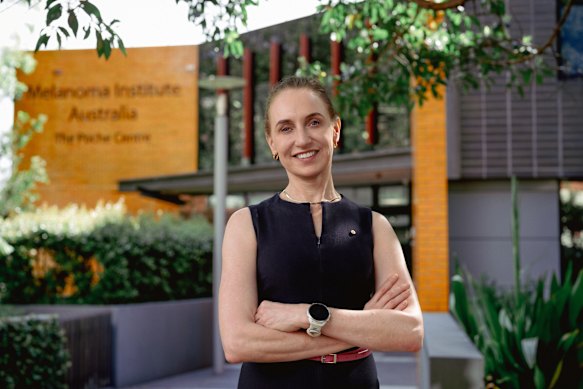

The Sydney researcher who transformed melanoma from a death sentence into a treatable disease has won the prestigious Prime Minister’s Prize for Science in recognition of her work at the forefront of precision cancer treatments.
Professor Georgina Long, who was, with the late Professor Richard Scolyer, the 2024 Australian of the Year, was honoured with the award on Tuesday evening for groundbreaking research that improved survival tenfold for people with stage 4 melanoma, and 24-fold for those with brain metastases.
“Science does not get the limelight often enough, yet it underpins everything we do,” Long told this masthead. “It is not just a person in a lab coat at a bench.”
Long’s recent landmark trial of an mRNA therapeutic melanoma vaccine – which found combining a tailor-made vaccine with an immunotherapy drug reduced the risk of melanoma recurrence or death by 42 per cent – was not included in her nomination as its results were published too recently.
Long, who is medical director at the Melanoma Institute Australia, affiliated with the University of Sydney, said the award was an opportunity to recognise the value of investing in Australian science.
“We are a small and mighty country punching above our weight,” she said. “We come from an age where science has not been celebrated as it should be, and [not recognised for] how fundamental it is to everything we do.”
Long shared the award with Adelaide University’s Professor Anthony Thomas, a physicist whose discoveries have reshaped how humanity understands matter, antimatter, dark matter and neutron stars.
His research was credited with transforming international understanding of the structure of the proton, one of the fundamental building blocks of the universe, and for establishing Australia as a major player in global physics.
Prime Minister Anthony Albanese said this year’s winners prove Australian science and scientists matter. He said the recipients were “helping pave a path to a brighter, smarter Australia”.
Also among the eight honourees was Professor Asha Bowen of The Kids Research Institute Australia, who was recognised for her pioneering research in partnership with Aboriginal communities.
The paediatrician’s landmark See, Treat, Prevent (SToP) trial, conducted across nine remote communities, achieved a 50 per cent reduction in skin sores among local children, the first significant decline in more than 50 years.
Bowen, who won the Frank Fenner Prize for Life Scientist of the Year, said she hoped the award would shine a spotlight on the need, gaps and opportunities to strengthen the health of Aboriginal children.
“We really want to see Aboriginal kids with no more skin sores than any other Australian child and we want to see rates of rheumatic heart disease, [a] downstream consequence of skin sores, disappear in this country,” she said. “We have the resources and the health systems to achieve that; we need the will and the investment to get there.”
The Examine newsletter explains and analyses science with a rigorous focus on the evidence. Sign up to get it each week.
From our partners
Disclaimer : This story is auto aggregated by a computer programme and has not been created or edited by DOWNTHENEWS. Publisher: www.smh.com.au