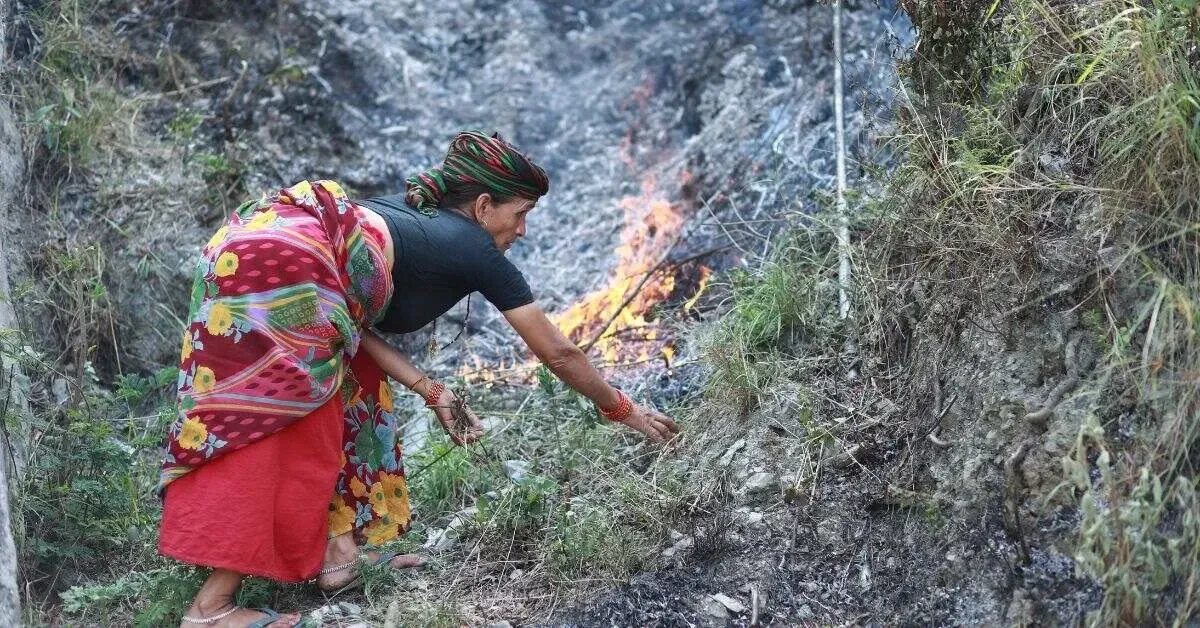
Every morning, 75-year-old Bhagirathi Devi walks into the forest beside her village in Uttarakhand’s Champawat district. She patrols the area, returns home around noon and heads back for another round at 2 pm, often staying until sunset.
Her task is to ensure that nobody cuts trees, damages vegetation or allows cattle to graze where they should not.
For more than two decades, Bhagirathi has helped protect and restore this forest in Manar village. Known locally as Van Amma, she began the effort in 2000, when the woodland had become almost barren following years of excessive grazing and tree felling.
Today, the community-managed forest is also a site of fire prevention.
In a report published by Down To Earth on 31 May 2025, journalist Bhagirath documented how the village’s women organised themselves to restore the forest, regulate access, and remove dry leaves and pine needles before the fire season.
According to residents, there has been no forest fire in the restored forest since the initiative began. The Champawat Forest Department has also recognised the effort as a model for fire prevention.
Manar’s experience points to something important about forest protection in Uttarakhand: preventing fires is not always about reaching a burning hillside with firefighting equipment. It can begin much earlier, with people who understand the forest, depend on it and have the authority to regulate how it is used.
Across the state’s mountain villages, women are increasingly taking on this responsibility.
As men migrate in search of employment, women remain to manage agriculture, livestock and household needs. Their daily work brings them into close contact with forests, making them among the first to notice smoke and respond to small fires.
The Ghost Village question: who is left to protect the forest?
Uttarakhand’s migration story is often told through the image of the ghost village: a settlement where houses remain locked, agricultural fields lie fallow, and only a handful of residents remain.
The scale of depopulation is reflected in government figures cited in the 2021 report Locked Houses, Fallow Lands: Climate Change and Migration in Uttarakhand, India, prepared by The Energy and Resources Institute (TERI) and the Potsdam Institute for Climate Impact Research.
According to the 2011 Census, 1,048 of Uttarakhand’s 16,793 revenue villages were uninhabited. A subsequent survey by the state’s Rural Development and Migration Commission in 2018 identified another 734 villages that had become uninhabited after 2011.
The report notes that depopulation has affected all 13 districts, although the problem is more pronounced in the hill districts.
However, not every village affected by migration is entirely deserted. In many settlements, men have moved to towns and cities for work while women, children and older residents remain. Women continue cultivating fields, looking after cattle, collecting forest produce and caring for family members.
This changes who is available to respond when a forest fire breaks out.
In Manar, Bhagirathi Devi’s initiative began with a problem familiar to many women in mountain villages. Before the forest was restored, women had to walk seven to eight kilometres to a neighbouring forest, Siddhmandir, to collect fodder and firewood. Bhagirathi told Down To Earth that this journey took five to six hours every day.
The loss of nearby forest cover had also affected the flow of local springs. Restoring the woodland was therefore not simply a conservation exercise. It was an attempt to make village life more sustainable.
For women who remain, the responsibility is consequently twofold: maintaining households in villages with fewer working-age residents and protecting the natural resources that make those settlements habitable.
Why women are often the first to notice a fire
The reasons women become first responders are closely connected to the division of labour in rural households.
Collecting firewood and fodder, taking cattle to graze, gathering leaves and working on agricultural land are routine responsibilities for many women in Uttarakhand. These activities keep them in and around forests for several hours a day.
When a fire begins, they may notice the first signs of smoke before it becomes visible from the village or reaches the attention of forest officials.
A 2023 paper by researchers Ripu Daman Singh, Surabhi Gumber, R C Sundriyal, Jeet Ram and Surendra P Singh, published in Tropical Ecology, provides important context for understanding this relationship.
Titled Chir pine forest and pre-monsoon drought determine spatial and temporal patterns of forest fires in Uttarakhand Himalaya, the research analysed satellite-derived fire data from 2002 to 2020 across 24 forest divisions in the state.
The researchers recorded 80,440 fire detections over the 19 years. Their analysis found that warmer pre-monsoon temperatures, a greater proportion of chir pine forest and lower winter and pre-monsoon rainfall together explained 56% of the variation in fire incidence.
They also noted that human activities associated with farming and the collection of fuel and fodder influence the likelihood of fires.
The paper specifically recommends examining changes in population distribution and communities’ dependence on forests as part of effective fire management.
This is where women’s everyday relationship with forests becomes relevant.
They are not simply residents living near a fire-prone landscape. Their livelihoods are directly connected to the condition of that landscape.
A fire can mean losing fodder for cattle, travelling farther to collect fuelwood, spending additional hours searching for forest produce and, in some cases, losing agricultural resources.
The relationship between gender and firefighting is not simply a question of who is more willing to respond. It is also a question of who is expected to undertake the work when the forest that sustains the household is threatened.
In a report published by Mongabay on 8 September 2026, journalist Swati Thapa documented this pattern in Uttarakhand villages.
Researcher Kavya Pandey of the Centre for Wildlife Studies, Bengaluru, told Thapa that traditional gender roles and women’s responsibility for household work and caregiving help explain why they are often the first to respond to fires.
This offers a field-level account of a wider connection between women’s labour and forest protection.
How a community can stop a fire before it spreads
Manar offers a particularly useful example of what happens when women move beyond responding to individual fires and take responsibility for managing an entire forest.
When Bhagirathi Devi began the initiative in 2000, she brought other women together to form a van panchayat, a community forest-management council. She was unanimously elected its first sarpanch.
The initial work involved clearing and fencing parts of the degraded forest. The women also worked with BAIF Development Research Foundation, a Pune-based organisation involved in silvopasture initiatives in the region.
Silvopasture combines trees, grasses and livestock management. The idea was to restore vegetation while ensuring that the community could continue to access fodder and other forest resources.
With BAIF’s support and training, residents fenced the woodland using stones and thorny plants. They cleared invasive species such as lantana and planted native trees and fodder species, including banj oak (Quercus leucotrichophora), angu (Fraxinus micrantha) and utish (Alnus nepalensis).
For two years, grazing was prohibited to allow the vegetation to recover. It took another five to six years for the trees to establish themselves.
According to Manju Manral, the first president of Manar’s Silvopasture Management Committee, 11.6 hectares of forest were eventually revived.
The work was not entirely voluntary.
Down To Earth reported that women involved in the restoration received Rs 120 per day from BAIF. They voluntarily contributed 10% of their wages towards maintaining the forest. Each household also contributed Rs 20 a month towards Bhagirathi’s salary for guarding the woodland.
A separate 2022 field study by the International Centre for Integrated Mountain Development, BAIF and the Centre for Ecology Development and Research also found that the forest under Manar’s van panchayat was healthier than the forest outside its management area.
What the 2026 fire season reveals
In an assessment published on 2 June 2026 on the Indian Institute of Remote Sensing’s (IIRS) Sudoor Manthan science portal, researchers Athira V Mukundan, Madhusmita Murmu, Chandra Mohan Bhatt and Arijit Roy analysed forest-fire activity across the state between January and May 2026.
Using NASA’s MODIS active-fire data, they recorded:
The May figure represented a 109% increase over April. It also accounted for approximately 38% of all detections recorded between January and May.
Pauri Garhwal recorded the highest cumulative number of detections during the five-month period, at 207, followed by Chamoli with 190 and Tehri Garhwal with 130.

The researchers also used Sentinel-2 satellite imagery to map burned areas in Pauri Garhwal. Comparing images from April with those captured between 25 and 28 May, they identified approximately 838.66 sq km of burned area. Most of this was classified as low-severity burning, while 0.94 sq km fell into the highest severity category.
These figures are satellite-based detections and mapped burn areas, not a count of independently verified individual fires. Nevertheless, they show how quickly fire activity intensified towards the end of the pre-monsoon season.
The 2023 research by Singh and his colleagues helps explain this seasonal pattern.
Most fires in Uttarakhand occur between March and May, when temperatures rise, vegetation dries and fresh pine litter accumulates on the forest floor.
The human cost of these fires can be severe. On 13 June 2024, four forest department personnel died while fighting a blaze in Binsar Wildlife Sanctuary in Almora district. According to a report by The Times of India on 14 June 2024, four others were seriously injured after the firefighting team was engulfed by flames.
For women who fight smaller fires in community forests, the risks are no less real, particularly when they have no protective clothing, footwear or firefighting equipment.
Besides, women’s participation does not automatically translate into decision-making power.
A 2026 research chapter by K Nagahama, published in Springer Proceedings in Earth and Environmental Sciences, examines women’s participation in a Uttarakhand van panchayat through household surveys, interviews, forest surveys and long-term observations conducted between 2011 and 2023.
The research examines an important distinction: being present in community forest management does not necessarily mean having equal authority over decisions or control over resources.
The problem is also visible in the reporting from Uttarakhand.

In her September 2026 Mongabay investigation, Swati Thapa spoke to Laxmi Kharayat, a field trainer with The Hunger Project, who described cases where women formally listed as van panchayat heads were unaware of their positions, while male family members exercised authority on their behalf.
There is also a gap between the work women undertake and the employment opportunities available to them.
Seasonal fire watchers recruited by the forest department are predominantly men. Women who assist in firefighting often do so without regular wages or access to appropriate protective equipment.
The Forest Fire Prevention and Management Scheme and India’s National Action Plan on Forest Fires recognise the importance of early detection, community participation and coordinated firefighting. The challenge is to ensure that these provisions translate into practical support for women at the village level.
This means providing women with training in fire prevention and safe firefighting, protective clothing, gloves, sturdy footwear, communication equipment and access to emergency assistance.
It also means creating paid opportunities for women as seasonal fire watchers and ensuring that they have actual decision-making authority within van panchayats.
Just as importantly, their work should not be treated as an unpaid extension of household responsibilities simply because they are the people who remain in the village.
Forest protection begins with the people who depend on it
Bhagirathi Devi’s work did not begin with a firefighting operation. It began with a forest that had become too degraded to support the people living beside it.
By bringing women together, restoring native vegetation, regulating grazing and establishing a system for removing dry litter, the village created a model of long-term community protection.
For women in Uttarakhand’s mountain villages, protecting a forest also means protecting the resources that keep their households functioning.
When the forest burns, the consequences reach their cattle, farms, water sources and daily routines. Their leadership has shown that communities can play a significant role in preventing fires, provided they have the authority and resources to do so.
The next step is to ensure that this responsibility does not remain invisible or unpaid.
The women who recognise the first signs of smoke, organise their neighbours and maintain village forests should be treated as essential partners in forest protection, not as an informal firefighting force expected to manage with whatever tools they have at hand.
Sources:
‘Guardians of groves-How women of an Uttarakhand village successfully revived a lost forest’: By Bhagirath, Published on 31 May 2025
‘How Uttarakhand’s women and villages are defending forests with community, care and smart tools’: By Varsha Singh, Published on 16 June 2025
‘Forest commons for multiple benefits: Restoration of degraded land and revival of springs in Uttarakhand, India’: By Dinesh Prasad Raturi, Santosh Paudel & Erica Udas, Published on 14 October 2022
‘Chir pine forest and pre-monsoon drought determine spatial, and temporal patterns of forest fires in Uttarakhand Himalaya’: By Ripu Daman Singh, Surabhi Gumber, R. C. Sundriyal, Jeet Ram & Surendra P. Singh, Published on 5 June 2023
‘LOCKED HOUSES,FALLOW LANDS-Climate Change and Migration in Uttarakhand, India’: By Potsdam Institute for Climate Impact Research (PIK), Potsdam and The Energy and Resources Institute (Teri), Published in 2021
‘Sickles, sarees and smoke: Women on the frontlines of Uttarakhand forest fires’: By Swati Thapa, Published on 8 September 2026
‘Uttarakhand Forest fire Activities and Burned Area Assessment 2026’: By Athira V Mukundan, Madhusmita Murmu, Chandra Mohan Bhatt and Arijit Roy, Published on 2 June 2026
Disclaimer : This story is auto aggregated by a computer programme and has not been created or edited by DOWNTHENEWS. Publisher: thebetterindia.com