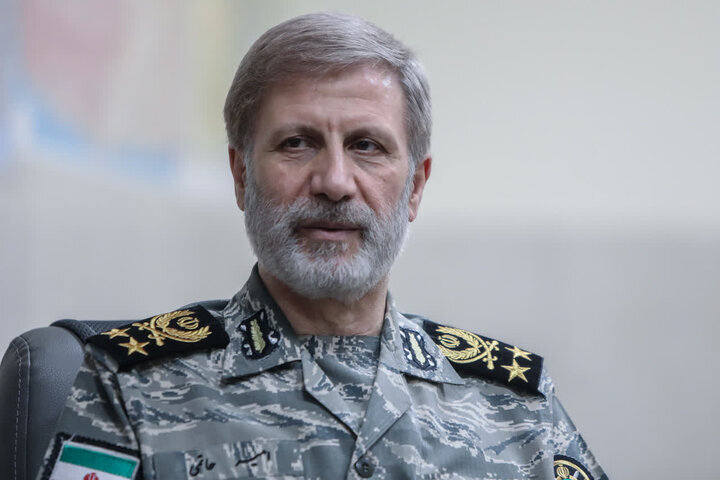
TEHRAN – Iran’s Army chief has warned that the Strait of Hormuz will remain closed and come under increasingly tighter Iranian control until the country’s seven conditions are fulfilled, stressing that any renewed aggression against Iran would trigger a more forceful response, with no geographical limitations.
Major General Amir Hatami made the remarks on Tuesday while addressing senior commanders in Tehran. The address was also delivered via videoconference to Army units across the country.
Hatami said Iran’s comprehensive national power, encompassing military, social, political and geopolitical dimensions, had fundamentally overturned the calculations of its adversaries, who had failed to appreciate the country’s capabilities before launching their aggression.
He highlighted the defensive nature of Iran’s military operations, noting that the country had confronted the United States, which presents itself as a superpower, and its ally, Israel, which had defeated several neighboring countries in a six-day war.
The Army chief said the enemy had assumed that Iran would be unable to sustain its missile operations beyond three or four days, drawing on its experience from the 12-day war. However, Iran continued its strikes until the final day of the conflict and maintained its ability to launch attacks during the subsequent 10-to-12-day confrontation.
He added that Iran’s military preparedness and operational capabilities were currently in a strong position and that the country had achieved its objectives in defending itself.
The Army chief also recalled the late Leader’s warning that any aggression against Iran would turn into a regional war, saying many had failed at the time to grasp the strategic significance of that assessment but had come to understand it once the conflict unfolded.
Hatami, who is also a member of Iran’s Defense Council, said the regionalization of the war had enabled Iran to expand the conflict both vertically and horizontally, transforming its position from that of a regional power into a global one and making the consequences of its power felt worldwide.
He stressed that Iran had not allowed those responsible for the war to confine its costs to the Iranian people, saying the consequences had also been felt by the parties that initiated and supported the conflict, including at their own gas stations and in their living rooms.
He said Iran had already drawn up new operational plans and completed the necessary preparations to implement the directives.
Under the new approach, he warned, any attack on Iran’s infrastructure would be met with retaliatory strikes against the adversary’s infrastructure on a scale that would make recovery far more difficult.
Hatami emphasized that Iran was now formulating its military plans without geographical restrictions, adding that the country would not shoulder the consequences of war alone. Any party that assisted or sided with Iran’s adversaries would also have to bear the costs.
He further cited the Commander-in-Chief’s directive that, in the event of another war, Iran would determine its timing and conditions.
The Army chief described Iran’s adversaries as being in a state of desperation and strategic passivity, warning that another war would push them into an even deeper predicament.
Concluding his remarks, Hatami said Iran’s objectives were to remove the threat of war, bring an end to the neither-war-nor-peace situation, and secure the lifting of ‘unjust sanctions.’
He stressed that these objectives were tied to the implementation of Iran’s seven conditions, adding that the Strait of Hormuz would remain closed until they were fulfilled.
“The Strait of Hormuz will not be reopened; it will become increasingly closed, and stronger control will be exercised over it,” he said.
Disclaimer : This story is auto aggregated by a computer programme and has not been created or edited by DOWNTHENEWS. Publisher: tehrantimes.com