
If there’s one place you should be safe from audience participation, it’s when reading a book. Not any more. Early on in Jasper Fforde’s Dark Reading Matter the author makes a request of his readers – no matter where you are, or what you are doing, if you see text appear in a certain font, could you please read it aloud.
The first time I see this I’m at home, and despite being the sort of person who strategically positions herself in comedy shows for minimal interaction, or who got through school choir by half-heartedly miming, I find myself gingerly speaking the words aloud: “Oh my goodness, they’ve trodden on the gibbon.”
Dark Reading Matter is the eighth and final book in the Thursday Next series. It started in 2001 with Fforde’s debut novel, The Eyre Affair, and tracks the titular Thursday Next, a detective, as she fights battles of varying surreality against corporations, corruption and, on occasion, Enid Blyton characters.
“I think that the real jumping-off point for this book was that I dedicated it to readers,” says Fforde. “If you’ve been reading my series for the last 25 years, this is for us … and we’re going to have some fun.”

The series has always been meta – the main character lives in an alternate version of our world, and within her world she discovers that books aren’t simply objects containing words; they’re the output of the BookWorld, where all the characters are real and performing books kind of like a play.
Beyond that they have their own society and lives and, yes, a police force, which is there to stop things going off the rails. In the final novel, however, Fforde takes the opportunity to shake off all shackles and see what truly is possible with the written word. Our world is suddenly a new layer on top of things, we the reader have a role to play – thus the speaking aloud – and Fforde himself turns up in the book – well, sort of. “He’s awful!” says Fforde with a laugh. “I mean, he’s a terrible human being.”
The techniques Fforde uses in all his books push at the boundaries of what we expect. His novels throw you in the deep end, with their seemingly chaotic blend of wordplay, adventure and hard truths – but it’s at 3am, when you realise you haven’t been able to put the book down, that you realise how intricately put together it all is. There’s a reason for the seemingly random illustration at the front. That isn’t just any donkey on the cover. And the gibbon is important.
Under all the fun and the wordplay his books all take on deeper themes; they’re about free will, they fight against unchecked authority and they advocate for what is fair and right. Here is no different – what on the surface may seem like silliness is actually a battle cry. Dark Reading Matter is first and foremost a joy to read and a love letter to the readers who have come on this decades-long journey with Fforde and his fictional detective Thursday Next – but at its core it’s a fight for the future of literature.
Dark Reading Matter comes at an existential moment for literature; at a time when physical stories are being literally cut up and fed into machines to teach AI how to write.
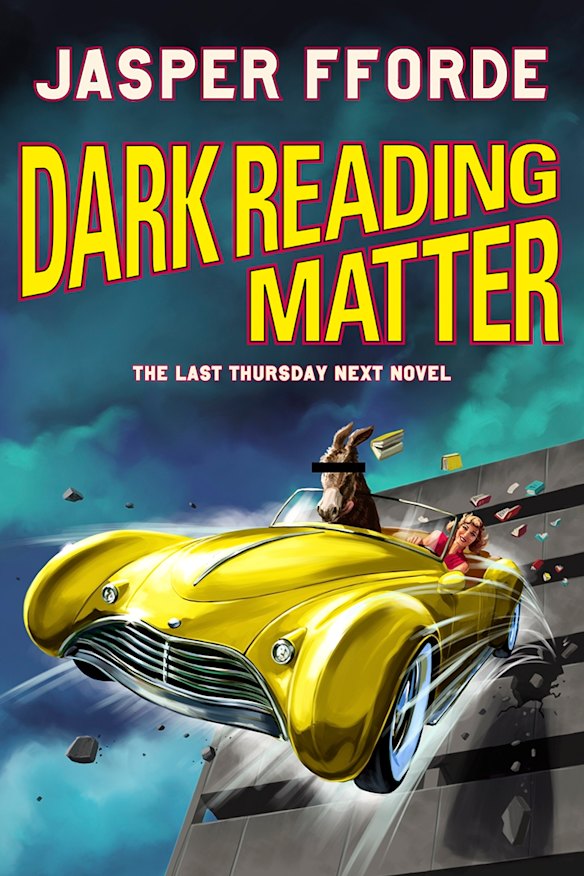
The key antagonist of the story, Roger Thatt, is trying to gain access to the “dark reading matter” – not the BookWorld but all the bits from around the edge. It’s the place where all ideas and potential ideas go; memories, thoughts, discarded drafts. Thatt wants to harvest it all, to monetise it, to control inspiration.
This novel manages to explore the threat of AI without being preachy or dull – a miraculous achievement in a saturated conversation – and manages to do it through both plot and structure.
“I was out to write a book that AI could not scrape. It could not scrape this. It could not understand it,” he says. It’s true – what would artificial intelligence make of conversations that happen purely in the footnotes, which in the book are used as a communication system? How would it navigate the narrative impact of font changes? Or, stepping back, would the character names – including Landen Parke-Laine, Acheron Hades and Jack Schitt – and the entire blend of pop culture, history and puns that go into creating them even be a possibility? “It can’t think up new stuff. It can only take old stuff and repackage it,” he says.
Before he was an author, Fforde was in the film industry, working as a focus puller. He started at age 19, and across a 20-year career worked on films including GoldenEye, Entrapment and The Mask of Zorro, but it was a volatile industry. “The jobs could dry up literally any moment.”
He started writing short stories at the age of 27, and across the next 12 years “I had five books written and [none published]. No one interested at all.” He found a strange freedom in the rejection, however, and started writing The Eyre Affair.
“I thought, well, it doesn’t matter what I write because I’m not going to be published. So I’m just writing for fun.” The manuscript was “fun and silly, and it just mixes everything together – literary theory and vampires and werewolves and everything else”. The resulting book deal was enough that Fforde could stop work. His final project was an ad featuring Leonardo DiCaprio – “and the following week I was an author”. The Eyre Affair was an instant hit and became a New York Times bestseller.
Though Fforde is still a keen photographer and still working in the creative industries, there is both a wistfulness and an edge of concern when he talks about the film industry. “I miss it a lot,” he says. The threat of AI is looming, though. “If I was in the film industry now, I would be thinking it’s all over for us,” he reflects. “If I was an actor or a filmmaker I would be terrified.” He pauses. “Or, alternatively, I would be thinking I need to start a theatre troupe. You know – this could be the greatest resurgence of theatre that the world may ever see.”
Fforde has been pushing boundaries, subverting expectations and challenging himself with every book he writes. The Constant Rabbit is a novel that takes on nationalism and Brexit specifically while also being about anthropomorphised rabbits. His first standalone novel Early Riser imagines a world where the human race hibernates for months each year. The Shades of Grey novels take on discrimination and class through a society that ranks people based on what colours they can perceive.
There is another, quieter thread that laces through the latter half of Dark Reading Matter, in a non-fiction detour where a version of Fforde himself is the protagonist. He reflects on articles he’s read, on his writing, and in one section recalls drives with his mother “during her latter years when the Alzheimer’s became momentarily not the debilitation that it was, but a gift that could keep on giving: I could take her on these drives each week and every time she would enjoy it as though the first”, he writes.
“All of us will be involved with dementia … either personally or someone close to us, and it was a very big part of my life,” Fforde says.
When he takes us further into the dark reading matter of the novel, we’re taken to a place populated by memories, with one character meeting their younger self, the balance of recollection uneven between them. “The concept that there is a place where every human experience has ended up, all our memories, all our moments that we feel have gone are all still there – I think that’s a way, way bigger idea than I could even write about … There’s a nod to a theory about black holes, that because information can’t be destroyed, information cannot vanish forever,” he reflects.
‘I think there’s a way in which we can just try and shift things a little bit for the better.’Jasper Fforde, author
“I don’t know whether I put it in there but all the stories that my mum told me, about things that she’d done in the past, I retold back to her when we had our afternoons together, driving up on the Elan. She couldn’t remember them, of course, and they’d gone … we’d actually swapped memories, that I now had her memories in a weird way.”
He points to a prescient idea from Kurt Vonnegut’s The Sirens of Titan, about shared human knowledge that could be taken as a precursor to the internet, or the pool of knowledge drawn upon by AI. “I’ll paraphrase,” says Fforde. “There is a cloud of collective consciousness that floats over all of us – you draw from the cloud and you put into the cloud, and authors, I felt, taking this idea further, you promote your world-view, which you hope – you think – is positive … In our small way, as authors and as painters and as singer-songwriters, we’re trying to push that cloud into a direction that makes sense for a more pluralist and fair, free society. Away from the right-wingers, the billionaire tech oligarchs, into a place where we all mutually support one another.”
On Dark Reading Matter: “What does this do for literature? I’m not sure it does anything. I think it’s trying to just make people feel that there is a better place that we could be … I think there’s a way in which we can just try and shift things a little bit for the better.” He pauses, then, unable to let the comment go without some self-deprecation, adds: “But it does make me sound a little grand and pompous.”
The Booklist is a weekly newsletter for book lovers from Jason Steger. Get it delivered every Friday.
Disclaimer : This story is auto aggregated by a computer programme and has not been created or edited by DOWNTHENEWS. Publisher: www.smh.com.au