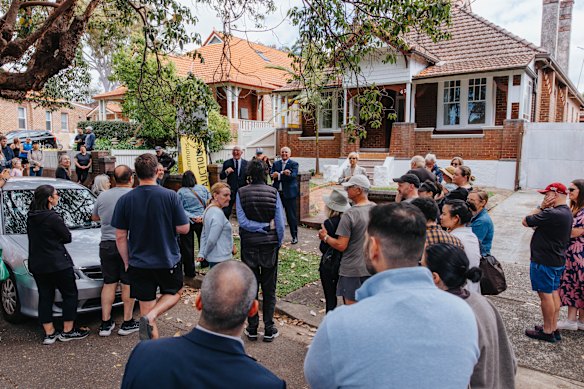

Home buyers would need to spend almost half their income on mortgage repayments to purchase a typical home, as rising interest rates erode the affordability benefits of a steep property downturn.
Measures of housing affordability remain near historic depths, research house Cotality warned, even though property prices have plunged this year, because mortgage costs have risen.
An average household would need 49.5 per cent of income to service a new mortgage if they bought in the September quarter, the third-highest level on record, Cotality’s latest Housing Affordability Report, released on Wednesday, shows.
But the picture varies by location and property type. Sydneysiders buying the typical house would need to spend 67.6 per cent of their household income on their repayments, while Melburnian house buyers would require 46.1 per cent.
In practice, many banks would be cautious about lending to borrowers who could find themselves in mortgage stress, often defined as spending more than 30 per cent of income on repayments.
In some neighbourhoods, the typical property is even further out of reach. Residents of Sydney’s eastern suburbs would need to spend a hypothetical 136.8 per cent of their incomes on repayments for a typical house, even taking into account the ample incomes earned by many locals. The research assumes a 20 per cent deposit but, in practice, many buyers here have built equity in another home before upsizing, or have other assets.
“It’s just a ludicrous ratio to income. In these types of areas it’s less about what your income is, it’s more about what your wealth is,” Cotality head of research Gerard Burg said.
Residents in Melbourne’s inner east would need 71.6 per cent of their income for a new mortgage on a house. But locals in Melbourne’s more affordable western suburbs would need only 28.5 per cent of their own incomes to buy a unit.
For first home buyers using the Australian Government 5% Deposit Scheme, a purchase sooner on a smaller deposit means paying off a larger loan relative to the price of the property.
Meanwhile, the research found the national dwelling value costs 8.2 times as much as the typical pre-tax household income, slightly below its record high but above its long-term average and the fifth-highest on record.
A household aiming to save a 20 per cent deposit that could save 15 per cent of their income a year would take 10.9 years to save, just below its peak but longer than average.
Burg said affordability was improving, but only slowly, from record levels of unaffordability. Housing was not affordable by historical standards nor by international standards, he said, and there had not been a rush of first home buyers.
“There is still a significant challenge for people who are looking to make a home purchase,” he said. “They have to commit an enormous amount of their income, there is a large proportion of the population who can find themselves priced out of the market.
“People on lower incomes in areas that are traditionally affordable to a lower-income population are increasingly priced out of these markets … It’s not as simple as telling someone to move further afield.”
A typical renting household would need to set aside 33.7 per cent of income for rent payments, above the 30 per cent threshold for rental stress and higher than average.
Burg said housing affordability was a complicated issue to solve.
“Even what is now the fastest downturn in the history of the combined capitals over the past 40 years – there’s been lots of attention around that – hasn’t had a huge impact on affordability. [It] means those moves through the cycle aren’t enough to change things,” he said.
“It’s really about a co-ordinated strategic approach to increasing housing supply … Real sustainable gains in terms of affordability come down to having that supply in such a fashion that you can have incomes growing more rapidly than the value of these properties and gradually ease that burden over time.”
AMP chief economist Shane Oliver thought any improvements to affordability this year were modest.
To achieve a decent improvement in housing affordability, property prices would need to fall 20 per cent, he said, a drop that he did not think was likely. He is forecasting price falls of about 15 per cent.
But he noted the risk that if unemployment rises and property prices fall, some recent home buyers may lose their jobs and need to sell their homes for less than their loan balance.
Separate figures from S&P Global Ratings released on Tuesday showed 1.12 per cent of Victorian home borrowers are behind on their repayments, and 0.91 per cent in NSW.
“Affordability was just so horrible to start with, perhaps we have just reversed the deterioration that occurred through the last year rather than seeing a dramatic improvement,” he said.
“The impact of higher interest rates on serviceability is such that it has largely offset the improvement in affordability due to lower house prices.”
Property alerts are now available in The Age and SMH apps. Turn them on to receive the latest market news and trends.
 Elizabeth Redman is the national property editor at The Age and The Sydney Morning Herald.Connect via X or email.
Property listings
From our partners
Disclaimer : This story is auto aggregated by a computer programme and has not been created or edited by DOWNTHENEWS. Publisher: www.smh.com.au