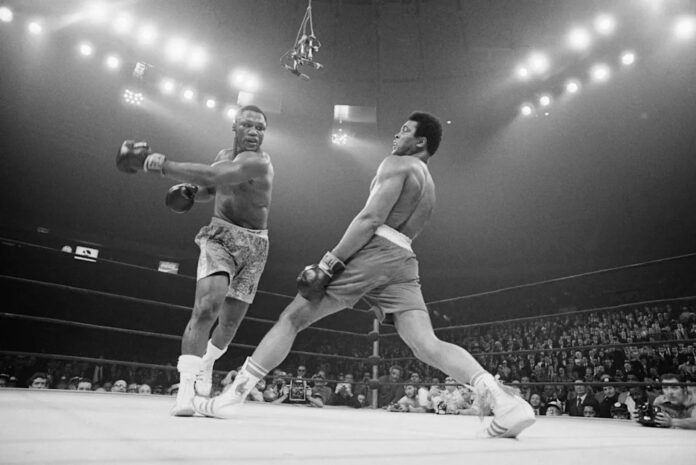
History shows that the sport of boxing can do innumerable things to self-harm or self-destruct, but will always have a fighting chance of survival so long as its heavyweight division maintains a pulse. This has been the case since its inception and never has it been truer than today, at a time when the sport seems hell-bent on either reducing its visibility or becoming a playground for imposters to redefine what it means to box.
It is, for one division, perhaps a heavy weight to carry. Yet the great thing about heavyweights, as a support group, is that whenever required to stand up and be counted, they usually do. They suffer their dips and depressions, as any division will, but on the whole, where there are heavyweights, there will be help. Also, a degree of hope.
Advertisement
Theirs, after all, is a language easily understood. If the nuances of lightweights, featherweights and flyweights tend to alienate the general public, there is no such issue with the bigger boys. Rather than feel confused, any time a person stumbles upon two heavyweights in a ring, they will typically have a clear idea of both the narrative and its likely conclusion. Moreover, they have context. They know many of the famous names: Ali, Frazier, Foreman, Tyson, Holyfield, Johnson, Louis, Marciano, Dempsey, Balboa. Chances are, without much effort at all, they can imagine what a heavyweight looks like — the frame, the ferocity, the face — and will have in their mind a picture of what happens when two of them throw punches. There will in all likelihood be damage, little in the way of subtlety and, most importantly, a knockout to finish. That, for any casual viewer of fights, is the key element. The hook. Often it is the thing that will motivate them to watch in the first place. Often it is why they return for more.
“It’s a great thing for boxing when the big men are good and they fight each other,” HBO legend Larry Merchant once told me — the theory being that boxing can never thrive or gain widespread popularity if heavyweights aren’t front and center of the class photo. “When the heavyweight division works,” he said, “it all kind of works.”
Of course, few understand the history and importance of the heavyweight division better than Merchant, a man who attended the 1971 “Fight of the Century” between Muhammad Ali and Joe Frazier and, to this day, calls it “the greatest event I ever covered.” In fact, so spellbound was a young Merchant by the heavyweights of the 1970s, he even bought a share in Frazier back when fighters were financially supported by the locals who watched them fight. In those days, Merchant said, there were 80 shares priced at $250 apiece, and only by raising $20,000 worth would Frazier be able to quit his job with a Philadelphia meat-packing company and devote himself full-time to his boxing career. Frazier, in turn, then contributed his blood, sweat and tears to one of the heavyweight division’s most fruitful and memorable eras. Nobody asked for a refund.
Muhammad Ali (R) and Joe Frazier, heavyweight legends.
(Bettmann via Getty Images)
After that era — defined by Ali, Frazier and George Foreman — it was soon Larry Holmes’ moment to shine, only Holmes, despite the beauty of his jab, was far less appealing to the public than the men he had replaced. That Holmes period was then followed by short reigns for a horde of other heavyweights, nearly all of whom were inferior to Holmes and whose names most fans would struggle to recall without clues. Among them were the likes of John Tate, Mike Weaver, Michael Dokes, Gerrie Coetzee, Tim Witherspoon, Pinklon Thomas, Greg Page, Tony Tubbs, Michael Spinks and Trevor Berbick.
Advertisement
With no dominant force to be found at that time, the division was considered to be in the doldrums. There were too many belts and too many average heavyweights holding them, and the division slipped into irrelevance as a result. For years it cried out for someone to emerge and grab it by the scruff of its neck; restore some order, return it to its former glory.
Then along came a 20-year-old from Brooklyn, New York whose destruction of Trevor Berbick in 1986 proved to be the division’s Narcan. Suddenly, thanks to Mike Tyson, both the division and the sport had been restored to life. One shot directly into the muscle and it was healthy again, sexy again, and worth paying attention to again. Before long, just about every prominent celebrity of the time was watching Tyson at ringside, each jostling to get as close to the ring as possible. Better yet, all over the world people were now congregating around television sets to watch Tyson fight, making each Tyson demolition a communal experience only a fool would miss.
Some of these rubberneckers will have continued to watch, too. They would have continued to watch after the Tyson bubble was burst by James “Buster” Douglas, and after Tyson had gone to jail, and after the likes of Evander Holyfield, Lennox Lewis and Riddick Bowe all had their turn as champion. They will have watched in the hope of one day seeing another Tyson arise, or simply because, having witnessed the original, they now knew how thrilling it was to see a heavyweight do heavyweight things.
Only with the passing of time of course have we come to acknowledge Tyson’s singularity and stopped waiting for a successor. We have also seen the heavyweight division mostly function as either a collection of mediocre equals passing around half a dozen belts or a dictatorship governed by the Klitschko brothers, Vitali and Wladimir, who were, for better or worse, Tyson’s antithesis in every way imaginable.

The Klitschko brothers never quite captured the imagination of the mainstream sporting public.
(Martin Rose via Getty Images)
More recently fans were teased with the prospect of another golden age when Tyson Fury, Anthony Joshua and Deontay Wilder each held heavyweight titles concurrently and at various points threatened — only threatened, mind — to bring some order to proceedings. That they ultimately failed to do so will reflect badly on that period, but still it was fun and still Fury, Joshua and Wilder got people caring about the heavyweights — and therefore boxing — again. “The heavyweight division hasn’t had this kind of a lineup since the early ’90s of Holyfield and Tyson and Lewis,” Merchant said of that latest batch of big-name heavyweights. “I think that for the average fan having a fleet of good heavyweights is important. For any fan wanting to see hard-to-call matches and rematches, it’s great.”
Advertisement
Great or not, the only reliable thing about the heavyweight division is that it never stands still. Champions come and go, titles change hands, upsets happen. Today, Fury, Joshua and Wilder, once the future of the division, now represent its past, and even Oleksandr Usyk, that generation’s best, chose to dump his heavyweight titles in June and essentially said, “That’s it, my work here is done.”
Usyk, who will turn 40 in January, has since expressed a desire to return to cruiserweight, where he first made his name. Meanwhile, in his absence we now have four heavyweight belts (WBC, WBA, IBF and WBO) spread among a lucky few, and a Dec. 11 fight between Fury and Joshua which is as much a slap in the face for fans as a reward for their patience. It might, for that era, mark the curtain call; its last breath.
Then again, better late than never. For just as Fury and Joshua both need it, the sport probably needs it. It needs not only this specific heavyweight fight on Dec. 11 but additional ones too, the bigger the better. It needs these fights the same way the film industry needs big, dumb superhero movies to compensate for the money lost on the grown-up arthouse fare for which today’s audiences no longer have the attention span. It needs them because if history has taught us anything, it’s that the health of the sport rests squarely on the shoulders of its marquee division.
Luckily for boxing, the heavyweight division is currently pulling its weight and doing OK. In fact, there is an argument to be made that in 2026, the heavyweight division has been responsible for generating more of the sport’s most compelling moments, storylines and fights than any other weight class.
Advertisement
For starters, the heavyweight brawl between Daniel Dubois and Fabio Wardley in May would be a worthy recipient of any “Fight of the Year” honor handed out in the next few weeks. By far the most brutal fight of the year, what Dubois-Wardley 1 lacked in finesse it more than made up for in terms of drama, blood and savagery, with Dubois somehow recovering from two early knockdowns — the first after just 16 seconds — to turn the tide and stop Wardley in Round 11. Between them the two Brits delivered everything fans find so thrilling about heavyweight boxing: The uncertainty, the sudden momentum shifts, the barbarism.
Indeed, such was the violence on display that night, both would have been entitled — encouraged, even — to take the remainder of the year off to rest and recover. However, afraid of losing momentum, Dubois and Wardley instead agreed to a rematch in London just five months later. This time it was Wardley who found himself knocked down 17 seconds into Round 1, and this time Dubois refused to prolong the pain. By Round 2 the fight was over, Wardley was in a heap, and Dubois had retained his WBO heavyweight title.
That belt once belonged to Usyk, of course, though it was nowhere to be seen the night Usyk beat Rico Verhoeven, a kickboxer with next to no boxing experience, in May. That was another of the year’s major talking points, by the way, as well as further evidence of the heavyweight division’s capacity to wrong-foot its audience and create drama.

Usyk and Verhoeven created one of the spectacles of the year with their boxing match at the Pyramids of Giza.
(KHALED DESOUKI via Getty Images)
Looking back, Usyk’s decision to box Verhoeven in Egypt was bizarre enough — likewise the WBC’s decision to sanction it — yet the fight itself, which lasted almost 11 rounds, took the concept of bizarre to a whole new level. Verhoeven, after all, didn’t just manage to survive rounds with Usyk. He won them — plenty of them. For much of the fight he had Usyk anxious and bemused and, had it not been for the Ukrainian’s heroics in Round 11, we could have been discussing the heavyweight division’s biggest upset since Tyson vs. Douglas. Seriously, it was that seismic. It was that bizarre.
Advertisement
Speaking of upsets, there has been no shortage of those at heavyweight this year. Three of the standout prospects in the division, in fact, have all had their unbeaten records snapped in 2026; a reminder both of the precarity of any heavyweight fight and the uncertainty of the division’s long-term future.
The first to falter in 2026 was Cuban Lenier Pero, whose 13-0 record was spoiled in April by Jarrell Miller, a veteran New Yorker whose exploits will forever be spoiled by the numerous performance-enhancing drug tests he has flunked as a professional. After Pero it was then the turn of Richard Torrez, America’s next great hope. He had won 14 fights in a row before being unceremoniously flattened in Round 2 by Cuba’s Frank Sanchez on the same night Usyk messed around with a kickboxer in Giza.
Finally, in August, you had the collapse of Moses Itauma, a British heavyweight whose hype far exceeded the hype around both Pero and Torrez. Whether warranted or not, Itauma was already receiving Mike Tyson comparisons and viewed as more than just a prospect. He was, if anything, seen as the heir apparent; his ascent to the throne presumed rather than merely predicted. Some even went so far as to say Usyk should delay retirement and stick at heavyweight to allow Itauma a passing-of-the-torch opportunity, as if beating Usyk was entirely conceivable; the logical next step.
As it happened, Itauma, just 21, tripped before reaching Usyk, all because Filip Hrgovic stood up to the kind of punches Itauma had used to chop down his 14 previous opponents. He took them and he felt them, don’t worry about that, but by Round 9 — the round in which the fight ended — it was patently obvious Hrgovic had won the war by virtue of outlasting Itauma and saying “no” to a child accustomed to hearing the word “yes.” It was, in every respect, a lesson. It was also one of the most captivating spectacles in the sport this year; a real see-it-to-believe-it moment in a division built on them.

Hrgovic’s stunner over Itauma (L) provided one of the biggest upsets of 2026.
(Steven Paston – PA Images via Getty Images)
No less shocking was the sight of Anthony Joshua, a former two-time heavyweight champion, getting knocked down twice in the opening round of a routine tune-up fight against Kristian Prenga in July. That fight, a mismatch on paper, had been designed to ease Joshua back into action following a personal tragedy in December 2025. Yet, for all the time and precautions taken beforehand, it was no hand-holding exercise. Instead, Joshua, almost stopped in Round 1, appeared timid and vulnerable from the get-go, and only his courage and punch power, combined with Prenga’s ineptitude, bailed him out in Round 2.
Advertisement
Next up, on Saturday, is Agit Kabayel, the WBC champion from Germany. He, like the others (Dubois and Hrgovic), claimed his title after Oleksandr Usyk dropped it in June, at which point he became the first German world heavyweight champion since Max Schmeling in 1932. Before that, Kabayel, born in Germany to Kurdish parents, held the interim version of the belt, which he won with a sixth-round stoppage of Zhilei Zhang last year. Now, having kept winning and waiting, his first proper WBC title fight against Nelson Hysa, an unbeaten Albanian, takes place at Düsseldorf’s Merkur Spiel-Arena, where Tyson Fury dethroned Wladimir Klitschko on the very same day 11 years ago.
It is at home Kabayel, 34, has become quite the star, borne out by the 25,000 tickets he shifted in just 24 hours of presale for this weekend’s bout against Hysa. In Germany, a nation familiar with stadium fights, it is reasonable to suppose the natives now flock to watch Kabayel (27-0, 19 KOs) for the same reason they once came out to watch the Klitschkos, two Ukrainians, and Nikolay Valuev, a seven-foot Russian. They come out to watch him because he is a heavyweight.
“What Agit has done over the last few years has been tremendous,” said his promoter, Frank Warren. “Agit Kabayel is one of the biggest ticket-selling fighters in the world. You look at the last fight [against Knyba in January] — the first fight we did here [in Germany] — and it sold out in a day. We’re going to be opening up for 40,000 [spectators on Saturday] and the atmosphere is going to be unbelievable. Nelson has taken a big tranche of tickets himself — he’s got 6,000 or so — and it’s going to be great. After this fight the winner is going to be involved in massive fights next year.”
Massive fights. Massive men. Massive interest.
Advertisement
Perhaps even when the meaning and value of everything else in boxing, and life, has been stripped away, we the people will still know and appreciate what it means to be the heavyweight champion of the world. Perhaps, in a world lacking leaders, direction and unity, that will end up being the last thing to go. The last beacon of order and truth. The last language understood. The last fighter standing.
Disclaimer : This story is auto aggregated by a computer programme and has not been created or edited by DOWNTHENEWS. Publisher: Sports.yahoo.com