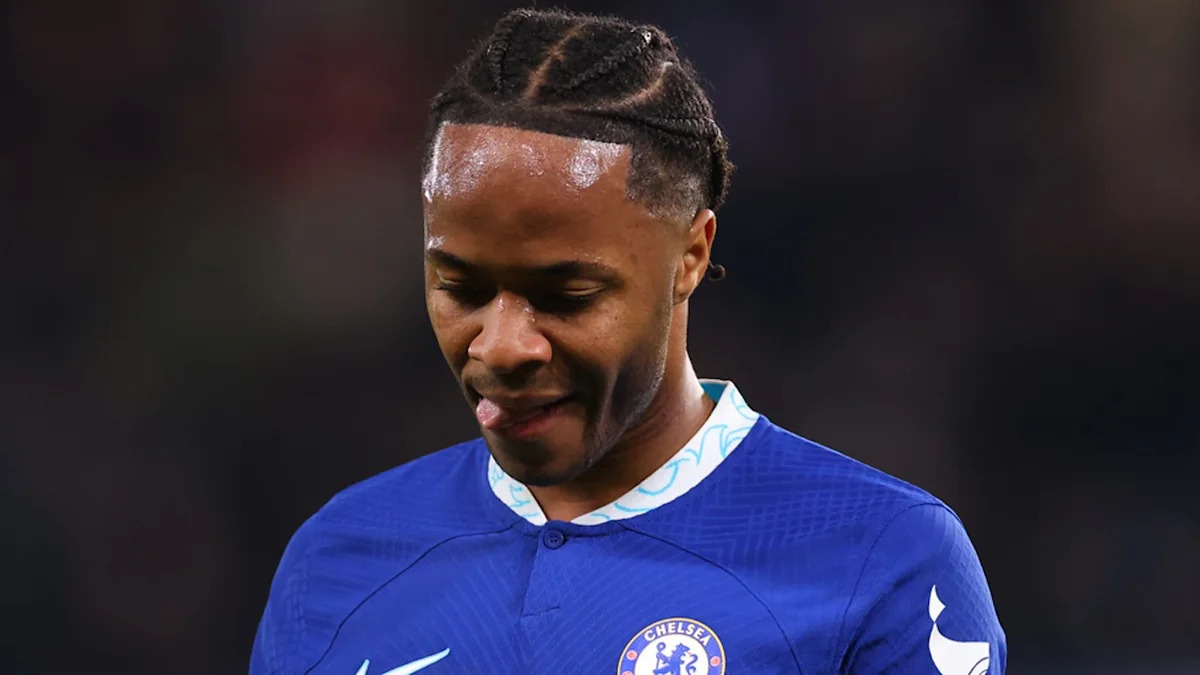
Raheem Sterling grew up a stone’s throw from Wembley Stadium, and went on to start a European Championship final for England there.
At his peak, the four-time Premier League winner was earning £325,000 a week at Chelsea.
Advertisement
“Raheem is a huge player with a huge influence in the last few years in English football,” said then Blues boss Thomas Tuchel when he signed a 27-year-old Sterling in a £50m deal in 2022.
“He is at the perfect age to take responsibility around the younger players that we have and be an example.
“He just needs to do what he did over the last few years and he will be a huge asset for us.”
Sterling enjoyed a 10-year England career, also played for Liverpool, Manchester City and Arsenal, and commanded combined transfer fees of about £100m.
But his career at the top level of English football looks to be in the balance at the age of 31 after he was handed a 12-month prison sentence, suspended for 18 months, for dangerous driving. Sterling has also been disqualified from driving for two years and ordered to carry out 100 hours of unpaid work.
Advertisement
At an earlier hearing in September, Sterling admitted dangerous driving on a motorway before crashing a Lamborghini on 28 May.
The crash caused “substantial” damage to his car and all four wheels, which prevented him from driving further, the court heard.
Sterling also admitted possessing nitrous oxide for wrongful inhalation, and failing to provide a specimen for analysis.
A stark warning aged 10
Sterling’s life was touched by tragedy at a young age.
Born in Kingston, Jamaica, he was just two when his father was shot dead.
His mother, Nadine, was determined to give her children a safer environment to live in. She moved to England to lay a path for Sterling and his sister to join her once she had found a home and finished her education, while cleaning bathrooms and changing bedsheets in hotels to earn extra money.
Advertisement
Sterling grew up on a housing estate in Neasden, north-west London, and spent part of his education at Vernon House, where teachers attempted to help the football-obsessed youngster with behavioural problems.
In an interview with the Players’ Tribune in 2018, Sterling said: “I was so naughty that they kicked me out of primary school. I just didn’t like to listen to anyone but my mum. That was my problem.”
He was 10 when teacher Chris Beschi told him: “If you carry on the way you’re going, by the time you’re 17 you’ll either be playing for England or in prison.”
Sterling would grow to become one of the standout English attacking talents of his generation.
Advertisement
On 14 November 2012 – aged 17 years and 342 days – Sterling made his England debut on the night his Liverpool captain Steven Gerrard won his 100th cap in a 4-2 defeat by Sweden in Stockholm.
Sterling would go on to make 81 more appearances for his country, scoring 20 goals.
He featured at three World Cups – 2014, 2018 and 2022 – and two European Championships. He was one of the standout players as England reached the Euro 2020 final at Wembley, where they were beaten by Italy.
Sterling was now at the peak of his career – the former Queens Park Rangers youngster, who has a tattoo on his forearm of a young boy holding a football looking up at the Wembley arch, named in the team of the tournament by Uefa.
Advertisement
Liverpool had signed a 15-year-old Sterling from QPR for £600,000 in February 2010.
He made his senior Reds debut two years later and became the second-youngest goalscorer in their history – behind Michael Owen – when he scored the winner against Reading in October 2012 at the age of 17.
In 2015, Sterling joined Manchester City in a deal worth up to £49m, making him the most expensive English player at the time.
He had been under contract at Anfield until 2017 but turned down a new deal to move to Liverpool’s rivals, with City boss Manuel Pellegrini describing the 20-year-old as “one of the best attacking players in world football”.
Advertisement
Sterling went on to score 131 goals in 339 appearances in all competitions during seven successful years at Etihad Stadium.
As well as four Premier League titles, he helped City win five League Cups, one FA Cup and one Community Shield.
It was while he was at City, in 2021, that Sterling became an MBE in the Queen’s Birthday Honours for his services to racial equality in sport.
“I am grateful to have been recognised,” he said. “But my priority is to try to help to educate society and myself. I’m learning every day.”
After City came the move to Chelsea, where his career began to stall.
Advertisement
Tuchel, now England manager, was sacked two months after signing Sterling, who made just 45 Premier League starts for the Blues over four years.
Off the pitch, he launched a scholarship fund aimed at closing the gap in the number of black British students who go to university.
On the pitch, he was finding it a struggle.
He spent 18 months as a member of Chelsea’s so-called ‘bomb squad’, and a season-long loan to Arsenal in 2024-25 proved largely unsuccessful.
Making headlines off the pitch
As well as his success on the field, Sterling has made headlines off it too.
In 2015, when he was 20, reports began to surface about his behaviour away from the game.
Advertisement
Sterling was pictured apparently inhaling nitrous oxide and was also photographed smoking a shisha pipe.
That prompted then Liverpool boss Brendan Rodgers to warn Sterling he would “look back in 20 years and wonder what he was doing”.
Sterling also made headlines while on duty for England at the 2018 World Cup in Russia.
The Sun ran a story titled “Raheem shoots himself in the foot” as pictures emerged of a tattoo of an M16 assault rifle on his leg.
Sterling explained on social media: “When I was 2 my father died from being gunned down to death I made a promise to myself I would never touch a gun in my life time. I shoot with my right foot so it has a deeper meaning.”
Advertisement
The incident led to a widespread discussion in the UK about the treatment of black athletes in the media, with comparisons drawn between how Sterling’s life was covered compared to others.
Sterling spoke out a number of times on the issue and wider racism in society, which was reflected in him being made an MBE.
Five years later, Sterling’s career has stalled. He has not played since appearing for Feyenoord on 17 May, after agreeing a short-term move to the Netherlands.
Eleven days after that game, he was arrested after crashing a Lamborghini near the M3 in Hampshire.
‘Crest of a wave to fall from grace’
Sterling was riding the crest of a wave when he moved from Manchester City to Chelsea in the summer of 2022 for £50m.
Advertisement
His medal cabinet was already fit to burst with 10 major trophies under Guardiola and, alongside Harry Kane, he was arguably England’s most important player for then head coach Gareth Southgate.
Tuchel viewed Sterling as his number one target that summer and Chelsea’s new ownership – Behdad Eghbali and Todd Boehly – delivered as the club entered the post-Roman Abramovich era.
Two months later, Tuchel was sacked and Graham Potter was in situ.
Sterling’s career has not been the same since.
It is, of course, senseless to suggest the troubles Sterling has had on and off the pitch in recent years are simply down to the sacking of Tuchel in 2022.
Advertisement
But speak to those close to Sterling and they will explain Tuchel was among the key factors behind the winger’s decision to swap Manchester for west London.
He was captivated by Tuchel’s vision, not only for the team, but his role in it.
Disclaimer : This story is auto aggregated by a computer programme and has not been created or edited by DOWNTHENEWS. Publisher: Sports.yahoo.com