When millions of shoppers scour the internet in the coming days for Black Friday and Cyber Monday deals, lurking just underneath the surface at retailers like Gap are artificial intelligence tools that help engineers troubleshoot e-commerce site issues to prevent lost sales.
For roughly half a year, the apparel retailer has relied on Devin, an AI software engineering agent developed by the AI lab Cognition, to hunt for online technical issues, identify the root causes of any issues, and develop tested code fixes that human engineers review, validate, and publish.
Sven Gerjets, Gap’s chief technology officer, says that when a TikTok Shop landing page erroneously blocked users from the site, or when a similar technical failure that involved a PayPal site recently occurred, Devin has been able to accelerate the team’s ability to solve these issues that can add up to become “multi-million-dollar problems.”
“Every e-commerce company is constantly focused on how you get the paper cuts out of your website so that everybody has a great experience,” says Gerjets, who joined the Fortune 500 company ( No. 293) in June 2024 to reunite with President and CEO Richard Dickson after the pair worked together at toy maker Mattel. “It’s just a lot of work on these large, complex sites, and having an agent that’s watching your site 24/7 and is able to do the coding work, so that when the engineer gets engaged, they’re just making sure the fix is valid.”
Gerjets is heading into his third holiday season with Gap, which processes more than 1,500 orders every minute during peak demand spikes. Getting Devin up and running involved a proof of concept test with a small cohort of workers that later convinced skeptical colleagues that the tool’s autonomous features were actually helpful.
Across Gap, Gerjets has prioritized giving employees broad access to AI tools, but has also invested in upskilling that’s more recently focused on agentic AI. Last year, Gap conducted a study with Microsoft that involved 200 employees split into two groups. One got only prompt training, while the other also received more mindset-focused training. The latter group was two times more likely to successfully adopt AI in their workflows and this finding has helped influence Gap’s upskilling approach.
Workers across the company, including designers who tend to be especially protective of their creative process, are now leaning more on AI. “All of these places where we start getting that mindset shift to happen, adoption happens much more rapidly,” explains Gerjets. “But, we have to make sure the capabilities are good enough where people aren’t disillusioned by it and get an AI hangover.”
Gerjets adds that Gap is now prioritizing more transformative changes to workflows with autonomous agentic AI, with a priority on three key parts of the business: marketing, technology, and the product-to-market life cycle, the latter involving Gap employees who identify a style trend and all the work that goes into getting those fashionable garments on the shelf.
“We’re redefining what gets done by people and what gets done by agents and resetting what a role looks like and what a function looks like,” says Gerjets. “It’s heavy organizational change management and heavy process reengineering.”
Eight years after a Black Friday crash, Lowe’s turns to “chaos testing”
At Lowe’s, appliances, holiday decorations, and tools are all big sellers during the holiday season. But, the home-improvement retailer’s IT team had a particularly rough Black Friday in 2018, when the company’s e-commerce site crashed.
Since then, Chief Information & AI Officer Seemantini Godbole says the retailer has “done tremendous work in terms of our technology stack and stability.” These efforts include a centralized human-run “command center” that monitors all of its online properties, including the retailer’s own desktop website, mobile app, and links that populate social channels including Instagram and TikTok.
Lowe’s, which ranks 52nd on the Fortune 500, also conducts “chaos testing,” simulations in which the retailer purposely puts synthetic pressure on its ecosystem to ensure it can handle a spike in sales that mirrors Black Friday. Lowe’s will even take down a service—say, an inventory software system—to not only keep an eye on the redundancy layers it has invested in to pick up the slack, but also to observe how adeptly IT workers are able to bring the service back online.
“We also try to figure out how long it took for the teams to detect that the service was down, and whether they are using AI tools, looking at it themselves, and how long did it take for them to bring the service back up,” says Godbole. The team then dedicates some time to discuss what went well and what processes could be improved upon. “There is a little bit of an introspection after the incident is over,” adds Godbole.
John Kell
NEWS PACKETS
Jensen Huang is back. What’s next? Well, by now we all know that Nvidia’s board has reinstated Jensen Huang as CEO less than two weeks after it emerged he had extramarital affairs, including with a subordinate and another woman who is suspected of working with Chinese intelligence. Investors cheered the news, as did some employees, President Donald Trump, and some of the tech industry’s loudest CEOs. And yet, Huang-led Nvidia is facing plenty of unknown risks to the business in the months ahead, including a probe by California’s Department of Justice into whether the company’s advanced chips have ended up in China, a U.S. Securities and Exchange Commission investigation into Nvidia’s accounting practices, and two anticipated appearances from Huang before Congress in December.
AI stocks are taking a beating. Anthropic’s wild ride on the public markets since its Thursday debut continued this week, with the stock trading below its $83 IPO price for the first time on Tuesday, as tech stocks broadly had a bad day, with a sell-off that extended to Asia where Japanese chip stocks faced pressure, as well as tech investor SoftBank Group. Tech and AI stocks have been volatile since this summer, and even after Wall Street had its best day since April 2025 on Monday following the reinstatement of Huang as CEO, the S&P 500 is still about $5 trillion below its peak.
AI’s leaders keep striking a fearful tone. Over the weekend, Meta’s Chief AI Officer Alexandr Wang posted a warning on X that “superintelligence is arriving” and said that this means “it is hard to imagine a world where humanity can maintain control over fully unconstrained recursive self-improvement.” Soon after this, Axios published a story reporting that concerns are rising within Anthropic and OpenAI that internal, unreleased AI models are getting so powerful that employees at both labs are concerned they cannot ever be released. At OpenAI, Bloomberg reports that Jakub Pachocki, the company’s chief scientist, is advocating for industrywide standards that would require companies to agree to set thresholds in AI development as it pertains to the ability of researchers to understand and monitor AI behavior.
CrowdStrike inks a blockbuster cybersecurity deal. On Monday, cyber provider CrowdStrike agreed to buy Zscaler in an all-stock transaction that is valued at $43.9 billion, combining two of the biggest names in the sector as advancements in AI are driving corporations to spend far more on their cyber defenses. More than four-fifths of security and finance leaders say they expect their cyber budgets to increase, according to a recent survey conducted by PwC, which also found that about half say that cyber risks are a standing agenda item discussed by the board. This growth has led to dealmaking in the sector, including Proofpoint’s $6.3 billion deal for Varonis, ServiceNow’s $7.75 billion acquisition of Armis, and Google’s $32 billion takeover of Wiz.
ADOPTION CURVE
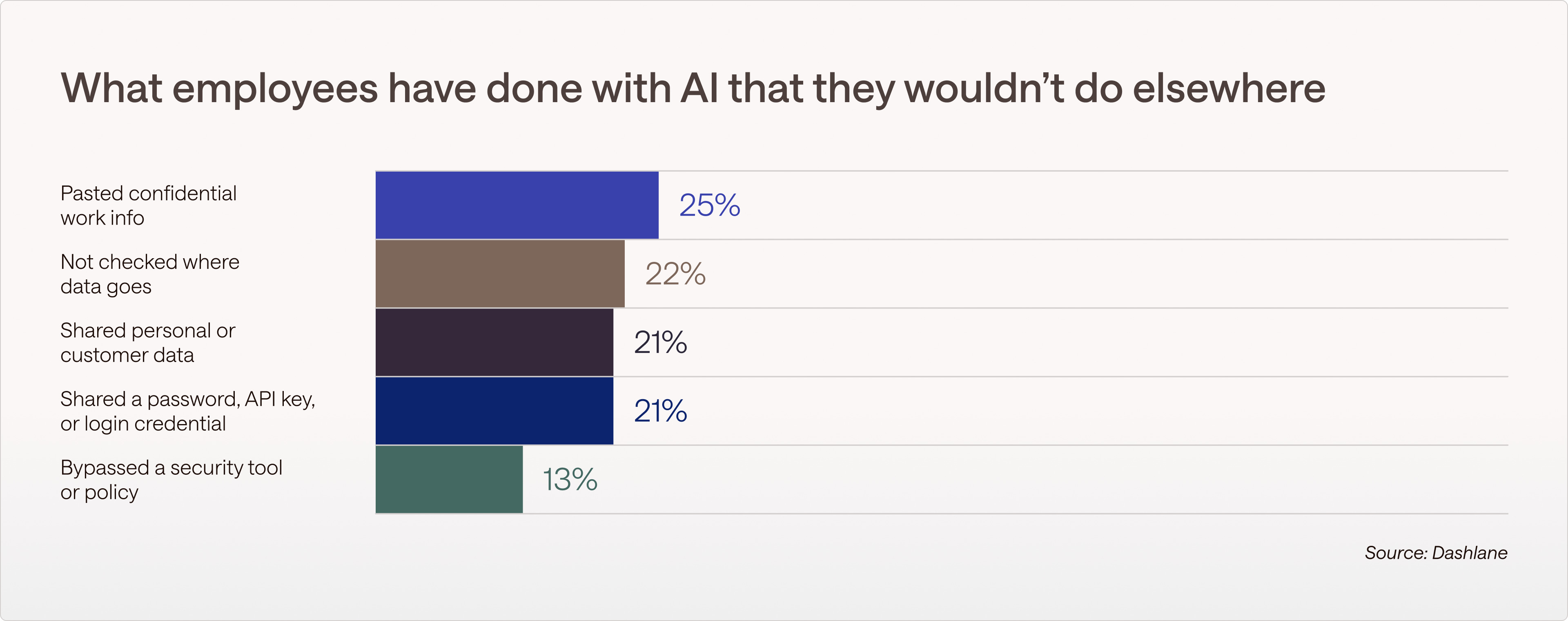
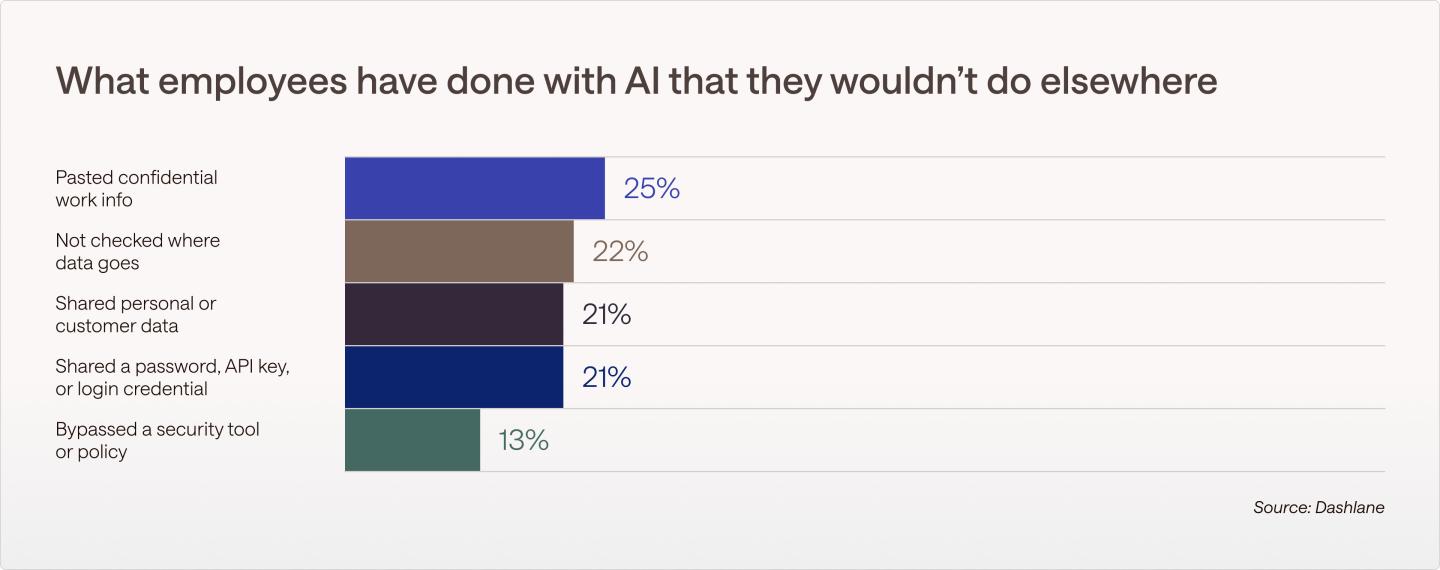
The majority of workers admit they give AI tools sensitive data. A new survey found that 52% of employees would hand over their login credentials to an AI tool if they were asked to do so, and about one in five admitted that they’ve already shared a password, API key, or login credential with an AI tool. One in five employees has also granted an AI tool or agent access to a file, account, or system that they later learned shouldn’t be shared in that manner, according to a survey of 3,000 workers and 800 IT security leaders conducted by cybersecurity firm Dashlane.
“Because people think of AI as a trustworthy tool or colleague, they are very happy to share things with them,” Christophe Frenet, chief product officer at Dashlane, tells Fortune. “That’s where issues happen.”
When employees hand over this sensitive information to AI tools, it can increase the attack surface for a company, which refers to the vulnerabilities or pathways that hackers use to gain unauthorized access. It can also create headaches for the CIO or chief information security officer when trying to identify the attack surface after a hack occurs.
Frenet says enterprises should invest in employee cybersecurity training to explain the risks associated with giving AI tools access to credentials, but that IT should also invest in visibility tools to detect what apps are installed on a computer, closely monitor browser traffic, and establish restrictions that would prevent an employee’s ability to connect their workplace systems with unapproved AI vendors.
Courtesy of Dashlane
JOBS RADAR
Hiring:
– L.A. Care Health Plan is seeking a CIO, based in Los Angeles. Posted salary range: $356.5K-$606.1K/year.
– Barnes & Thornburg is seeking a deputy CIO, based in Chicago. Posted salary range: $285K-$300K/year.
– AmeriSave Mortgage is seeking a EVP of technology, a remote-based role. Posted salary range: $250K-$350K/year.
– American Physical Society is seeking a chief digital information officer, based in College Park, Maryland. Posted salary range: $290K-$395.1K/year.
Hired:
– HomeServices of America named Maria Latushkin as CTO, a newly created role with enterprise-wide responsibility for the real estate services company’s technology strategy. Most recently, Latushkin served as group VP of technology and engineering at grocery giant Albertsons. Previously, she served as CTO at Omada Health, Narvar, and One Kings Lane.
– Acclaro announced the appointments of Darren Taylor as CTO and Carsten Hansen as chief product officer. Taylor will oversee product engineering, architecture, and infrastructure at the business services company, while Hansen will lead product strategy. Taylor joins Acclaro from translation and localization services provider Lionbridge, where he served as SVP of engineering. Hansen also comes from Lionbridge, where he was head of product.
– Claritas appointed Prem Jacob to serve as the marketing and consumer insights company’s chief product and technology officer. He joins Claritas after Jacob most recently served as CTO at visual merchandising software provider One Door. Previously, Jacob held senior executive leadership positions at Klick Health and Epsilon.
– Stowers Institute for Medical Research appointed Brandon Mayer as VP and CTO, where he will lead the nonprofit biomedical research organization’s technology strategy, research, enterprise systems, and cybersecurity. Previously, Mayer served as CIO and chief transformation officer at insurance firm Employers Reassurance Corporation, a subsidiary of GE Aerospace.
– Moore Colson named Jon Wooten as its CIO, leading the accounting and advisory firm’s technology strategy and IT function. Prior to joining Moore Colson, Wooten was a senior director at insurance services provider McLarens and also previously served as director of IT at insurance claims management firm Engle Martin & Associates.
– CentraCare announced the appointment of Jonathan Shoemaker as its CIO. Prior to joining the Minnesota-based health care system, Shoemaker served as CEO of software company About Healthcare. He also spent 18 years at Allina Health, where he served as CIO.
Disclaimer : This story is auto aggregated by a computer programme and has not been created or edited by DOWNTHENEWS. Publisher: fortune.com