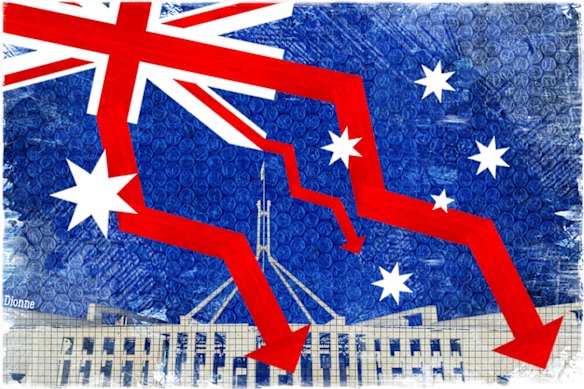
Year in, year out during this century, those of us who’ve followed the regular utterances of our politicians have heard them intoning empathically that Australians were “doing it tough”. Household discussions about finances “around the kitchen table” were invariably solemn, stressful affairs. Regardless of political stripe and the economic environment – even during the long period when interest rates and inflation were low and overall the times were good – this was the common language of politics.
But here we are in 2026 and it’s actually true: many Australians are doing it tough. Anyone who’s filled the tank with petrol or has done a big supermarket shop in the past month didn’t need to see the October inflation rate of 4.9 per cent to realise how punishing things are. More than a few older Australians, having made their way through the often economical wild boom-and-bust ’70s, ‘80s and ’90s, will look at the current inflation and interest rates and wonder what the fuss is about. But in those days they didn’t have to contend with the obscene, socially destructive cost of housing in the 2020s. And they could also rely on substantial, regular workforce-wide pay rises to provide relief.
In the suburbs and the regions, reality has overtaken the rhetoric, leaving great numbers of Australians stranded economically, low on hope. This feeling of disillusion is the driver for the political disruption that’s taking place. In the past 20 years, we’ve changed governments three times, had seven prime ministers and gone through the Global Financial Crisis and a pandemic. Wars in Ukraine and the Middle East have driven up energy prices, while the new and, to some, terrifying technology of AI and its concomitant data centres are fuelling inflation.
The series of governments that we’ve elected have in their own ways failed to persuade increasing proportions of the national electorate that they were serious and knew what they were doing. In response, more and more voters have gone looking for alternatives. At the 2007 election, the total primary vote for Labor and the Coalition was 85 per cent. At last year’s election it had fallen to 66 per cent. This month’s Resolve poll measured the combined support for the ALP and the Coalition at 50 per cent.
We’re in an environment in which good news (a growing economy, rising demand, near to full employment) inevitably leads to bad news (an overheated economy plagued by inflation requires higher interest rates and more people put out of work to slow demand). When we’re caught in that cycle, people trying to establish a family, look after their children with less stress and finally ditch that side hustle will rightly wonder how they’re ever going to get ahead.
There’s no doubt about it, the Albanese government is in serious trouble over, primarily, the cost of living and, more broadly, the public’s confidence in its handling of the economy. Its position is not irretrievable. How it responds to its troubles and charts a course out of them over the six months between now and the next budget will determine its fate. Treasurer Jim Chalmers, with Anthony Albanese’s backing, this week chose the confessional path, delivering a ministerial statement on Monday that basically said things are going to get worse before they get better.
With Wednesday’s high inflation figure imminent, Chalmers understood that an avalanche of contumely would be coming his way. In his downbeat outlining of the difficult times ahead, he took an interesting tactical turn, dropping his established practice of claiming to respect everyone’s views. He foreshadowed a more aggressive approach to his detractors, questioning their motivations. He told the parliament: “So much of the daily commentary on our economy is stuck in an endless spiral of negativity which is designed to be a self-fulfilling prophecy.” With his personal polling numbers under water, and the opposition and a number of commentators predicting his removal as treasurer, he hasn’t got much to lose by throwing a few punches.
But even if he might have been prompted at least a little by a desire to protect himself, there was something to what he said. It would help if the nation could find a way to improve how economic policy is advanced, argued and discussed. Context and truth often seem to be on a long holiday. A good example has been the clockwork-like warnings from business bodies and friendly commentators and economists over the past five years of an imminent wage-price spiral.
Not much is required to inspire these dire predictions. They followed the government’s first-term introduction of same job same pay and multi-employer bargaining reforms, which some in the business press laughably condemned as a revival of the industrial relations of the 1970s. They also turn up whenever a high-profile enterprise agreement is reached or the Fair Work Commission in its annual wage review gives a pay rise to workers on the minimum wage.
No wage-price spiral has happened; in fact, real wages are in decline. Reserve Bank board member Iain Ross, a former Fair Work Commission president, seems to have been so frustrated by the continued hysteria that he recently delivered a speech explaining why it can’t happen. Put simply, the key inhibitors are the presence of long-lasting enterprise agreements, the minimisation of industrial awards and the negligible proportion of unionists in the private sector. As anyone who paid a jot of attention would know.
But that’s unlikely to matter: the warnings are likely to continue. Just as union leaders are there to satisfy the rank-and-file, so too are industry lobby group chiefs obliged to play up to the businesses that pay subscriptions to keep these bodies afloat and influential. Self-interested stakeholder groups, once tangential to the business of politics, are now deeply embedded and omnipresent in the nation’s fully professionalised political architecture. A new employer mega-body, the Alliance of Industry Associations, which includes 31 industry bodies including the Business Council of Australia, the National Farmers Federation, the Australian Banking Association and the Australian Industry Group, has been formed, reportedly with the aim of holding a growth and productivity summit ahead of the 2028 election. Seeing off a weakened, supposedly business-unfriendly Labor government. Now, that would be a win, for some. Perhaps not the workers pushing for a pay rise.
Shaun Carney is a regular columnist, an author and former associate editor of The Age.
The Opinion newsletter is a weekly wrap of views that will challenge, champion and inform your own. Sign up here.
 Shaun Carney is a regular columnist, an author and former associate editor of The Age.
From our partners
Disclaimer : This story is auto aggregated by a computer programme and has not been created or edited by DOWNTHENEWS. Publisher: www.smh.com.au