
If you want a window on the Japanese soul, nothing beats skinny-dipping. As with tea drinking or flower arranging, the Japanese have elevated bathing in the buff in one of the country’s hot springs to a ritualised art form, a quintessential visitor experience.
Thanks to the subterranean furnace beneath Japan, the country has about 3000 onsen, natural hot springs, and the Japanese have enjoyed the soothing effects of communal soaking for centuries before it occurred to Californians to do likewise. It’s not only soothing, it’s healthy. Fed by mineral-rich waters brewed deep underground, onsen are renowned for their therapeutic properties.
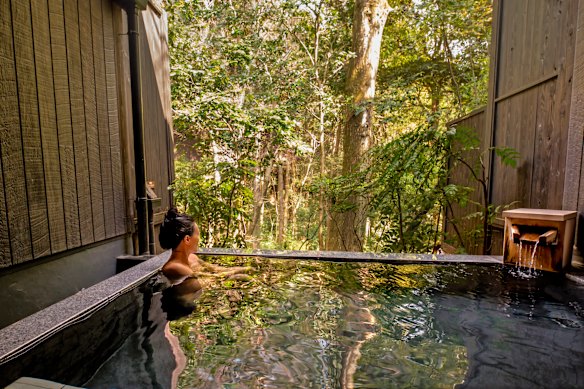
Some onsen are free but a top-end onsen in an attached ryokan, a traditional inn, will set you back several hundred dollars per night. The connoisseur’s experience is the rotenburo – outdoor onsen in wild, natural settings.
Most onsen are segregated, with a red noren curtain usually identifying the women’s side, blue for blokes. You’ll get a locker or a basket to stash your clothes, and a towel about the size of a largeish table napkin. Shoes stay at the front door and, once inside, the striptease begins. This might present a hurdle but after the first time it’s surprisingly liberating. Ogling is unthinkable. When it comes to deadpan, the Japanese are the absolute world champs. Remove jewellery – the mineral-rich waters are not kind to precious metals.
Down to your birthday suit, enter the bathing area. A typical onsen has low stools in front of a row of taps. Every square centimetre must now be scrubbed with soap using your wet towel, then rinsed off with handheld shower heads. Only when the rinse is complete can you head for the baths. Stain the bath with a single soap bubble and you’ll spread shock and dismay. Ditto for hair: it never touches the water.
Sign up for the Traveller newsletter
The latest travel news, tips and inspiration delivered to your inbox. Sign up now.
There are several baths in an onsen, with different temperatures and possibly even colours, signifying different mineral compositions. Enter with caution. The water is typically about 40 degrees, although sometimes closer to 50 degrees for those of virile inclination. If available, the cold-water tub is the grand finale.
Tattoos are problematic in onsen. Inked bodies have traditionally been associated with membership of the yakuza, Japan’s mafia. As such, anyone with tatts has been excluded from public bathing places, but not totally. I was once in a bathhouse in a rough part of Osaka when a human peacock entered. From his neck to his wrists and down to mid-calf, every bit was lavishly scribed. “Yakuza,” whispered Ian, my guide. Although he took up a little more room than the average Japanese, it’s difficult to look dangerous when you’re stark naked.
Some young Japanese are now sporting tattoos and using onsen, and the ban is losing its grip, especially in tourist areas. Got a small tattoo? Cover it up with a tattoo seal, a flesh-coloured adhesive patch, available on Amazon. The top brand is Japan’s own Aqua Tattoo Cover Seal. Another option is a private onsen or a room in a ryokan with a private, open-air onsen bath.
The trick with onsen bathing is surrender. Shed your inhibitions and status along with your clothing and take a deep dive into Japanese culture. It’s sociology and a hot soak, pure luxurious indulgence. What could be nicer?
 Michael Gebicki is a Sydney-based travel writer, best known for his Tripologist column published for more than 15 years in Traveller. With four decades of experience, his specialty is practical advice, destination insights and problem-solving for travellers. He also designs and leads slow, immersive tours to some of his favourite places. Connect via Instagram @michael_gebickiConnect via email.
From our partners
Disclaimer : This story is auto aggregated by a computer programme and has not been created or edited by DOWNTHENEWS. Publisher: www.smh.com.au