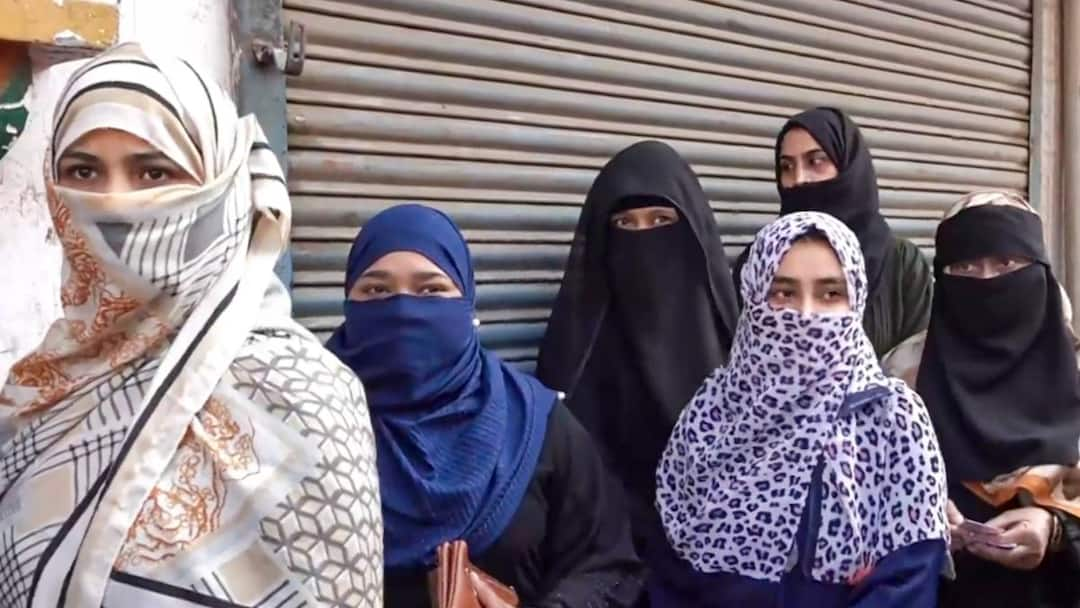
The Supreme Court has sought a response to a petition challenging an Allahabad High Court ruling that held wearing a hijab is not an essential religious practice in Islam. The top court clarified that the High Court’s decision would not be considered a binding precedent and directed that the matter be heard alongside the pending Karnataka hijab case.
“Tag with Civil Appeal No. 7095/2022 and this judgment shall not be treated as precedent,” the Supreme Court ordered.
A bench comprising Justice Aravind Kumar and Justice Vipul Pancholi passed the order on November 20 while hearing a plea filed by the Muslim Women’s Study Circle, an organisation representing Muslim women. The petition challenges the Allahabad High Court’s August 21, 2026, judgment in the case of Sukaina Rizvi.
Rizvi was denied admission to Class XI at Tagore Public School in Attarsuiya, Prayagraj, after she insisted on wearing a headscarf along with the prescribed school uniform.
The Allahabad High Court bench of Justice JJ Munir and Justice Indrajeet Shukla had dismissed her plea, ruling that wearing a hijab by Muslim women does not qualify as an essential religious practice under Islam. It also held that students cannot demand permission to wear additional clothing if an institution follows a uniform dress code that is genuine, non-discriminatory and aimed at maintaining discipline and institutional identity.
The High Court had based its decision on the 2022 Karnataka High Court Full Bench judgment, which upheld the right of educational institutions to prescribe uniforms that do not include the hijab.
Petition Alleges Violation Of Constitutional Rights
The Muslim Women’s Study Circle has argued before the Supreme Court that the Allahabad High Court’s decision is arbitrary and discriminatory and infringes upon Articles 14, 15, 19(1)(a), 21 and 25 of the Constitution.
According to the petitioner, the ruling undermines the religious freedom of Muslim women and creates barriers to their access to education.
The plea also questions the High Court’s reliance on the essential religious practices test. It maintains that wearing a hijab is a constitutionally protected right under Article 25 and that restrictions on the practice disproportionately affect Muslim women.
The petitioner has further alleged unequal treatment, pointing out that religious symbols worn by members of other communities, such as Sikh turbans, are treated differently.
It has also cited the principles laid down by the Supreme Court in the Shirur Mutt and Bijoe Emmanuel cases, arguing that the High Court did not adequately account for constitutional protection afforded to sincerely held religious beliefs.
Petition Cites Quranic Verses To Support Hijab
The petitioner has maintained that wearing a hijab is rooted in Quranic teachings, particularly Surah Al-Noor, Verse 31 and Surah Al-Ahzab, Verse 59.
It argues that these verses instruct believing women to cover themselves and that the practice cannot be declared non-essential merely because some members of the Muslim community do not follow it.
The plea has also referred to the Supreme Court’s observations in M. Siddiq v. Mahant Suresh Das, the Ayodhya title dispute case. It argues that constitutional courts should not choose between competing theological interpretations and must respect the faith and beliefs of individual worshippers.
Another argument raised in the petition concerns the validity of the essential religious practices test itself. The petitioner has questioned the High Court’s reliance on the doctrine when its constitutional validity is under consideration before a nine-judge Constitution Bench in the Sabarimala reference proceedings.
Supreme Court’s Split Verdict In Karnataka Hijab Case
The Karnataka hijab controversy had reached the Supreme Court after the state High Court upheld educational institutions’ authority to prescribe uniforms that excluded the hijab.
In October 2022, the Supreme Court delivered a split verdict on appeals challenging the Karnataka High Court’s decision. While Justice Hemant Gupta dismissed the appeals, Justice Sudhanshu Dhulia allowed them.
Following the difference of opinion, the matter was referred to a larger bench, where it remains pending.
Disclaimer : This story is auto aggregated by a computer programme and has not been created or edited by DOWNTHENEWS. Publisher: abplive.com