For Manchester City, life after three Champions League-winning midfielders began in earnest against Arsenal in August. They were a goal down after 23 seconds. It was an inauspicious start for Enzo Maresca and Elliot Anderson alike.
A reunion with Arsenal on Sunday could be deemed a meeting of managerial midfielders, in Maresca and Mikel Arteta. Each learned from Pep Guardiola, who won the European Cup as a Barcelona player and manager and then in charge of City. But it is also a first Premier League clash since Bernardo Silva and Rodri joined their mentor in decamping from the Etihad Stadium in the summer. Arsenal may not have been sorry to see any go; if Guardiola’s resignation could facilitate an era of dominance from Arteta, and if it may have already begun with last season’s Premier League title, a further factor could be the departures of the City captain and Spain’s World Cup-winning skipper.
Advertisement
If City have been confronted with the question of how to replace the irreplaceable, there are different answers. One is simply that it is impossible: they are irreplaceable. Another is: expensively. City committed £326m to three midfield recruits, in Anderson, Ayyoub Bouaddi and Enzo Fernandez. A third is: incoherently, at least so far. Perhaps it is unfair to expect newcomers, both in the dugout and the centre of the pitch, to bring the same cohesion and chemistry as predecessors who became the faces of longevity and continuity, but thus far they have not.
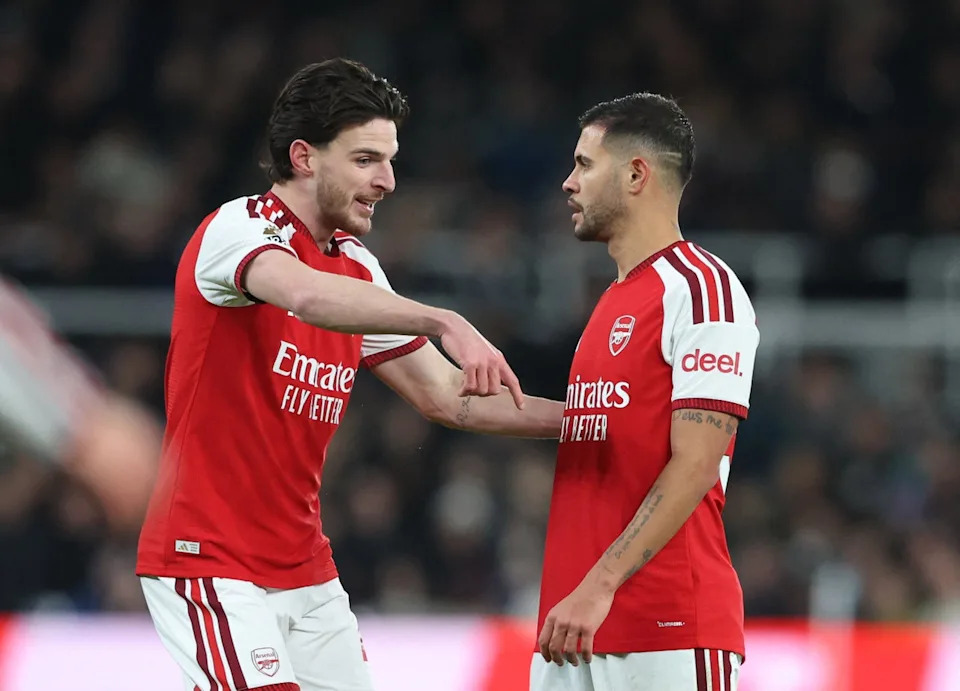
A further subplot, arguably, is that Arsenal boast men who represented an alternative line of succession at City: not merely Arteta, Guardiola’s first assistant in Manchester, but Bruno Guimaraes, who was of interest at the Etihad in 2024, but when City chose not to activate his release clause, and Declan Rice, the target who preferred to join Arsenal in 2023. Arguably the England vice-captain was the best central midfielder in the Premier League even with Rodri and Silva; without them, and despite Pascal Gross’ extraordinary start to the season, he definitely is.
Arsenal’s Declan Rice and Bruno Guimaraes provide a key advantage over Man City in Bernardo Silva and Rodri’s absence (Reuters)
But if Arsenal won the war last season, City prevailed in the battles, based around the formidable double act of Silva and Rodri. They faced the Gunners three times; but for Gabriel Martinelli’s injury-time equaliser at the Emirates Stadium, they would have won all three. Rodri’s prowess then may have come at a cost: it was his third start in a week, and he only began two more games in the next three months. City had barely a third of the ball, in an anti-Pep performance, but were superb out of possession.
Advertisement
In March’s Carabao Cup final, Nico O’Reilly’s box-crashing brace earned him the man-of-the-match award, but victory was underpinned by the midfield platform constructed by the Portuguese and the Spaniard. Finally, in City’s Premier League win at the Etihad, when victory seemed to shift the initiative to them in the title race, Silva was talismanic and terrific, turning in one of the best of his 460 performances for City. Two astonishing defensive interventions, one running back with Kai Havertz, the other winning a header against the rather taller Viktor Gyokeres, led Erling Haaland to compare him to Fabio Cannavaro.

Manchester City’s Enzo Fernandez is providing Enzo Maresca with a ‘balance’ problem (Reuters)
That influence, that drive, that capacity to perform in major matches: perhaps it was inevitably irreplaceable, just as Rodri’s Golden Ball-winning World Cup showed no other defensive midfielder can be as good as him. The first three-and-a-half months of Maresca’s reign have shown City lack anyone who is knitting the team together as well as Rodri and Silva did. A susceptibility to the counter-attack could be a flaw in the Guardiola years, but has been more so without the two men charged with cutting them out.
It has been compounded by some of the stranger structural issues. Fernandez has spent some of his time in the inside-right channel, some apparently with designs of being a No 10. Anderson has often been isolated. He has been excellent, but even a £116m midfielder can only cover so much ground on his own.
Advertisement
Maresca has tended to use the word “balance”, reflecting City’s quest for it. The most obvious answer involves introducing Bouaddi alongside Anderson: the times Fernandez has played with most positional discipline have at least involved some of the bigger games, whether away at Porto, in a Manchester derby when down to 10 men or at Anfield. But City’s openness in midfield was exploited by Paris Saint-Germain: Bouaddi, a half-time remedy, brought improvement.

Manchester City’s Ayyoub Bouaddi celebrates scoring vs Napoli (Reuters)
There is a sense that City may have complicated the equation with the Enzo reunion, Maresca’s £125m move for his former Chelsea ally Fernandez. The Argentinian’s fondness for operating in the final third can impact upon Rayan Cherki and Phil Foden; instead of a third possible No 10, City could have done more with another player with the skillset of Guimaraes or his old Newcastle sidekick Sandro Tonali, players who can be a No 6 or a No 8, in the mould of Anderson.
But maybe the task for Fernandez, Anderson, Bouaddi and Maresca always threatened to be thankless. Coming after Rodri and Silva in midfield or Guardiola in the technical area ran the risk anyone would be an automatic downgrade. And maybe Arsenal will underline that.
Disclaimer : This story is auto aggregated by a computer programme and has not been created or edited by DOWNTHENEWS. Publisher: Sports.yahoo.com