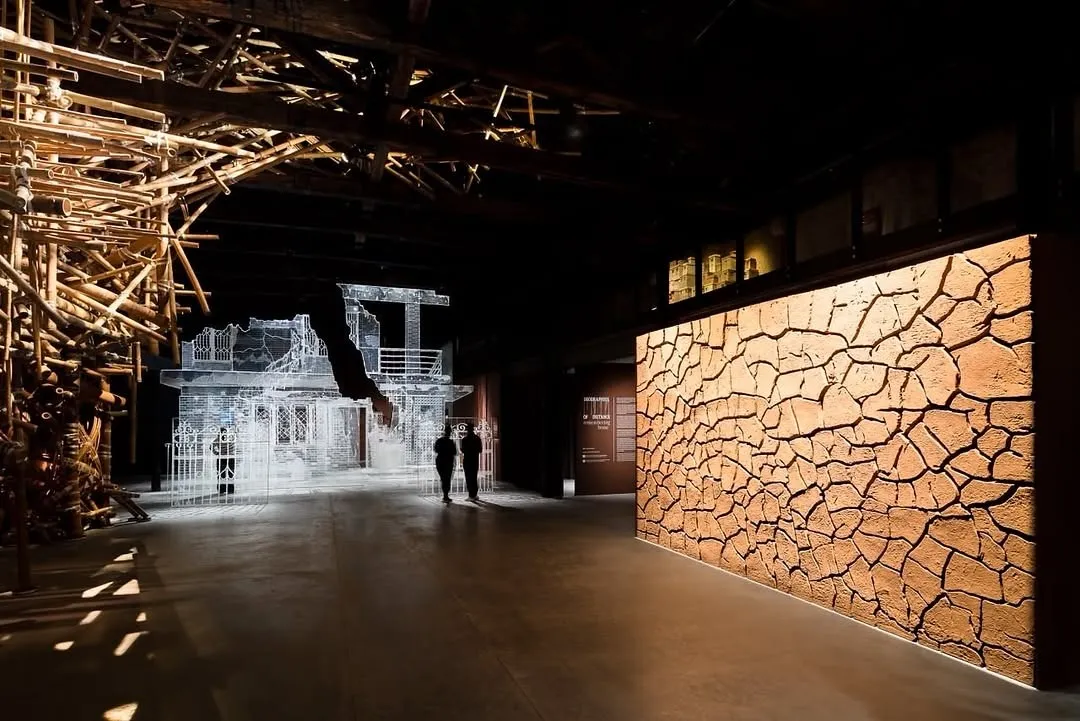
When the Delhi house where artist Sumakshi Singh spent her childhood summers was demolished, she found an extraordinary way to bring it back. Using delicate white threads, she recreated its doors, windows, stairs and even its gates.
Thousands of kilometres away in Venice, Italy, her childhood home became part of an exhibition that drew around 4.5 lakh visitors.
Alongside her work stood a towering bamboo structure inspired by Indian construction sites, a miniature Ladakhi settlement made from discarded egg trays and paper, and sculptures inspired by India’s natural landscapes.
On 25 November 2026, these creations earned India the Visitors’ Lion for Best National Participation at the Venice Biennale, one of the world’s biggest international art exhibitions. The award was decided by public vote.
Behind the winning exhibition, titled Geographies of Distance: Remembering Home, are five Indian artists who took inspiration from everyday materials, childhood memories and generations-old traditions to explore something we can all relate to: what it means to call a place home.
Here are the five artists and the fascinating stories behind their creations.
1. Sumakshi Singh: A house recreated in thread
Artwork: Permanent Address
Imagine walking into a house that is no longer there.
That is the experience Sumakshi Singh creates with Permanent Address, an intricate, life-size reconstruction of her family home in Delhi. The artist has recreated the house using embroidered thread and water-soluble fabric.

Photograph: (Instagram/@)
The house was built in 1951 by Singh’s grandparents, who came to India during Partition. It became the venue for family weddings, reunions and childhood sleepovers. It was also where she spent afternoons learning to knit and embroider with her grandmother.
Years later, when the house was demolished, the same craft helped her recreate the place she had always called home.
2. Asim Waqif: Bamboo that tells a story of changing cities
Artwork: Chaal
Using 12 tonnes of bamboo sourced largely from Assam and West Bengal, artist and architect Asim Waqif built a 30-foot-high structure in Venice without using a single nut or bolt.
The bamboo pieces are bent and tied together, forming a structure that resembles the scaffolding that supports buildings across Indian cities.

The choice of material is central to the artwork. Bamboo has long been used in traditional construction, but modern building practices increasingly favour materials such as steel and aluminium.
Waqif’s installation draws attention to this shift and the risk of losing traditional skills, such as bending and tying bamboo to build scaffolding.
3. Ranjani Shettar: A garden suspended in the air
Artwork: Under the Same Sky
In contrast to Waqif’s towering structure, Ranjani Shettar’s installation feels like stepping into a floating garden.
Inspired by flowers and natural growth, Under the Same Sky features sculptural forms suspended from the ceiling. Shettar created the flower-like sculptures using handwoven cotton fabric, steel and lacquer.

Working from her studio near Sagara in Karnataka, Shettar has used these materials for nearly two decades. Her installation allows visitors to experience the garden from within.
4. Skarma Sonam Tashi: Bringing Ladakh’s homes to Venice
Artwork: Echoes of Home
What does a traditional Ladakhi settlement look like when recreated thousands of kilometres away?
Artist Skarma Sonam Tashi offers an answer through Echoes of Home, an installation inspired by the architecture and landscape of Ladakh.
Using papier-mâché, cardboard, egg trays and old paper, he creates a miniature settlement that evokes the region’s traditional homes, built using earth, stone and timber.

Growing up in Ladakh, Tashi was familiar with traditional homes built using locally available earth, stone and timber. Designed for the region’s harsh climate, these houses help keep families warm during winter and cool during summer.
As concrete and steel buildings increasingly replace traditional homes, his artwork draws attention to generations of knowledge that Ladakh risks losing.
5. Alwar Balasubramaniam: When nature becomes the artist
Artworks: Drift and Not Just for Us
Sometimes, the most compelling artwork is made from something as familiar as the ground beneath our feet.
For these works, artist Alwar Balasubramaniam, also known as Bala, uses clay and soil sourced from rural Tamil Nadu to create sculptural panels.
The surfaces are marked by natural cracks and fissures, capturing the effects of time and environmental forces. Rather than smoothing over these imperfections, the artist makes them the focus of the work.

While the artwork was being created, peacocks, monkeys and snakes passed through the work in progress, leaving their marks on it.
It is a reminder of the idea behind his work: the earth is home to every living creature.
Five artists, one idea of home
India returned to the Venice Biennale after seven years with an exhibition built around materials familiar to millions of Indians: bamboo, thread, cotton, paper and earth.
Through their creations, the five artists brought stories of Partition, traditional architecture, family memories, craftsmanship and India’s changing landscapes to an international audience.

With around 4.5 lakh visitors and an award decided by the public, their exhibition showed how stories rooted in everyday Indian life could resonate with people across the world.
Sources:
India in Venice
‘An Indian postcard from Venice: Why a pavilion at ‘Olympics of the art world’ matters’ by Trisha Mukherjee & Divya A for The Indian Express, Published on 23 September 2026.
‘India wins the Visitors’ Lion for Best National Participation at the 61st Venice Art Biennale’ by Press Information Bureau
Disclaimer : This story is auto aggregated by a computer programme and has not been created or edited by DOWNTHENEWS. Publisher: thebetterindia.com