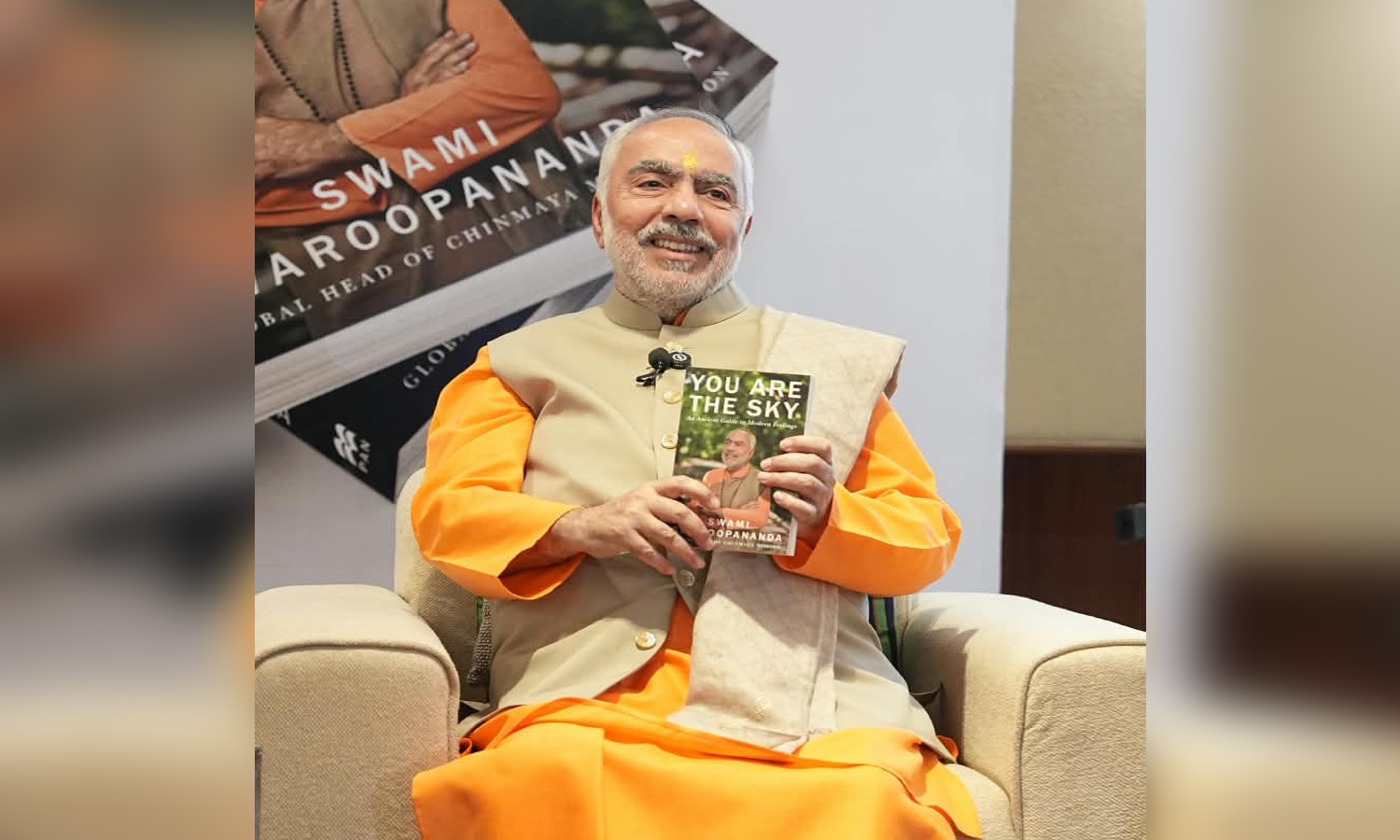
The truth, really speaking, is very simple. Vedanta is not a complex philosophy. Vedanta is actually the Declaration of Truth, and therefore it’s the most obvious, the most natural. It becomes difficult because we have contrary logic, and therefore it has to be explained logically by great acharyas like Adi Shankaracharya, and that makes people think it’s very difficult. But really speaking, Vedanta is our day-to-day life, and it just simplifies our life rather than becoming difficult.
Why the title You Are the Sky?
There is a wonderful quote in our mission: “You are the sky, you are your limit.” The sky represents vastness, symbolically the infinitude, and that’s actually our own nature. If we can expand our vision of life, the limitations we put on ourselves become insignificant.
There is also a beautiful meditation in the Bhagavad Gita. Just as clouds, winds, and storms are accommodated in space, they come and go, but the sky remains unaffected. Imagine that you are the infinite sky in which these emotions are rising. Even the mightiest of storms come and go, but space remains untouched. In the higher sense, our Self, the Atma, which is infinite, which is the observer, never gets affected or contaminated by our thoughts and emotions.
With so much online activity, restlessness and comparison, if you could give this generation one page from the book, what would it be?
We should be emotionally strong. We must have the resilience to bear our emotions. Unfortunately, neither today’s education nor sometimes even upbringing gives us that. The earlier we become aware and start shaping our life by building value systems and learning how to face emotions that make us uncomfortable or make us perform inadequately, the faster we will grow.
Youngsters have only been restless. Were you not a restless youngster? It’s a phase where you don’t have experience of the past, and you look at the future with anxiety. That uncertainty makes a person anxious, restless, sometimes frustrated, angry. Finally, it turns upon oneself, and that’s the worst thing that can happen: you lose your self-worth and self-esteem. Then you make a bloated presentation of yourself, whether as a bully or a show-off. So at any age, get to know yourself. This is given in the spiritual science.
When should this start?
From the womb. It starts with parenting. We have the classic cases of Prahlad and Abhimanyu. The Western world has taken to prenatal education, and we have started garbh samskara again. It’s the parents’ responsibility not just to give children a means of making a living, but also to teach them how to live their life.
In this era of scrolling addiction, we see everyone else’s career, relationships, and lifestyle. How do we break the cycle of comparison?
It has to start very early, with parents guiding children on how to deal with competition. Even in a school singing competition, parents get over-anxious if their child doesn’t win. Children may well have the resilience to bear these emotions, but parents react out of their own ego: “Why was my child not given the ranking?” That creates complexes, even aggressiveness, in children.
Parenting is an art. Parents must understand they are the first role models. If they can’t guide their children, they should put them in schools and colleges with value-based upbringing, where they learn about themselves and learn to share. As families become isolated, the Western world is recognizing the problem and trying to adjust, while we are reinventing the wheel by going down the path that led to the decline of cultures. We must take charge now, because generations pass on what they know. This is not learned just by teaching. It has to be demonstrated.
How can parents help children process uncomfortable feelings?
Parents are the best well-wishers, but they are limited by their own knowledge, beliefs, and inhibitions. What we give children is very important. When they see values like acceptance, forgiveness, and forbearance in their parents, and recognize the strength in them rather than seeing them as weakness, they emulate them. Mothers especially are our role models for emotions.
Even if parents have their own weaknesses, they must tell the children, “This is a weakness. Don’t copy that.” Our rishis and the Upanishads said: whatever you saw good in us and admired, follow that; if you saw anything imperfect, don’t copy. Even if our parents had conflict with their in-laws, they never allowed us to disrespect our grandparents.
The first beneficiary is the parent, and the first sufferer is also the parent. If children are happy, productive, and successful, or keep their mental balance even in failure, the parents are happy. If they harm themselves through addictions or depression, the parent suffers first. So we must pass on positive qualities, not hypocritically, but by showing what gives us strength.
How can professionals handle emotions at work, without snapping or bringing them home, and keep inner peace while staying productive?
When you are balanced, you are productive, and to some extent you insulate yourself from the impact. In the corporate world, we must understand that people are there for an income. It is very often a selfish world, and very rarely is there true cooperation. But each one has to set an example, and the secret of leadership is whether you lead people in the right direction or the wrong one.
If you remain steady in your values, character, and performance, people follow you. Ours is a culture of doing your duty whether anybody else does or not, because by doing your duty you fulfill yourself. Otherwise, you say, “That person is not doing it; why should I?” and we become as incompetent as the other person, and who bears the consequences?
Even when somebody insults, hurts, or backstabs you, you must know how to protect yourself. That’s why we have the Mahabharata. You have to be good and strongly good, not foolishly good. We associate goodness with weakness, thinking that if you are good, people will take advantage of you. But those who live a life of dharma are never weak, because they’ve got nothing to fear. Swami Chinmayananda once said: “What is the use of your goodness if people don’t take advantage of it?” But not for advantage. Look at Hanuman:- bala, buddhi, vidya, and atichatur. Nobody says you have to be dumb to be good. It is those who can retaliate who can have compassion. Compassion is the ornament of the brave and strong, not of the weak.
The Mahabharata demonstrates what happens when you follow that knowledge, and what happens when you compromise, even if you are good. The Gita’s principle is: put your mind to your performance. Do your best with what is in hand, and the result will take care of itself. Management courses ponder over it, but none teaches this art of success without stress, and how to keep the mind balanced.
Anger, Fear and Anxiety: Are They Bad?
In my book, I’ve written about even an emotion like anger. You can’t say you’ll never get angry. If somebody is harming your child, you will get angry. If that anger protects your child, it’s useful. If your child is doing something harmful to himself, you are angry at that harmful thing, not at your child. If you don’t know the difference and you verbally hurt your child, it becomes harmful.
You lose discrimination during anger. So calm the mind first, and then you’ll be able to reason out what you got angry about. Some anger may be justified, but until we calm our minds and then act, in anger we do something we later regret. We cannot avoid these emotions, but they have to be channeled.
A sudden danger triggers instinctive fear that makes you act and protect yourself. That is positive fear. Anxiety that helps you prepare for your exams is positive. But it has become fashionable to be over-anxious even after preparing, and that only harms you.
The whole thrust of the book is that all emotions are given to us for a reason. None of them is bad on its own, not even fear and anxiety. So the question is how to transform emotions, even anger, fear, and jealousy, into positive strength.