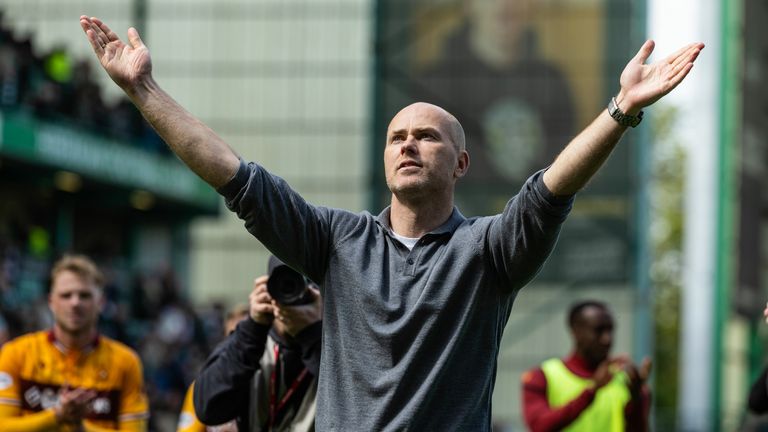
When Jens Berthel Askou spoke to Elijah Just about joining Motherwell, painting a picture of a team that would control the ball, he took some convincing. “I could understand his scepticism,” Askou tells Sky Sports. They had worked together before.
But Askou has become a very different coach to the one who had been at Horsens in his native Denmark. “My regret from back then is that I did not implement what I really preferred to do. I just needed a little bit of time as a coach to be brave enough to do it.”
The 44-year-old former Norwich City defender is proving himself brave enough now. In fact, he has become one of the most tactically interesting coaches in European football, having transformed Motherwell and now beginning to do the same at Toulouse.
Just, who is now at Swansea, did indeed link up with Askou at Motherwell and helped the team to play some of the most stylish stuff in Scotland. Their possession statistics leapt from 39 per cent to 59 per cent, playing a brand of football few thought possible.
“Motherwell just gave me the next level of confidence and belief,” says Askou. If it could work in Scotland, where his side finished fourth having briefly been in a title race, then it could work anywhere. “It is a very similar journey,” he says of his new role at Toulouse.
Again, he has taken over a team unaccustomed to having the ball. Toulouse ranked second bottom for possession in Ligue 1 last season. Now, they are up among the top seven. “If we compare our style now to last season, it is quite a big change,” he says.
“From day one against Lyon, we dominated and created chances. The plan is to press the opponent as high as possible for as long as possible and to keep them under siege and attack relentlessly without the ball. It is not just a game plan. It is an identity.”
Life in southern France is a little different to his previous assignment. “People are still eating outside here,” he says, smiling broadly. “It is fantastic, a wonderful city. But I loved the west end of Glasgow too. It was a very cool place to live. I miss the people.”
On the pitch, the parallels are obvious. As at Motherwell, he has been met with some resistance and the results are lagging a little behind the data with Toulouse in midtable. “The underlying numbers put us in fourth. It is easy to see what we are doing.”
Askou once said that his ideas require months to take shape. “I have to correct myself a bit,” he says now. “It is actually possible to teach the basics in two weeks and be competitive in six. You can see a difference in how much the players want the ball.”
Even so, he is still questioned when these players make errors that lead to goals. The accusations of overplaying are familiar now. “It is one of those stupid paradoxes that still exist in football.” Coaches who concede due to underplaying are rarely called out.
“When teams go long and concede goals because they are having to defend more, that is not being criticised as a style-of-play goal,” Askou explains. “Even though, when they play those longer balls, they are completely spread all over the park when they lose it.”
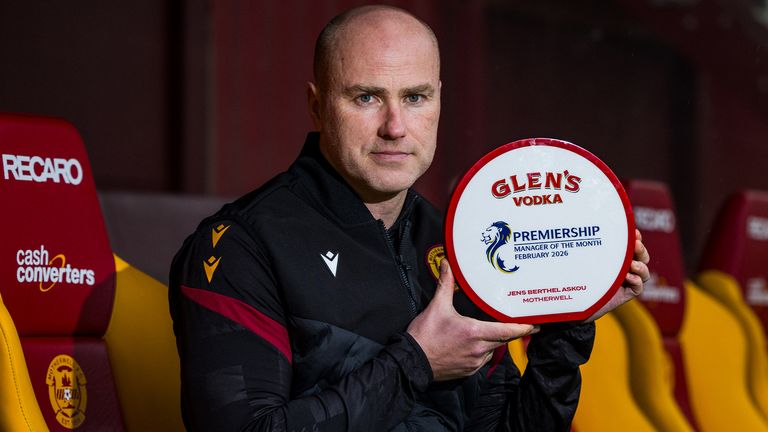
Askou had a successful season in charge at Motherwell
His commitment to his football is total and it has been a process not an epiphany to reach this point. But he cites his time as assistant manager at Copenhagen as being key. “That opened my eyes. I realised that my next chance to be head coach, I had to go all in.”
He explains: “I just felt from a personal point of view that if I am lucky enough to do this for the next 20 years and I am going to invest so much of my energy, my time and my life into this, when it takes a huge toll on my family, then it has be fun, it has to be exciting.”
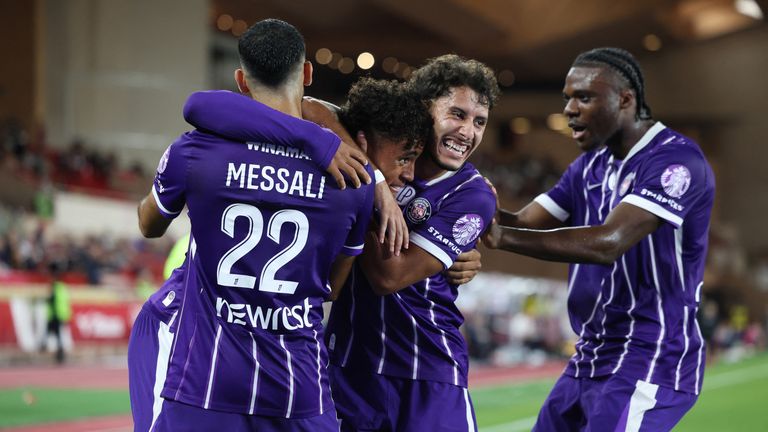
Toulouse have embraced a different style of play this season under their new coach
Players respond to it. He urges them to “remember why we fell in love with this game when we were kids” and that means wanting the ball. With time, Askou believes that he has matured enough as a leader to know that sticking to his principles is everything.
“Now, I have enough experience and knowledge as a leader to be calm and patient and spread that bravery, to really make that bravery grow roots in the squad and in the club. That way it is strong enough to withstand all the resistance that can come.”
It is curious to note that his predecessor at Toulouse, Carles Martinez, has gone on to become Bayer Leverkusen head coach after doing some fine work in France. “His intention was to adapt to a more Spanish, possession-based style,” notes Askou.
But Martinez took a pragmatic approach last term. “After the first season, they changed a little bit. They went back to a more direct counter-attacking style.” Do not expect his successor ever to revert to those tactics. “There is no turning back now,” he insists.
He is trying to stay open-minded, of course. “I have to keep reminding myself that the reason I am here now is because I have allowed myself to be open to new ideas.” Football evolves and coaches are obliged to make tactical adjustments to prosper.
“I cannot keep copying what I am doing for the next 10 years because then someone is going to blast right past me. You have to be curious, you have to be innovative.” But there are non-negotiables. His players will keep taking the ball under pressure.
“To give yourself the best opportunity to perform, the consistency of approach and the principles have to be there,” Askou continues. “The overall approach to the game in terms of being brave and trying to dominate is never going to change.”

Elijah Just discovered a different version of Askou at Motherwell
How far can that take Toulouse? He points to the success of Bodo/Glimt in Norway and Como in Italy as evidence that teams can disrupt the natural order. “There are possibilities everywhere in football.” He sees Brighton in England as another example.
“Through strategic decisions and bravery in recruitment, by allowing a progressive coach to develop a style, you now find them towards the top of the strongest league in the world. The focus on data is allowing for clubs to have more innovative approaches.
“I just feel blessed to have found another opportunity with people who are supportive, enthusiastic and humble. If we keep overperforming then eventually some of the light will end up on the players and also on me and the other good people here at this club.”
His football has put him in that spotlight. The aim now? “To raise the bar. To be even more ambitious and brave.” You had better believe him. And if Jens Berthel Askou ever wants to link up with a former player again, you can be certain they will believe him now too.
Disclaimer : This story is auto aggregated by a computer programme and has not been created or edited by DOWNTHENEWS. Publisher: skynews.com