
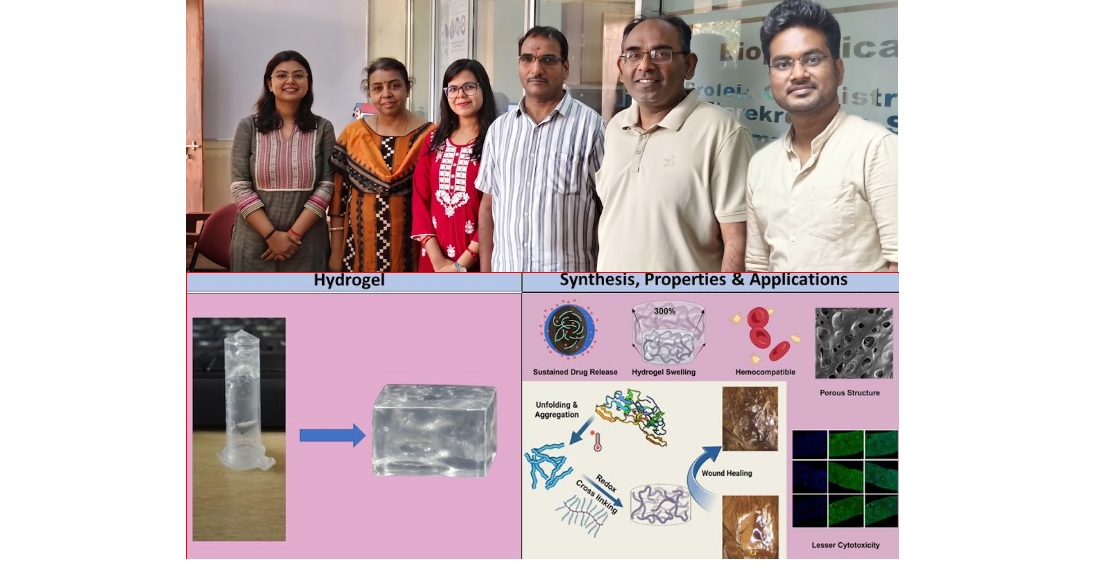
Bhubaneswar: Researchers at the National Institute of Technology (NIT) Rourkela have developed a method to convert inactive proteins discarded by pharmaceutical companies into hydrogels with potential applications in wound healing, tissue regeneration and drug delivery.
The research team comprising Prof. Harekrushna Sahoo, Prof. Monalisa Mishra and Prof. Devendra Verma repurposed discarded bone morphogenetic protein-2 (BMP-2) to develop a protein-based hydrogel.
Proteins can lose their biological function when exposed to heat or chemicals, causing them to unfold and form aggregates. Such inactive proteins are generally discarded by pharmaceutical and biotechnology companies.
The NIT Rourkela team heated BMP-2 proteins to about 85°C for 10 minutes, causing them to unfold and aggregate. Hydrogen peroxide and hyaluronic acid were subsequently added to convert the aggregates into a gel.
The resulting hydrogel contains tiny pores that can absorb water, retain medicines and interact with biological tissues.
“The synthesis and performance are associated with the synergistic contribution of BMP-2 protein and hyaluronic acid, particularly its water-retention properties, which improved the hydrogel architecture, antioxidant activity and sustained drug-release characteristics,” said Prof. Harekrushna Sahoo of department of chemistry.
In laboratory tests, the researchers loaded the hydrogel with the antibiotic ampicillin to examine its drug-release properties. The material also supported the growth of fibroblasts, cells involved in wound healing.
The team evaluated its wound-healing potential using Drosophila melanogaster as an in-vivo model.
Prof. Monalisa Mishra, Associate Professor, department of life sciences, said the results were promising but further studies were needed to establish biocompatibility in higher animal models before clinical trials.
Prof. Devendra Verma, Professor, department of biotechnology and medical engineering, said testing in higher animal models could take 10-12 months, potentially paving the way for clinical trials.
The findings were published in the Royal Society of Chemistry’s Journal of Materials Chemistry B (2026). The team has also secured an Indian patent for the technology (Application No. 202531107839), filed on November 6, 2025.
The researchers plan further studies to establish the hydrogel’s safety and therapeutic effectiveness.
Disclaimer : This story is auto aggregated by a computer programme and has not been created or edited by DOWNTHENEWS. Publisher: deccanchronicle.com








