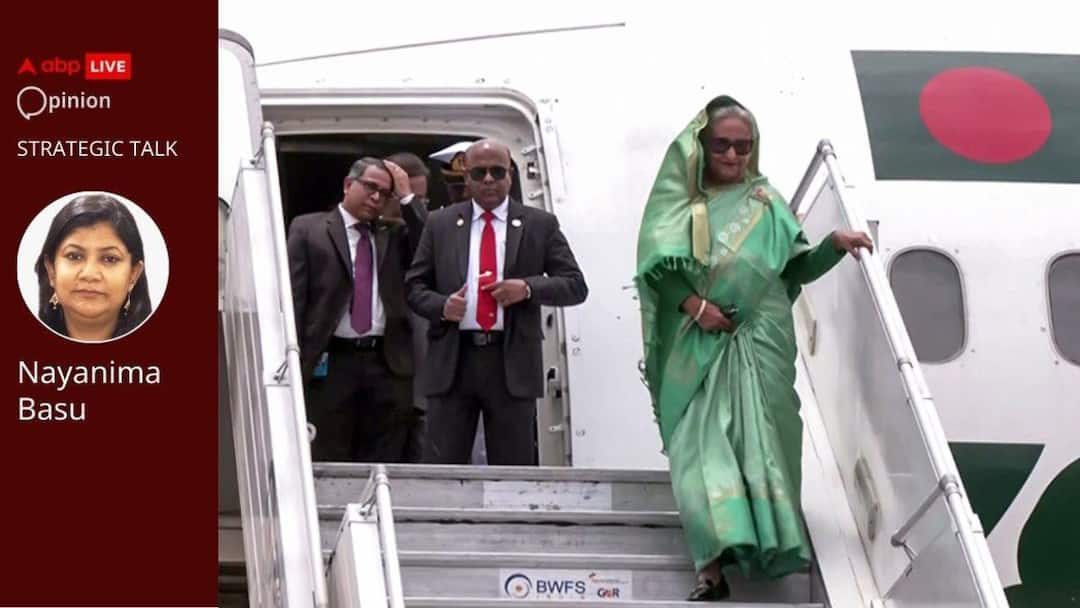
- Hasina’s fall ruptured India-Bangladesh ties, creating impasse.
- Keeping Hasina in Delhi obstructs new bilateral start.
- Delhi needs inclusive diplomacy, engaging all Bangladesh parties.
- Engaging Jamaat-e-Islami is crucial for future stability.
For fifteen years, India’s Bangladesh policy had one name: Sheikh Hasina. It was simple, it was stable, and for a long time, it worked. Delhi got a friendly government in Dhaka, secure borders, transit, and a crackdown on anti-India insurgents. Dhaka got Indian backing, development assistance, and a powerful friend in the region.
That era is now effectively over. And the longer both countries pretend it is not, the more damage they do to each other. Hasina’s fall in August 2024 was not just a change of government. It was a rupture.
A student-led uprising, fueled by anger over quotas, corruption, rigged elections, and the brutal suppression of dissent, ended the longest-serving premiership in Bangladesh’s history. She fled to India. Since then, she has lived in Delhi while Dhaka has demanded her return under India-Bangladesh extradition treaty to face trial for alleged crimes against humanity during the crackdown that killed hundreds.
India has refused even as the relationship has frozen in a cycle of mutual suspicion that serves neither side.
However, it is time to be blunt. Hasina needs to return. Not because Delhi should abandon an “old friend” but because keeping her in indefinite limbo has become the single biggest obstacle to a fresh start. Returning Hasina does not mean India should hand her over without due process, legal safeguards, or guarantees of a fair trial. India is bound by its extradition treaty, by its own courts, and by its principles.
But it does mean Delhi cannot keep treating the Hasina file as a permanent exception.
A new government in Dhaka, whether it is the interim administration, the Bangladesh Nationalist Party (BNP), or a coalition in which Jamaat-e-Islami is a powerful force, will not be able to normalise ties with India while its former Prime Minister sits in Delhi issuing statements, holding press conferences, and being seen as a quasi-government-in-exile.
For Bangladesh, Hasina’s return is about closure. The country cannot heal, hold credible elections, and rebuild its institutions if the central figure of the last decade and a half remains outside the reach of its justice system. The victims’ families want accountability.
The political class wants a clear break. Even those who once supported the Awami League know that the party cannot reinvent itself while its leader remains in exile, directing politics from abroad.
For India, facilitating a lawful, dignified resolution to the Hasina question is not a betrayal. It should be viewed as a strategy. Every month she remains in Delhi, she becomes a symbol in Bangladeshi politics of “Indian interference”. Every statement she makes is amplified by her opponents as proof that Delhi wants to restore the old order.
India’s influence in Dhaka today is at its lowest in decades precisely because it is seen as the protector of Hasina, not as a friend of Bangladesh. India and Bangladesh need to start afresh, and that fresh start cannot be built on nostalgia or history. It must be built on a new reality that Bangladesh is a sovereign, politically plural, and deeply nationalistic country of 170 million people.
It will not accept a relationship that is framed as Delhi choosing its rulers.
Also Read: OPINION | Quad Is Securitised, But It’s Not ‘Asian NATO’
There has to be a three-pronged strategy that needs to be chalked out.
Firstly, India must engage with Bangladesh as a country, not as a party. That means talking to the BNP, civil society, the military, business leaders, and most definitively the Jamaat-e-Islami. This is not a concession. It is how mature diplomacy works.
Second, both sides must reframe the agenda. The old agenda was security-first – transit, connectivity, and keeping China and Pakistan out. The new agenda must be people-first where issues such as water sharing, trade, jobs, energy, climate, health, and education should come to the fore. Bangladesh’s youth, who led the uprising, do not want lectures on geopolitics.
They want visas, jobs, fair trade, and respect.
Third, both sides must stop weaponising history. India must stop viewing every criticism from Dhaka as anti-Indian. Bangladesh must stop viewing every Indian concern as hegemonic.
The Teesta water dispute, border killings, trade imbalances – all these are real issues, but they are solvable if they are discussed as technical problems, not as tests of loyalty. This is where the Jamaat question becomes critical. For decades, Delhi has viewed Jamaat-e-Islami Bangladesh through a single lens – as a pro-Pakistan, Islamist force hostile to India.
That view is outdated and, in today’s Bangladesh it is self-defeating.
Jamaat is today one of the strongest, most organised opposition forces in Bangladesh. It has a disciplined cadre, a strong student wing, a significant vote bank, and a growing presence in local politics. In a post-Hasina Bangladesh, where the Awami League is discredited and the BNP is fragmented, Jamaat cannot be ignored.
Any future government will either include Jamaat or have to govern with Jamaat as a powerful opposition. To refuse to talk to Jamaat is to refuse to talk to a substantial section of Bangladesh. And India has engaged Jamaat before. This is not new.
In the 2000s, Indian diplomats and intelligence officials maintained back-channel contacts with Jamaat leaders when the BNP-Jamaat coalition was in power. In 2012-13, even as Delhi publicly backed Hasina, it quietly explored lines of communication with Jamaat to understand its thinking on India, on the border, and on regional security.
Indian envoys in Dhaka have met Jamaat leaders in the past. The idea that engagement is a taboo is a myth created by the Hasina era, when any contact with the opposition was treated as disloyalty.
Engaging Jamaat does not mean endorsing its ideology. India engages with the Taliban in Afghanistan, with the military junta in Myanmar, with Islamist parties in the Maldives and Malaysia. Diplomacy is not about liking your counterpart. It is about protecting your interests.
Additionally, India’s interests with Jamaat are manifold. First, to make clear that India will not tolerate anti-India militancy, cross-border smuggling, or the use of Bangladeshi soil by groups hostile to India. Second, to hear Jamaat’s concerns directly — on water, on trade, on border killings, on the treatment of Muslims in India — rather than through rumour and propaganda.
Third, to test whether Jamaat, which now presents itself as a democratic, welfare-oriented party, is willing to act responsibly if it comes to power.
If Jamaat is engaged, it will also have to answer tough questions – Will it respect the 1971 liberation war? Will it protect minorities? Will it keep Bangladesh’s foreign policy balanced? Engagement gives India leverage to ask those questions. The opposite will be detrimental to New Delhi’s own security interests.
The future of India-Bangladesh ties depends on this shift from a personality-based policy to a people-based policy. The Hasina era was built on one leader. The next era must be built on institutions, on multiple political forces, and on the aspirations of a young, restless population that wants change.
If India clings to Hasina, refuses to engage Jamaat, and treats the new Bangladesh as an aberration, it will push Dhaka closer to China, Pakistan, and other powers who are already waiting with open arms.
If India instead settles the Hasina question, embraces a fresh start, and engages all of Bangladesh’s political spectrum, including Jamaat, it can rebuild trust and reclaim its position as Dhaka’s most important partner. Hasina’s story in Bangladesh is not over. But it cannot be the future of the Delhi-Dhaka bilateral relationship.
For India and Bangladesh to move forward, Hasina needs to return, the old playbook needs to be discarded, and a new, inclusive diplomacy needs to begin.
Also Read: OPINION | Dhaka’s Dangerous Stalemate
[Disclaimer: The opinions, beliefs, and views expressed by the various authors and forum participants on this website are personal and do not reflect the opinions, beliefs, and views of ABP News Network Pvt Ltd.]
Disclaimer : This story is auto aggregated by a computer programme and has not been created or edited by DOWNTHENEWS. Publisher: abplive.com